

TiO 2 nanoparticles were described. The addition of the nanofiller into a polymer
matrix usually leads to an increase in modulus and positive enhancement of
abrasion and tear resistance of rubber nanocomposites.
The most available method to produce TiO 2 nanoparticles is the sol–gel method
(described in Sect. 2.4), and an in situ process can be performed in inorganicelastomeric matrix, like PDMS, to obtain nanocomposites reinforced using titanium
dioxide. The dispersion of the nanofiller strongly influences the storage modulus
behavior in the dynamic mode, and therefore the Payne effect, which is based on
agglomeration/disagglomeration of the filler, cannot be observed, because in a well
dispersed nanofiller system, no aggregates or agglomerates are formed [17].
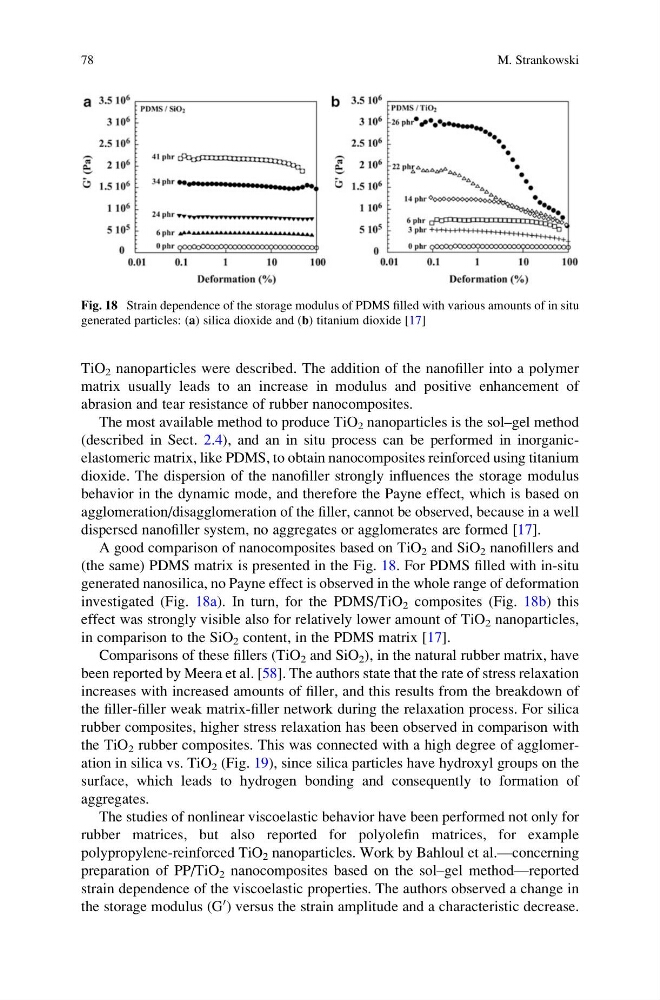
A good comparison of nanocomposites based on TiO 2 and SiO 2 nanofillers and
(the same) PDMS matrix is presented in the Fig. 18. For PDMS filled with in-situ
generated nanosilica, no Payne effect is observed in the whole range of deformation
investigated (Fig. 18a). In turn, for the PDMS/TiO 2 composites (Fig. 18b) this
effect was strongly visible also for relatively lower amount of TiO 2 nanoparticles,
in comparison to the SiO 2 content, in the PDMS matrix [17].
Comparisons of these fillers (TiO 2 and SiO 2 ), in the natural rubber matrix, have
been reported by Meera et al. [58]. The authors state that the rate of stress relaxation
increases with increased amounts of filler, and this results from the breakdown of
the filler-filler weak matrix-filler network during the relaxation process. For silica
rubber composites, higher stress relaxation has been observed in comparison with
the TiO 2 rubber composites. This was connected with a high degree of agglomeration in silica vs. TiO 2 (Fig. 19), since silica particles have hydroxyl groups on the
surface, which leads to hydrogen bonding and consequently to formation of
aggregates.
The studies of nonlinear viscoelastic behavior have been performed not only for
rubber matrices, but also reported for polyolefin matrices, for example
polypropylene-reinforced TiO 2 nanoparticles. Work by Bahloul et al.—concerning
preparation of PP/TiO 2 nanocomposites based on the sol–gel method—reported
strain dependence of the viscoelastic properties. The authors observed a change in
the storage modulus (G
0 ) versus the strain amplitude and a characteristic decrease.
Fig. 18 Strain dependence of the storage modulus of PDMS filled with various amounts of in situ
generated particles: (a) silica dioxide and (b) titanium dioxide [17]
78
M. Strankowski
matrix usually leads to an increase in modulus and positive enhancement of
abrasion and tear resistance of rubber nanocomposites.
The most available method to produce TiO 2 nanoparticles is the sol–gel method
(described in Sect. 2.4), and an in situ process can be performed in inorganicelastomeric matrix, like PDMS, to obtain nanocomposites reinforced using titanium
dioxide. The dispersion of the nanofiller strongly influences the storage modulus
behavior in the dynamic mode, and therefore the Payne effect, which is based on
agglomeration/disagglomeration of the filler, cannot be observed, because in a well
dispersed nanofiller system, no aggregates or agglomerates are formed [17].
A good comparison of nanocomposites based on TiO 2 and SiO 2 nanofillers and
(the same) PDMS matrix is presented in the Fig. 18. For PDMS filled with in-situ
generated nanosilica, no Payne effect is observed in the whole range of deformation
investigated (Fig. 18a). In turn, for the PDMS/TiO 2 composites (Fig. 18b) this
effect was strongly visible also for relatively lower amount of TiO 2 nanoparticles,
in comparison to the SiO 2 content, in the PDMS matrix [17].
Comparisons of these fillers (TiO 2 and SiO 2 ), in the natural rubber matrix, have
been reported by Meera et al. [58]. The authors state that the rate of stress relaxation
increases with increased amounts of filler, and this results from the breakdown of
the filler-filler weak matrix-filler network during the relaxation process. For silica
rubber composites, higher stress relaxation has been observed in comparison with
the TiO 2 rubber composites. This was connected with a high degree of agglomeration in silica vs. TiO 2 (Fig. 19), since silica particles have hydroxyl groups on the
surface, which leads to hydrogen bonding and consequently to formation of
aggregates.
The studies of nonlinear viscoelastic behavior have been performed not only for
rubber matrices, but also reported for polyolefin matrices, for example
polypropylene-reinforced TiO 2 nanoparticles. Work by Bahloul et al.—concerning
preparation of PP/TiO 2 nanocomposites based on the sol–gel method—reported
strain dependence of the viscoelastic properties. The authors observed a change in
the storage modulus (G
0 ) versus the strain amplitude and a characteristic decrease.
Fig. 18 Strain dependence of the storage modulus of PDMS filled with various amounts of in situ
generated particles: (a) silica dioxide and (b) titanium dioxide [17]
78
M. Strankowski