

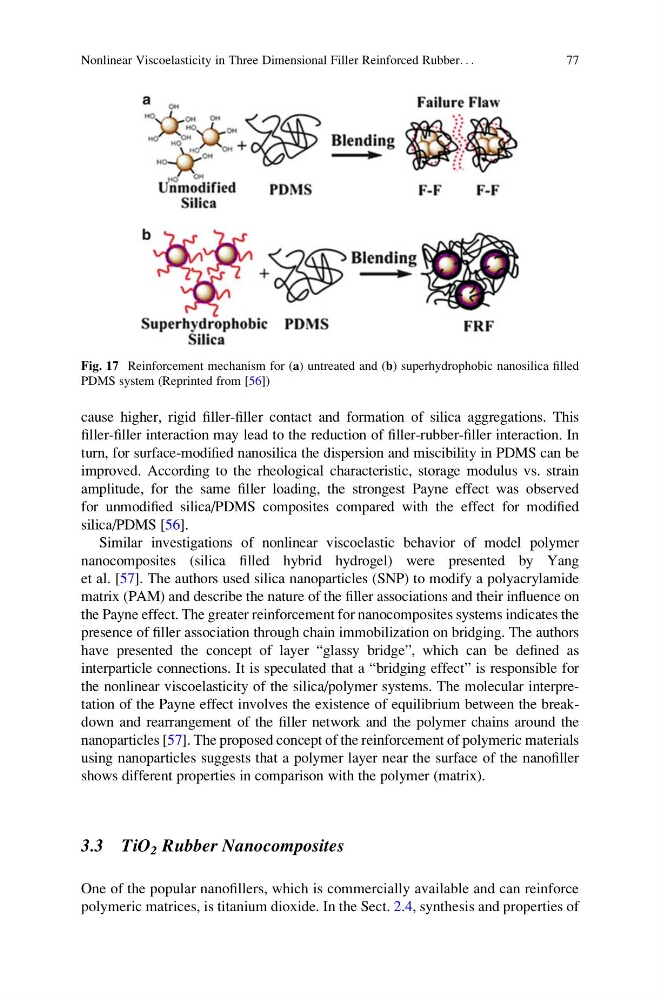
cause higher, rigid filler-filler contact and formation of silica aggregations. This
filler-filler interaction may lead to the reduction of filler-rubber-filler interaction. In
turn, for surface-modified nanosilica the dispersion and miscibility in PDMS can be
improved. According to the rheological characteristic, storage modulus vs. strain
amplitude, for the same filler loading, the strongest Payne effect was observed
for unmodified silica/PDMS composites compared with the effect for modified
silica/PDMS [56].
Similar investigations of nonlinear viscoelastic behavior of model polymer
nanocomposites (silica filled hybrid hydrogel) were presented by Yang
et al. [57]. The authors used silica nanoparticles (SNP) to modify a polyacrylamide
matrix (PAM) and describe the nature of the filler associations and their influence on
the Payne effect. The greater reinforcement for nanocomposites systems indicates the
presence of filler association through chain immobilization on bridging. The authors
have presented the concept of layer “glassy bridge”, which can be defined as
interparticle connections. It is speculated that a “bridging effect” is responsible for
the nonlinear viscoelasticity of the silica/polymer systems. The molecular interpretation of the Payne effect involves the existence of equilibrium between the breakdown and rearrangement of the filler network and the polymer chains around the
nanoparticles [57]. The proposed concept of the reinforcement of polymeric materials
using nanoparticles suggests that a polymer layer near the surface of the nanofiller
shows different properties in comparison with the polymer (matrix).
3.3 TiO 2 Rubber Nanocomposites
One of the popular nanofillers, which is commercially available and can reinforce
polymeric matrices, is titanium dioxide. In the Sect. 2.4, synthesis and properties of
Fig. 17 Reinforcement mechanism for (a) untreated and (b) superhydrophobic nanosilica filled
PDMS system (Reprinted from [56])
Nonlinear Viscoelasticity in Three Dimensional Filler Reinforced Rubber. . .
77
filler-filler interaction may lead to the reduction of filler-rubber-filler interaction. In
turn, for surface-modified nanosilica the dispersion and miscibility in PDMS can be
improved. According to the rheological characteristic, storage modulus vs. strain
amplitude, for the same filler loading, the strongest Payne effect was observed
for unmodified silica/PDMS composites compared with the effect for modified
silica/PDMS [56].
Similar investigations of nonlinear viscoelastic behavior of model polymer
nanocomposites (silica filled hybrid hydrogel) were presented by Yang
et al. [57]. The authors used silica nanoparticles (SNP) to modify a polyacrylamide
matrix (PAM) and describe the nature of the filler associations and their influence on
the Payne effect. The greater reinforcement for nanocomposites systems indicates the
presence of filler association through chain immobilization on bridging. The authors
have presented the concept of layer “glassy bridge”, which can be defined as
interparticle connections. It is speculated that a “bridging effect” is responsible for
the nonlinear viscoelasticity of the silica/polymer systems. The molecular interpretation of the Payne effect involves the existence of equilibrium between the breakdown and rearrangement of the filler network and the polymer chains around the
nanoparticles [57]. The proposed concept of the reinforcement of polymeric materials
using nanoparticles suggests that a polymer layer near the surface of the nanofiller
shows different properties in comparison with the polymer (matrix).
3.3 TiO 2 Rubber Nanocomposites
One of the popular nanofillers, which is commercially available and can reinforce
polymeric matrices, is titanium dioxide. In the Sect. 2.4, synthesis and properties of
Fig. 17 Reinforcement mechanism for (a) untreated and (b) superhydrophobic nanosilica filled
PDMS system (Reprinted from [56])
Nonlinear Viscoelasticity in Three Dimensional Filler Reinforced Rubber. . .
77