

chemical linkage of fillers to the polymer (due to bifunctional silanes) is reducing
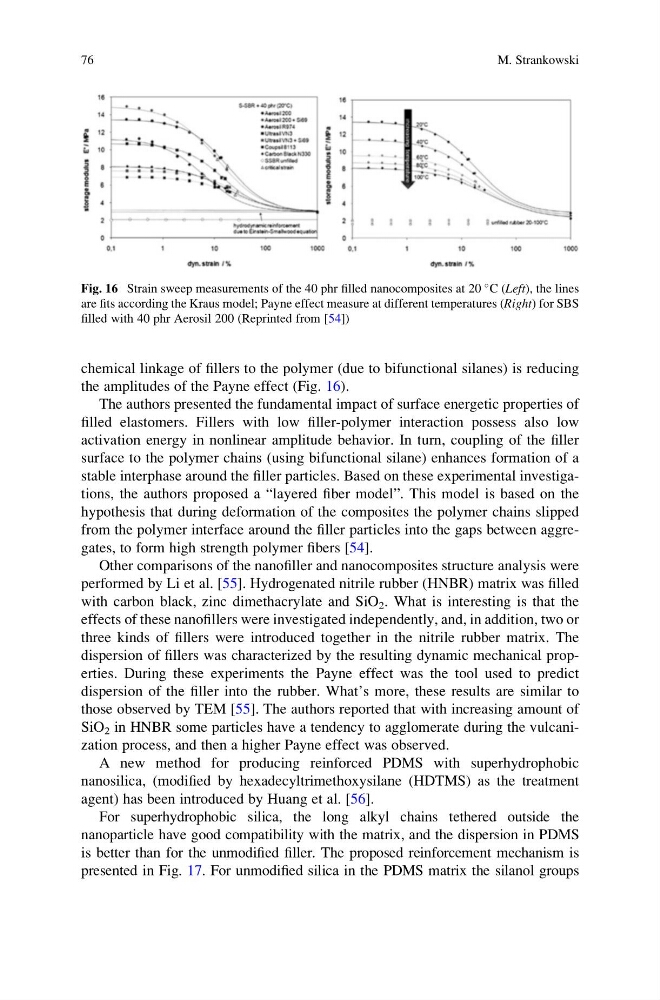
the amplitudes of the Payne effect (Fig. 16).
The authors presented the fundamental impact of surface energetic properties of
filled elastomers. Fillers with low filler-polymer interaction possess also low
activation energy in nonlinear amplitude behavior. In turn, coupling of the filler
surface to the polymer chains (using bifunctional silane) enhances formation of a
stable interphase around the filler particles. Based on these experimental investigations, the authors proposed a “layered fiber model”. This model is based on the
hypothesis that during deformation of the composites the polymer chains slipped
from the polymer interface around the filler particles into the gaps between aggregates, to form high strength polymer fibers [54].
Other comparisons of the nanofiller and nanocomposites structure analysis were
performed by Li et al. [55]. Hydrogenated nitrile rubber (HNBR) matrix was filled
with carbon black, zinc dimethacrylate and SiO 2 . What is interesting is that the
effects of these nanofillers were investigated independently, and, in addition, two or
three kinds of fillers were introduced together in the nitrile rubber matrix. The
dispersion of fillers was characterized by the resulting dynamic mechanical properties. During these experiments the Payne effect was the tool used to predict
dispersion of the filler into the rubber. What’s more, these results are similar to
those observed by TEM [55]. The authors reported that with increasing amount of
SiO 2 in HNBR some particles have a tendency to agglomerate during the vulcanization process, and then a higher Payne effect was observed.
A new method for producing reinforced PDMS with superhydrophobic
nanosilica, (modified by hexadecyltrimethoxysilane (HDTMS) as the treatment
agent) has been introduced by Huang et al. [56].
For superhydrophobic silica, the long alkyl chains tethered outside the
nanoparticle have good compatibility with the matrix, and the dispersion in PDMS
is better than for the unmodified filler. The proposed reinforcement mechanism is
presented in Fig. 17. For unmodified silica in the PDMS matrix the silanol groups
Fig. 16 Strain sweep measurements of the 40 phr filled nanocomposites at 20
C (Left), the lines
are fits according the Kraus model; Payne effect measure at different temperatures (Right) for SBS
filled with 40 phr Aerosil 200 (Reprinted from [54])
76
M. Strankowski
the amplitudes of the Payne effect (Fig. 16).
The authors presented the fundamental impact of surface energetic properties of
filled elastomers. Fillers with low filler-polymer interaction possess also low
activation energy in nonlinear amplitude behavior. In turn, coupling of the filler
surface to the polymer chains (using bifunctional silane) enhances formation of a
stable interphase around the filler particles. Based on these experimental investigations, the authors proposed a “layered fiber model”. This model is based on the
hypothesis that during deformation of the composites the polymer chains slipped
from the polymer interface around the filler particles into the gaps between aggregates, to form high strength polymer fibers [54].
Other comparisons of the nanofiller and nanocomposites structure analysis were
performed by Li et al. [55]. Hydrogenated nitrile rubber (HNBR) matrix was filled
with carbon black, zinc dimethacrylate and SiO 2 . What is interesting is that the
effects of these nanofillers were investigated independently, and, in addition, two or
three kinds of fillers were introduced together in the nitrile rubber matrix. The
dispersion of fillers was characterized by the resulting dynamic mechanical properties. During these experiments the Payne effect was the tool used to predict
dispersion of the filler into the rubber. What’s more, these results are similar to
those observed by TEM [55]. The authors reported that with increasing amount of
SiO 2 in HNBR some particles have a tendency to agglomerate during the vulcanization process, and then a higher Payne effect was observed.
A new method for producing reinforced PDMS with superhydrophobic
nanosilica, (modified by hexadecyltrimethoxysilane (HDTMS) as the treatment
agent) has been introduced by Huang et al. [56].
For superhydrophobic silica, the long alkyl chains tethered outside the
nanoparticle have good compatibility with the matrix, and the dispersion in PDMS
is better than for the unmodified filler. The proposed reinforcement mechanism is
presented in Fig. 17. For unmodified silica in the PDMS matrix the silanol groups
Fig. 16 Strain sweep measurements of the 40 phr filled nanocomposites at 20
C (Left), the lines
are fits according the Kraus model; Payne effect measure at different temperatures (Right) for SBS
filled with 40 phr Aerosil 200 (Reprinted from [54])
76
M. Strankowski