

3.2 Silicon Dioxide Rubber Nanocomposites
The nonlinear viscoelastic behavior of the nanocomposites based on natural rubber
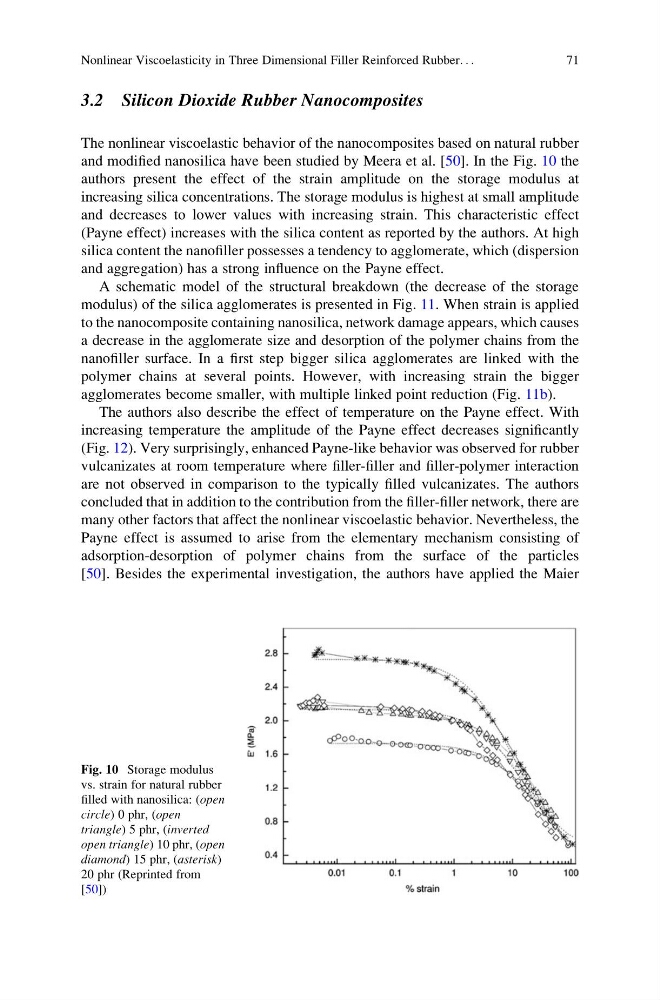
and modified nanosilica have been studied by Meera et al. [50]. In the Fig. 10 the
authors present the effect of the strain amplitude on the storage modulus at
increasing silica concentrations. The storage modulus is highest at small amplitude
and decreases to lower values with increasing strain. This characteristic effect
(Payne effect) increases with the silica content as reported by the authors. At high
silica content the nanofiller possesses a tendency to agglomerate, which (dispersion
and aggregation) has a strong influence on the Payne effect.
A schematic model of the structural breakdown (the decrease of the storage
modulus) of the silica agglomerates is presented in Fig. 11. When strain is applied
to the nanocomposite containing nanosilica, network damage appears, which causes
a decrease in the agglomerate size and desorption of the polymer chains from the
nanofiller surface. In a first step bigger silica agglomerates are linked with the
polymer chains at several points. However, with increasing strain the bigger
agglomerates become smaller, with multiple linked point reduction (Fig. 11b).
The authors also describe the effect of temperature on the Payne effect. With
increasing temperature the amplitude of the Payne effect decreases significantly
(Fig. 12). Very surprisingly, enhanced Payne-like behavior was observed for rubber
vulcanizates at room temperature where filler-filler and filler-polymer interaction
are not observed in comparison to the typically filled vulcanizates. The authors
concluded that in addition to the contribution from the filler-filler network, there are
many other factors that affect the nonlinear viscoelastic behavior. Nevertheless, the
Payne effect is assumed to arise from the elementary mechanism consisting of
adsorption-desorption of polymer chains from the surface of the particles
[50]. Besides the experimental investigation, the authors have applied the Maier
Fig. 10 Storage modulus
vs. strain for natural rubber
filled with nanosilica: (open
circle) 0 phr, (open
triangle) 5 phr, (inverted
open triangle) 10 phr, (open
diamond) 15 phr, (asterisk)
20 phr (Reprinted from
[50])
Nonlinear Viscoelasticity in Three Dimensional Filler Reinforced Rubber. . .
71
The nonlinear viscoelastic behavior of the nanocomposites based on natural rubber
and modified nanosilica have been studied by Meera et al. [50]. In the Fig. 10 the
authors present the effect of the strain amplitude on the storage modulus at
increasing silica concentrations. The storage modulus is highest at small amplitude
and decreases to lower values with increasing strain. This characteristic effect
(Payne effect) increases with the silica content as reported by the authors. At high
silica content the nanofiller possesses a tendency to agglomerate, which (dispersion
and aggregation) has a strong influence on the Payne effect.
A schematic model of the structural breakdown (the decrease of the storage
modulus) of the silica agglomerates is presented in Fig. 11. When strain is applied
to the nanocomposite containing nanosilica, network damage appears, which causes
a decrease in the agglomerate size and desorption of the polymer chains from the
nanofiller surface. In a first step bigger silica agglomerates are linked with the
polymer chains at several points. However, with increasing strain the bigger
agglomerates become smaller, with multiple linked point reduction (Fig. 11b).
The authors also describe the effect of temperature on the Payne effect. With
increasing temperature the amplitude of the Payne effect decreases significantly
(Fig. 12). Very surprisingly, enhanced Payne-like behavior was observed for rubber
vulcanizates at room temperature where filler-filler and filler-polymer interaction
are not observed in comparison to the typically filled vulcanizates. The authors
concluded that in addition to the contribution from the filler-filler network, there are
many other factors that affect the nonlinear viscoelastic behavior. Nevertheless, the
Payne effect is assumed to arise from the elementary mechanism consisting of
adsorption-desorption of polymer chains from the surface of the particles
[50]. Besides the experimental investigation, the authors have applied the Maier
Fig. 10 Storage modulus
vs. strain for natural rubber
filled with nanosilica: (open
circle) 0 phr, (open
triangle) 5 phr, (inverted
open triangle) 10 phr, (open
diamond) 15 phr, (asterisk)
20 phr (Reprinted from
[50])
Nonlinear Viscoelasticity in Three Dimensional Filler Reinforced Rubber. . .
71