

Reinforcement in a polyurea matrix by three different nanofillers (multiwall
carbon nanotubes (MWCNT), nanolayered silicate (nanoclay) and trisilanolphenylfunctionalized POSS was investigated by Casalini et al. [49]. The effects of the
nanofiller are summarized in the Table 1 (Reprinted from [49]).
Many of the characteristic parameters, in obtained nanocomposites, were
increased in their values by the addition of nanofiller. The viscosity and the storage
modulus of PU/MWCNT and PU/Nanoclay systems increased in comparison to the
unmodified polymer. In turn, for PU/POSS nanocomposites a strong influence of
this type of nanofiller was observed, on glass transition temperature and PU
toughness. Only for PU nanocomposites containing MWCNT and nanoclay,
nonlinear viscoelastic behavior was observed. Generally, small filler particles
maximize the interfacial area and provide great reinforcement. However, for the
POSS nanofiller, the authors didn’t observe such improvement, because this
nanoparticles, in a polyurea matrix, doesn’t behave like a conventional nanofiller,
but rather like a chemically reactive additive [49].
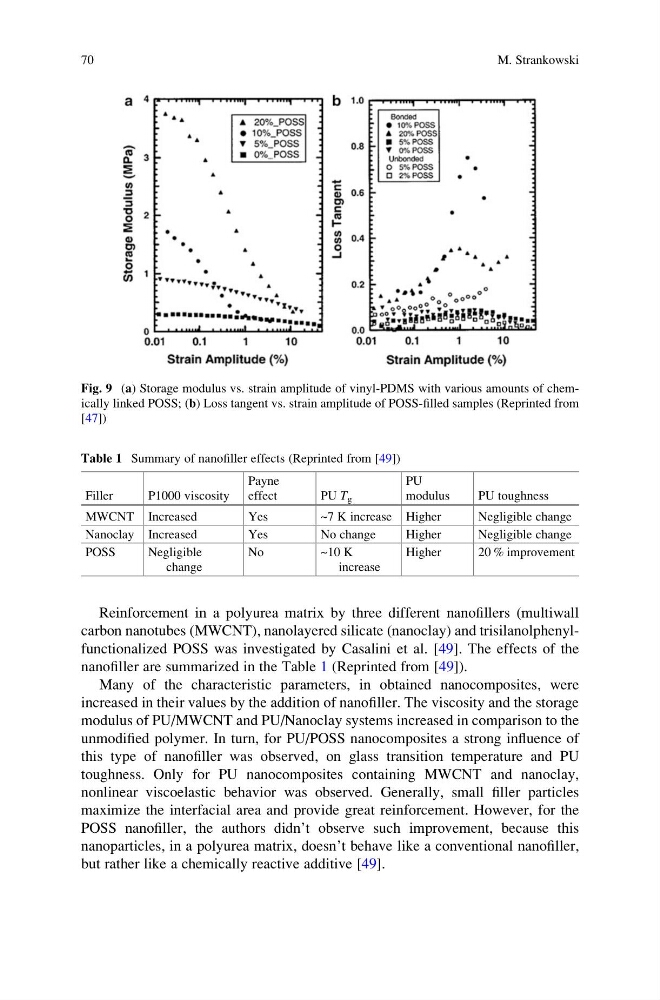
Fig. 9 (a) Storage modulus vs. strain amplitude of vinyl-PDMS with various amounts of chemically linked POSS; (b) Loss tangent vs. strain amplitude of POSS-filled samples (Reprinted from
[47])
Table 1 Summary of nanofiller effects (Reprinted from [49])
Filler
P1000 viscosity
Payne
effect
PU T g
PU
modulus
PU toughness
MWCNT Increased
Yes
~7 K increase Higher
Negligible change
Nanoclay Increased
Yes
No change
Higher
Negligible change
POSS
Negligible
change
No
~10 K
increase
Higher
20 % improvement
70
M. Strankowski
carbon nanotubes (MWCNT), nanolayered silicate (nanoclay) and trisilanolphenylfunctionalized POSS was investigated by Casalini et al. [49]. The effects of the
nanofiller are summarized in the Table 1 (Reprinted from [49]).
Many of the characteristic parameters, in obtained nanocomposites, were
increased in their values by the addition of nanofiller. The viscosity and the storage
modulus of PU/MWCNT and PU/Nanoclay systems increased in comparison to the
unmodified polymer. In turn, for PU/POSS nanocomposites a strong influence of
this type of nanofiller was observed, on glass transition temperature and PU
toughness. Only for PU nanocomposites containing MWCNT and nanoclay,
nonlinear viscoelastic behavior was observed. Generally, small filler particles
maximize the interfacial area and provide great reinforcement. However, for the
POSS nanofiller, the authors didn’t observe such improvement, because this
nanoparticles, in a polyurea matrix, doesn’t behave like a conventional nanofiller,
but rather like a chemically reactive additive [49].
Fig. 9 (a) Storage modulus vs. strain amplitude of vinyl-PDMS with various amounts of chemically linked POSS; (b) Loss tangent vs. strain amplitude of POSS-filled samples (Reprinted from
[47])
Table 1 Summary of nanofiller effects (Reprinted from [49])
Filler
P1000 viscosity
Payne
effect
PU T g
PU
modulus
PU toughness
MWCNT Increased
Yes
~7 K increase Higher
Negligible change
Nanoclay Increased
Yes
No change
Higher
Negligible change
POSS
Negligible
change
No
~10 K
increase
Higher
20 % improvement
70
M. Strankowski