

nanocomposite. The authors conclude that peaks occur according to the fillernetworking concept presented by Kraus [48]. The maximum loss tangent is correlated with the strain amplitude of the network.
These studies have shown that POSS can reinforce PDMS especially when it is
partially bonded to the polymer network. What’s more, when POSS fillers blended
with a PDMS silanol-terminated matrix (without bonding), the mechanical properties remained on the same level. Chemical bonds between the filler and the matrix
are not directly correlated with the reinforcement of the system, but improve the
dispersion of the filler in the polymer network. Bonded composites possess a
dynamic mechanical response very similar to rubbers filled with colloidal silica.
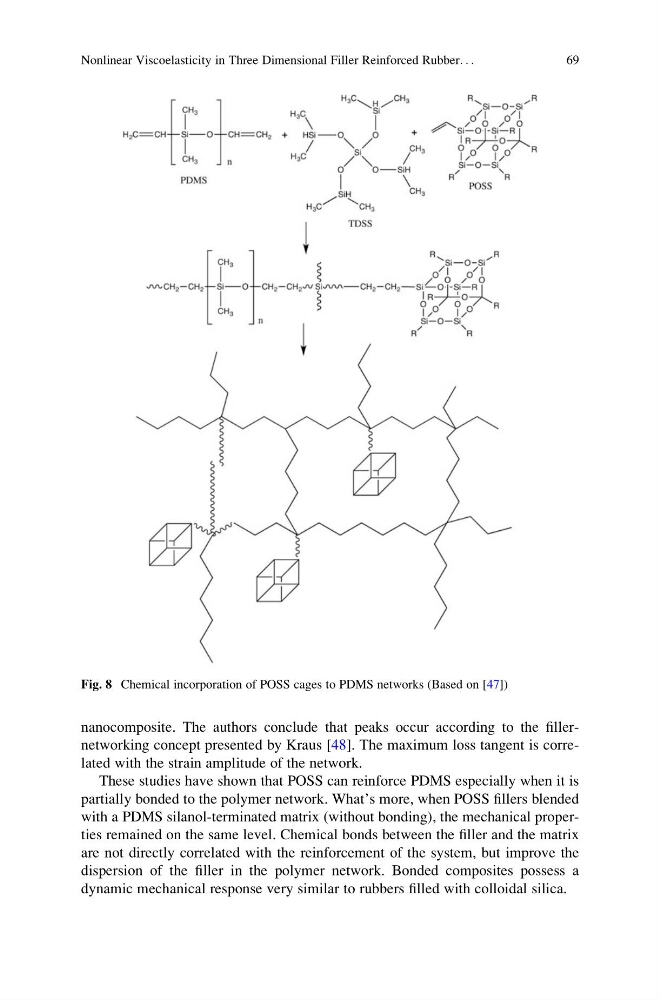
Fig. 8 Chemical incorporation of POSS cages to PDMS networks (Based on [47])
Nonlinear Viscoelasticity in Three Dimensional Filler Reinforced Rubber. . .
69
These studies have shown that POSS can reinforce PDMS especially when it is
partially bonded to the polymer network. What’s more, when POSS fillers blended
with a PDMS silanol-terminated matrix (without bonding), the mechanical properties remained on the same level. Chemical bonds between the filler and the matrix
are not directly correlated with the reinforcement of the system, but improve the
dispersion of the filler in the polymer network. Bonded composites possess a
dynamic mechanical response very similar to rubbers filled with colloidal silica.
Fig. 8 Chemical incorporation of POSS cages to PDMS networks (Based on [47])
Nonlinear Viscoelasticity in Three Dimensional Filler Reinforced Rubber. . .
69