

Temperature decreases the storage modulus and Payne effect as more and more
filler aggregates and clusters present within the nanocomposite break at enhanced
temperatures. The decrease in the initial storage modulus of neat PU with increase
in temperature is attributed to the loss of entanglements or improvement of soft
regions in the matrix at higher temperature. PU/GO nanocomposites also show a
similar kind of evolution but they have some additional crosslinks than PU.
5.2 Clay/Rubber Nanocomposites
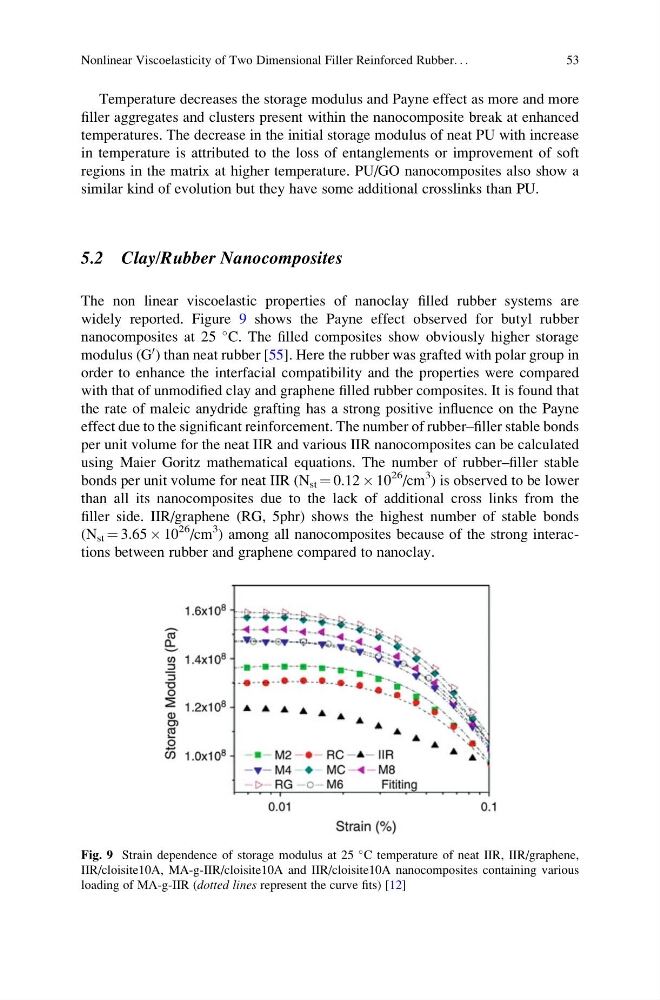
The non linear viscoelastic properties of nanoclay filled rubber systems are
widely reported. Figure 9 shows the Payne effect observed for butyl rubber
nanocomposites at 25
C. The filled composites show obviously higher storage
modulus (G
0 ) than neat rubber [55]. Here the rubber was grafted with polar group in
order to enhance the interfacial compatibility and the properties were compared
with that of unmodified clay and graphene filled rubber composites. It is found that
the rate of maleic anydride grafting has a strong positive influence on the Payne
effect due to the significant reinforcement. The number of rubber–filler stable bonds
per unit volume for the neat IIR and various IIR nanocomposites can be calculated
using Maier Goritz mathematical equations. The number of rubber–filler stable
bonds per unit volume for neat IIR (N st ¼ 0.12 Â 10
26
/cm
3 ) is observed to be lower
than all its nanocomposites due to the lack of additional cross links from the
filler side. IIR/graphene (RG, 5phr) shows the highest number of stable bonds
(N st ¼ 3.65 Â 10
26 /cm
3 ) among all nanocomposites because of the strong interactions between rubber and graphene compared to nanoclay.
Fig. 9 Strain dependence of storage modulus at 25
C temperature of neat IIR, IIR/graphene,
IIR/cloisite10A, MA-g-IIR/cloisite10A and IIR/cloisite10A nanocomposites containing various
loading of MA-g-IIR (dotted lines represent the curve fits) [12]
Nonlinear Viscoelasticity of Two Dimensional Filler Reinforced Rubber. . .
53
filler aggregates and clusters present within the nanocomposite break at enhanced
temperatures. The decrease in the initial storage modulus of neat PU with increase
in temperature is attributed to the loss of entanglements or improvement of soft
regions in the matrix at higher temperature. PU/GO nanocomposites also show a
similar kind of evolution but they have some additional crosslinks than PU.
5.2 Clay/Rubber Nanocomposites
The non linear viscoelastic properties of nanoclay filled rubber systems are
widely reported. Figure 9 shows the Payne effect observed for butyl rubber
nanocomposites at 25
C. The filled composites show obviously higher storage
modulus (G
0 ) than neat rubber [55]. Here the rubber was grafted with polar group in
order to enhance the interfacial compatibility and the properties were compared
with that of unmodified clay and graphene filled rubber composites. It is found that
the rate of maleic anydride grafting has a strong positive influence on the Payne
effect due to the significant reinforcement. The number of rubber–filler stable bonds
per unit volume for the neat IIR and various IIR nanocomposites can be calculated
using Maier Goritz mathematical equations. The number of rubber–filler stable
bonds per unit volume for neat IIR (N st ¼ 0.12 Â 10
26
/cm
3 ) is observed to be lower
than all its nanocomposites due to the lack of additional cross links from the
filler side. IIR/graphene (RG, 5phr) shows the highest number of stable bonds
(N st ¼ 3.65 Â 10
26 /cm
3 ) among all nanocomposites because of the strong interactions between rubber and graphene compared to nanoclay.
Fig. 9 Strain dependence of storage modulus at 25
C temperature of neat IIR, IIR/graphene,
IIR/cloisite10A, MA-g-IIR/cloisite10A and IIR/cloisite10A nanocomposites containing various
loading of MA-g-IIR (dotted lines represent the curve fits) [12]
Nonlinear Viscoelasticity of Two Dimensional Filler Reinforced Rubber. . .
53