

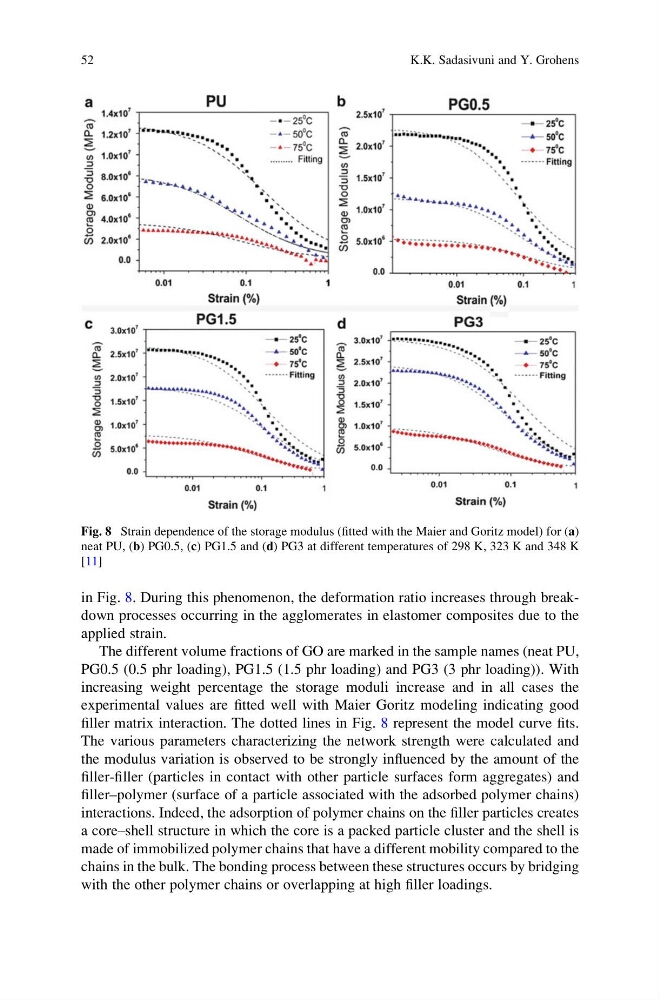
in Fig. 8. During this phenomenon, the deformation ratio increases through breakdown processes occurring in the agglomerates in elastomer composites due to the
applied strain.
The different volume fractions of GO are marked in the sample names (neat PU,
PG0.5 (0.5 phr loading), PG1.5 (1.5 phr loading) and PG3 (3 phr loading)). With
increasing weight percentage the storage moduli increase and in all cases the
experimental values are fitted well with Maier Goritz modeling indicating good
filler matrix interaction. The dotted lines in Fig. 8 represent the model curve fits.
The various parameters characterizing the network strength were calculated and
the modulus variation is observed to be strongly influenced by the amount of the
filler-filler (particles in contact with other particle surfaces form aggregates) and
filler–polymer (surface of a particle associated with the adsorbed polymer chains)
interactions. Indeed, the adsorption of polymer chains on the filler particles creates
a core–shell structure in which the core is a packed particle cluster and the shell is
made of immobilized polymer chains that have a different mobility compared to the
chains in the bulk. The bonding process between these structures occurs by bridging
with the other polymer chains or overlapping at high filler loadings.
Fig. 8 Strain dependence of the storage modulus (fitted with the Maier and Goritz model) for (a)
neat PU, (b) PG0.5, (c) PG1.5 and (d) PG3 at different temperatures of 298 K, 323 K and 348 K
[11]
52
K.K. Sadasivuni and Y. Grohens
applied strain.
The different volume fractions of GO are marked in the sample names (neat PU,
PG0.5 (0.5 phr loading), PG1.5 (1.5 phr loading) and PG3 (3 phr loading)). With
increasing weight percentage the storage moduli increase and in all cases the
experimental values are fitted well with Maier Goritz modeling indicating good
filler matrix interaction. The dotted lines in Fig. 8 represent the model curve fits.
The various parameters characterizing the network strength were calculated and
the modulus variation is observed to be strongly influenced by the amount of the
filler-filler (particles in contact with other particle surfaces form aggregates) and
filler–polymer (surface of a particle associated with the adsorbed polymer chains)
interactions. Indeed, the adsorption of polymer chains on the filler particles creates
a core–shell structure in which the core is a packed particle cluster and the shell is
made of immobilized polymer chains that have a different mobility compared to the
chains in the bulk. The bonding process between these structures occurs by bridging
with the other polymer chains or overlapping at high filler loadings.
Fig. 8 Strain dependence of the storage modulus (fitted with the Maier and Goritz model) for (a)
neat PU, (b) PG0.5, (c) PG1.5 and (d) PG3 at different temperatures of 298 K, 323 K and 348 K
[11]
52
K.K. Sadasivuni and Y. Grohens