

disrupted in this case. Thus Payne effect is closely related to nature of fillers and
rate of dispersion.
5 Rubber Nanocomposites
5.1 Graphene/Rubber Nanocomposites
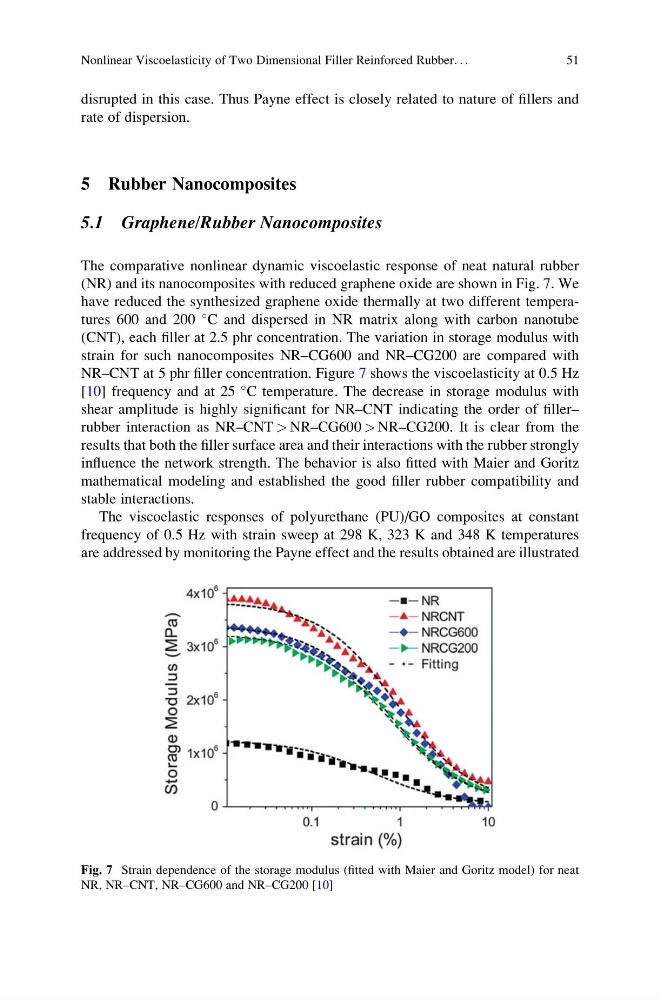
The comparative nonlinear dynamic viscoelastic response of neat natural rubber
(NR) and its nanocomposites with reduced graphene oxide are shown in Fig. 7. We
have reduced the synthesized graphene oxide thermally at two different temperatures 600 and 200
C and dispersed in NR matrix along with carbon nanotube
(CNT), each filler at 2.5 phr concentration. The variation in storage modulus with
strain for such nanocomposites NR–CG600 and NR–CG200 are compared with
NR–CNT at 5 phr filler concentration. Figure 7 shows the viscoelasticity at 0.5 Hz
[10] frequency and at 25
C temperature. The decrease in storage modulus with
shear amplitude is highly significant for NR–CNT indicating the order of filler–
rubber interaction as NR–CNT > NR–CG600 > NR–CG200. It is clear from the
results that both the filler surface area and their interactions with the rubber strongly
influence the network strength. The behavior is also fitted with Maier and Goritz
mathematical modeling and established the good filler rubber compatibility and
stable interactions.
The viscoelastic responses of polyurethane (PU)/GO composites at constant
frequency of 0.5 Hz with strain sweep at 298 K, 323 K and 348 K temperatures
are addressed by monitoring the Payne effect and the results obtained are illustrated
Fig. 7 Strain dependence of the storage modulus (fitted with Maier and Goritz model) for neat
NR, NR–CNT, NR–CG600 and NR–CG200 [10]
Nonlinear Viscoelasticity of Two Dimensional Filler Reinforced Rubber. . .
51
rate of dispersion.
5 Rubber Nanocomposites
5.1 Graphene/Rubber Nanocomposites
The comparative nonlinear dynamic viscoelastic response of neat natural rubber
(NR) and its nanocomposites with reduced graphene oxide are shown in Fig. 7. We
have reduced the synthesized graphene oxide thermally at two different temperatures 600 and 200
C and dispersed in NR matrix along with carbon nanotube
(CNT), each filler at 2.5 phr concentration. The variation in storage modulus with
strain for such nanocomposites NR–CG600 and NR–CG200 are compared with
NR–CNT at 5 phr filler concentration. Figure 7 shows the viscoelasticity at 0.5 Hz
[10] frequency and at 25
C temperature. The decrease in storage modulus with
shear amplitude is highly significant for NR–CNT indicating the order of filler–
rubber interaction as NR–CNT > NR–CG600 > NR–CG200. It is clear from the
results that both the filler surface area and their interactions with the rubber strongly
influence the network strength. The behavior is also fitted with Maier and Goritz
mathematical modeling and established the good filler rubber compatibility and
stable interactions.
The viscoelastic responses of polyurethane (PU)/GO composites at constant
frequency of 0.5 Hz with strain sweep at 298 K, 323 K and 348 K temperatures
are addressed by monitoring the Payne effect and the results obtained are illustrated
Fig. 7 Strain dependence of the storage modulus (fitted with Maier and Goritz model) for neat
NR, NR–CNT, NR–CG600 and NR–CG200 [10]
Nonlinear Viscoelasticity of Two Dimensional Filler Reinforced Rubber. . .
51