

trapped entanglements within the composite it can also be defined as the number of
elastically active rubber chains per volume unit of the material. The variation in the
storage modulus with strain (γ) is represented by Eq. (3).
G
0 γ
ð Þ ¼ G
0
st þ G
0
i
1
1 þ cγ
ð3Þ
with G
0
st ¼ (N g + N st ) k B T and G
0
i ¼ N i k B T. G
0
st is the value of G
0 arising from the
stable filler-rubber bonds and G
0
i that from the unstable bonds, C is the experimental parameter.
Payne effect studies in filled silicone elastomers were carried out by Aranguren
et al. [52, 53]. They found that direct filler-filler contacts are very few in the
composite especially at the lower filler concentrations since the filler surface is
completely wetted by the polymer. This was further confirmed using bound rubber
measurements as well. Thus the contacts between filler aggregates exist via the
polymer and the Payne effect result from agglomeration/deagglomeration of the
filler-rubber-filler network. Recently, Wang et al. [54] also described non linear
viscoelasticity of composites based on filler networks formed directly between filler
particles and also through the elastomer domains. In the second type of interaction,
the elastomer layers, glassy near the filler surface, have a modulus gradually
decreasing with the distance from the filler surface. In addition, filler-rubber
clusters entrap occluded rubber and this also behaves as filler mechanically. The
Payne effect would thus originate from the breakage and reformation of such filler
networks and clusters.
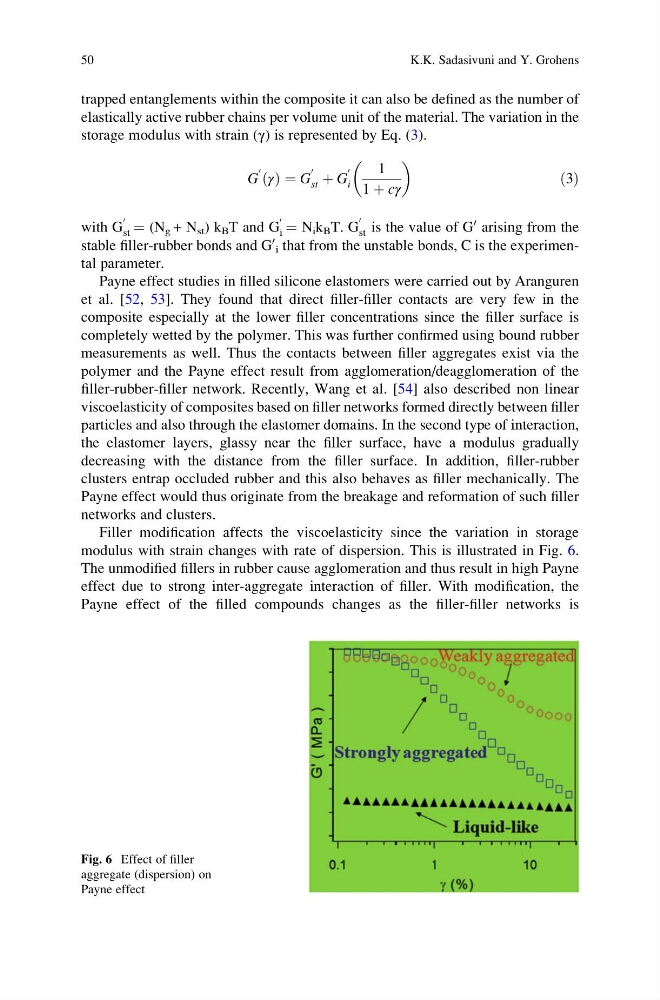
Filler modification affects the viscoelasticity since the variation in storage
modulus with strain changes with rate of dispersion. This is illustrated in Fig. 6.
The unmodified fillers in rubber cause agglomeration and thus result in high Payne
effect due to strong inter-aggregate interaction of filler. With modification, the
Payne effect of the filled compounds changes as the filler-filler networks is
Fig. 6 Effect of filler
aggregate (dispersion) on
Payne effect
50
K.K. Sadasivuni and Y. Grohens
elastically active rubber chains per volume unit of the material. The variation in the
storage modulus with strain (γ) is represented by Eq. (3).
G
0 γ
ð Þ ¼ G
0
st þ G
0
i
1
1 þ cγ
ð3Þ
with G
0
st ¼ (N g + N st ) k B T and G
0
i ¼ N i k B T. G
0
st is the value of G
0 arising from the
stable filler-rubber bonds and G
0
i that from the unstable bonds, C is the experimental parameter.
Payne effect studies in filled silicone elastomers were carried out by Aranguren
et al. [52, 53]. They found that direct filler-filler contacts are very few in the
composite especially at the lower filler concentrations since the filler surface is
completely wetted by the polymer. This was further confirmed using bound rubber
measurements as well. Thus the contacts between filler aggregates exist via the
polymer and the Payne effect result from agglomeration/deagglomeration of the
filler-rubber-filler network. Recently, Wang et al. [54] also described non linear
viscoelasticity of composites based on filler networks formed directly between filler
particles and also through the elastomer domains. In the second type of interaction,
the elastomer layers, glassy near the filler surface, have a modulus gradually
decreasing with the distance from the filler surface. In addition, filler-rubber
clusters entrap occluded rubber and this also behaves as filler mechanically. The
Payne effect would thus originate from the breakage and reformation of such filler
networks and clusters.
Filler modification affects the viscoelasticity since the variation in storage
modulus with strain changes with rate of dispersion. This is illustrated in Fig. 6.
The unmodified fillers in rubber cause agglomeration and thus result in high Payne
effect due to strong inter-aggregate interaction of filler. With modification, the
Payne effect of the filled compounds changes as the filler-filler networks is
Fig. 6 Effect of filler
aggregate (dispersion) on
Payne effect
50
K.K. Sadasivuni and Y. Grohens