

connectivity. When the strain amplitude increases, the percolation network breaks
into smaller and smaller entities. Maier and Go ¨ritz proposed yet another explanation to the Payne effect based on filler-rubber interactions contrary to the Kraus
model (based on filler network). According to this model, each filler-rubber bond
increases the network density, and this network density is supposed to vary with the
deformation of the material. It is proposed that the elastic modulus of the filled
elastomer has two contributions, the pure elastomer contribution and the filler
contribution arising from the filler/elastomer interface instead of the filler network.
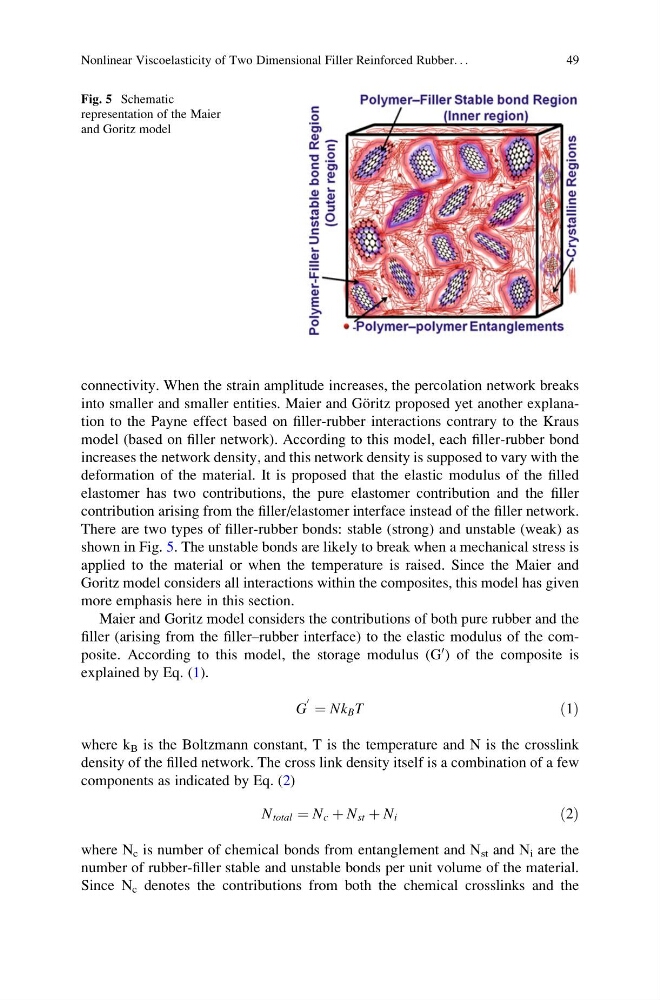
There are two types of filler-rubber bonds: stable (strong) and unstable (weak) as
shown in Fig. 5. The unstable bonds are likely to break when a mechanical stress is
applied to the material or when the temperature is raised. Since the Maier and
Goritz model considers all interactions within the composites, this model has given
more emphasis here in this section.
Maier and Goritz model considers the contributions of both pure rubber and the
filler (arising from the filler–rubber interface) to the elastic modulus of the composite. According to this model, the storage modulus (G
0 ) of the composite is
explained by Eq. (1).
G
0 ¼ Nk B T
ð1Þ
where k B is the Boltzmann constant, T is the temperature and N is the crosslink
density of the filled network. The cross link density itself is a combination of a few
components as indicated by Eq. (2)
N total ¼ N c þ N st þ N i
ð2Þ
where N c is number of chemical bonds from entanglement and N st and N i are the
number of rubber-filler stable and unstable bonds per unit volume of the material.
Since N c denotes the contributions from both the chemical crosslinks and the
Fig. 5 Schematic
representation of the Maier
and Goritz model
Nonlinear Viscoelasticity of Two Dimensional Filler Reinforced Rubber. . .
49
into smaller and smaller entities. Maier and Go ¨ritz proposed yet another explanation to the Payne effect based on filler-rubber interactions contrary to the Kraus
model (based on filler network). According to this model, each filler-rubber bond
increases the network density, and this network density is supposed to vary with the
deformation of the material. It is proposed that the elastic modulus of the filled
elastomer has two contributions, the pure elastomer contribution and the filler
contribution arising from the filler/elastomer interface instead of the filler network.
There are two types of filler-rubber bonds: stable (strong) and unstable (weak) as
shown in Fig. 5. The unstable bonds are likely to break when a mechanical stress is
applied to the material or when the temperature is raised. Since the Maier and
Goritz model considers all interactions within the composites, this model has given
more emphasis here in this section.
Maier and Goritz model considers the contributions of both pure rubber and the
filler (arising from the filler–rubber interface) to the elastic modulus of the composite. According to this model, the storage modulus (G
0 ) of the composite is
explained by Eq. (1).
G
0 ¼ Nk B T
ð1Þ
where k B is the Boltzmann constant, T is the temperature and N is the crosslink
density of the filled network. The cross link density itself is a combination of a few
components as indicated by Eq. (2)
N total ¼ N c þ N st þ N i
ð2Þ
where N c is number of chemical bonds from entanglement and N st and N i are the
number of rubber-filler stable and unstable bonds per unit volume of the material.
Since N c denotes the contributions from both the chemical crosslinks and the
Fig. 5 Schematic
representation of the Maier
and Goritz model
Nonlinear Viscoelasticity of Two Dimensional Filler Reinforced Rubber. . .
49