

corresponds to the increased interplanar distance and this explains the incorporation
of rubber chains inside the clay structure.
4 Theory of Non-linear Viscoelasticity
Rubber nanocomposites possess good nonlinearity in their viscoelastic properties
and knowledge on this characteristic is very important in order to regulate various
composite applications. The Payne effect is the most important dynamic mechanical measurement used to derive the interactions between the filler and polymer
molecules. This effect is observed as the decrease in storage modulus (G
0 ) with
strain amplitude due to the breakdown of filler aggregates in rubber composites
[44–46]. At higher strain rates, the rate of destruction of filler networks is higher
than their rate of reconstruction which causes the dissipation energy associated with
the network breaking to decrease [7, 47]. The maximum amount of energy dissipated comes from the consecutive breaking and reformation of all kinds of networks in the composites (filler–filler, filler–polymer, entanglement, glassy bridges,
etc.). This phenomenon is assumed to be arising from two factors, one related to the
hydrodynamic reinforcement and the other from the filler–filler and filler–elastomer
interactions. In the case of a neat matrix, molecular disentanglement does not occur
at low strain amplitudes and thus G
0 is constant. The mechanism behind the Payne
effect is explained as an adsorption–desorption process between the elastomer
chains and the filler particles [7, 45–47]. The different interpretations proposed to
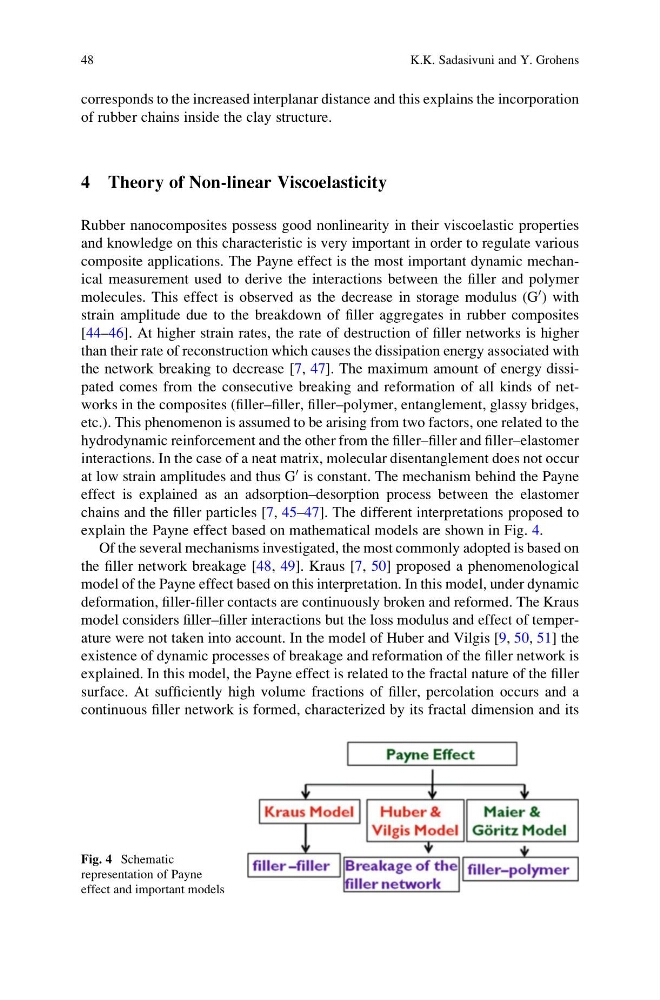
explain the Payne effect based on mathematical models are shown in Fig. 4.
Of the several mechanisms investigated, the most commonly adopted is based on
the filler network breakage [48, 49]. Kraus [7, 50] proposed a phenomenological
model of the Payne effect based on this interpretation. In this model, under dynamic
deformation, filler-filler contacts are continuously broken and reformed. The Kraus
model considers filler–filler interactions but the loss modulus and effect of temperature were not taken into account. In the model of Huber and Vilgis [9, 50, 51] the
existence of dynamic processes of breakage and reformation of the filler network is
explained. In this model, the Payne effect is related to the fractal nature of the filler
surface. At sufficiently high volume fractions of filler, percolation occurs and a
continuous filler network is formed, characterized by its fractal dimension and its
Fig. 4 Schematic
representation of Payne
effect and important models
48
K.K. Sadasivuni and Y. Grohens
of rubber chains inside the clay structure.
4 Theory of Non-linear Viscoelasticity
Rubber nanocomposites possess good nonlinearity in their viscoelastic properties
and knowledge on this characteristic is very important in order to regulate various
composite applications. The Payne effect is the most important dynamic mechanical measurement used to derive the interactions between the filler and polymer
molecules. This effect is observed as the decrease in storage modulus (G
0 ) with
strain amplitude due to the breakdown of filler aggregates in rubber composites
[44–46]. At higher strain rates, the rate of destruction of filler networks is higher
than their rate of reconstruction which causes the dissipation energy associated with
the network breaking to decrease [7, 47]. The maximum amount of energy dissipated comes from the consecutive breaking and reformation of all kinds of networks in the composites (filler–filler, filler–polymer, entanglement, glassy bridges,
etc.). This phenomenon is assumed to be arising from two factors, one related to the
hydrodynamic reinforcement and the other from the filler–filler and filler–elastomer
interactions. In the case of a neat matrix, molecular disentanglement does not occur
at low strain amplitudes and thus G
0 is constant. The mechanism behind the Payne
effect is explained as an adsorption–desorption process between the elastomer
chains and the filler particles [7, 45–47]. The different interpretations proposed to
explain the Payne effect based on mathematical models are shown in Fig. 4.
Of the several mechanisms investigated, the most commonly adopted is based on
the filler network breakage [48, 49]. Kraus [7, 50] proposed a phenomenological
model of the Payne effect based on this interpretation. In this model, under dynamic
deformation, filler-filler contacts are continuously broken and reformed. The Kraus
model considers filler–filler interactions but the loss modulus and effect of temperature were not taken into account. In the model of Huber and Vilgis [9, 50, 51] the
existence of dynamic processes of breakage and reformation of the filler network is
explained. In this model, the Payne effect is related to the fractal nature of the filler
surface. At sufficiently high volume fractions of filler, percolation occurs and a
continuous filler network is formed, characterized by its fractal dimension and its
Fig. 4 Schematic
representation of Payne
effect and important models
48
K.K. Sadasivuni and Y. Grohens