

Among the clay nanocomposites, MC (fully maleic anhydride grafted IIR
mixed with clay at 5 phr) had the highest number of stable bonds. Figure 9 also
shows the increase in the number of stable bonds (increased Payne effect) with the
rate of grafting and amount of MA-g-IIR (maleic anhydride grafted IIR). This is
attributed to the increased specific surface area with the increase in MA-g-IIR
content, which can improve the number of bonds and thus the filler–rubber bond
formation. The same conclusion was drawn from the analysis of the unstable
bonds as well.
In order to distinguish the importance of nonlinear viscoelastic properties of
rubber nanocomposites on nature of filler used, the influence of linear property
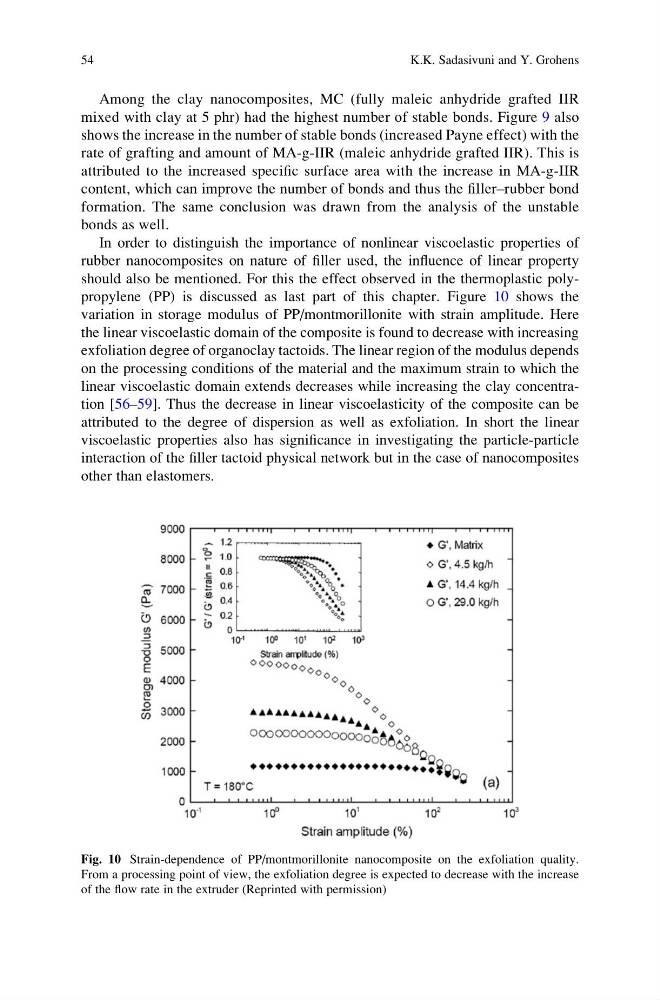
should also be mentioned. For this the effect observed in the thermoplastic polypropylene (PP) is discussed as last part of this chapter. Figure 10 shows the
variation in storage modulus of PP/montmorillonite with strain amplitude. Here
the linear viscoelastic domain of the composite is found to decrease with increasing
exfoliation degree of organoclay tactoids. The linear region of the modulus depends
on the processing conditions of the material and the maximum strain to which the
linear viscoelastic domain extends decreases while increasing the clay concentration [56–59]. Thus the decrease in linear viscoelasticity of the composite can be
attributed to the degree of dispersion as well as exfoliation. In short the linear
viscoelastic properties also has significance in investigating the particle-particle
interaction of the filler tactoid physical network but in the case of nanocomposites
other than elastomers.
Fig. 10 Strain-dependence of PP/montmorillonite nanocomposite on the exfoliation quality.
From a processing point of view, the exfoliation degree is expected to decrease with the increase
of the flow rate in the extruder (Reprinted with permission)
54
K.K. Sadasivuni and Y. Grohens
mixed with clay at 5 phr) had the highest number of stable bonds. Figure 9 also
shows the increase in the number of stable bonds (increased Payne effect) with the
rate of grafting and amount of MA-g-IIR (maleic anhydride grafted IIR). This is
attributed to the increased specific surface area with the increase in MA-g-IIR
content, which can improve the number of bonds and thus the filler–rubber bond
formation. The same conclusion was drawn from the analysis of the unstable
bonds as well.
In order to distinguish the importance of nonlinear viscoelastic properties of
rubber nanocomposites on nature of filler used, the influence of linear property
should also be mentioned. For this the effect observed in the thermoplastic polypropylene (PP) is discussed as last part of this chapter. Figure 10 shows the
variation in storage modulus of PP/montmorillonite with strain amplitude. Here
the linear viscoelastic domain of the composite is found to decrease with increasing
exfoliation degree of organoclay tactoids. The linear region of the modulus depends
on the processing conditions of the material and the maximum strain to which the
linear viscoelastic domain extends decreases while increasing the clay concentration [56–59]. Thus the decrease in linear viscoelasticity of the composite can be
attributed to the degree of dispersion as well as exfoliation. In short the linear
viscoelastic properties also has significance in investigating the particle-particle
interaction of the filler tactoid physical network but in the case of nanocomposites
other than elastomers.
Fig. 10 Strain-dependence of PP/montmorillonite nanocomposite on the exfoliation quality.
From a processing point of view, the exfoliation degree is expected to decrease with the increase
of the flow rate in the extruder (Reprinted with permission)
54
K.K. Sadasivuni and Y. Grohens