

solid-like viscoelastic behavior at low frequency region is due to strong filler-filler
and filler-polymer interactions, which demonstrate that the dynamics of long-range
polymer backbone chains is hindered prominently by the formation of the
interconnected or network-like structures of CNFs [119]. The influence of
nanofibers on the dynamic viscoelastic response of TPU/CNF nanocomposites is
relatively weaker at high frequencies as compared to lower frequencies. The
magnitude of viscosity decreases gradually with the increase in applied frequency
that is termed as shear thinning characteristic or pseudoplasticity of the polymeric
materials at molten state while it increases with the increase in nanofiber loading. In
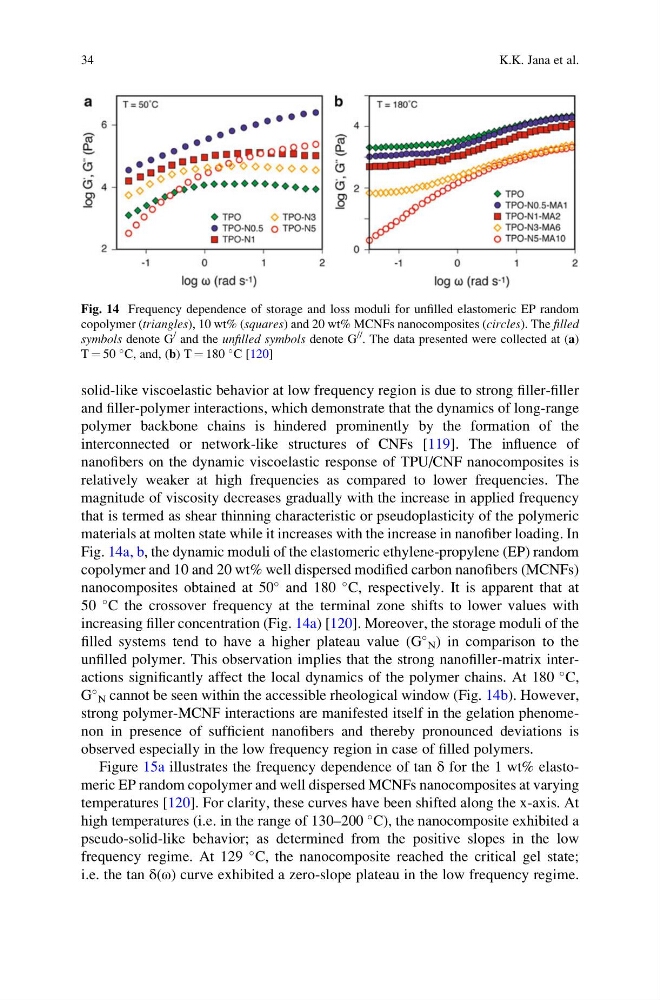
Fig. 14a, b, the dynamic moduli of the elastomeric ethylene-propylene (EP) random
copolymer and 10 and 20 wt% well dispersed modified carbon nanofibers (MCNFs)
nanocomposites obtained at 50
and 180
C, respectively. It is apparent that at
50
C the crossover frequency at the terminal zone shifts to lower values with
increasing filler concentration (Fig. 14a) [120]. Moreover, the storage moduli of the
filled systems tend to have a higher plateau value (G
N ) in comparison to the
unfilled polymer. This observation implies that the strong nanofiller-matrix interactions significantly affect the local dynamics of the polymer chains. At 180
C,
G
N cannot be seen within the accessible rheological window (Fig. 14b). However,
strong polymer-MCNF interactions are manifested itself in the gelation phenomenon in presence of sufficient nanofibers and thereby pronounced deviations is
observed especially in the low frequency region in case of filled polymers.
Figure 15a illustrates the frequency dependence of tan δ for the 1 wt% elastomeric EP random copolymer and well dispersed MCNFs nanocomposites at varying
temperatures [120]. For clarity, these curves have been shifted along the x-axis. At
high temperatures (i.e. in the range of 130–200
C), the nanocomposite exhibited a
pseudo-solid-like behavior; as determined from the positive slopes in the low
frequency regime. At 129
C, the nanocomposite reached the critical gel state;
i.e. the tan δ(ω) curve exhibited a zero-slope plateau in the low frequency regime.
Fig. 14 Frequency dependence of storage and loss moduli for unfilled elastomeric EP random
copolymer (triangles), 10 wt% (squares) and 20 wt% MCNFs nanocomposites (circles). The filled
symbols denote G
/ and the unfilled symbols denote G
// . The data presented were collected at (a)
T ¼ 50
C, and, (b) T ¼ 180
C [120]
34
K.K. Jana et al.
and filler-polymer interactions, which demonstrate that the dynamics of long-range
polymer backbone chains is hindered prominently by the formation of the
interconnected or network-like structures of CNFs [119]. The influence of
nanofibers on the dynamic viscoelastic response of TPU/CNF nanocomposites is
relatively weaker at high frequencies as compared to lower frequencies. The
magnitude of viscosity decreases gradually with the increase in applied frequency
that is termed as shear thinning characteristic or pseudoplasticity of the polymeric
materials at molten state while it increases with the increase in nanofiber loading. In
Fig. 14a, b, the dynamic moduli of the elastomeric ethylene-propylene (EP) random
copolymer and 10 and 20 wt% well dispersed modified carbon nanofibers (MCNFs)
nanocomposites obtained at 50
and 180
C, respectively. It is apparent that at
50
C the crossover frequency at the terminal zone shifts to lower values with
increasing filler concentration (Fig. 14a) [120]. Moreover, the storage moduli of the
filled systems tend to have a higher plateau value (G
N ) in comparison to the
unfilled polymer. This observation implies that the strong nanofiller-matrix interactions significantly affect the local dynamics of the polymer chains. At 180
C,
G
N cannot be seen within the accessible rheological window (Fig. 14b). However,
strong polymer-MCNF interactions are manifested itself in the gelation phenomenon in presence of sufficient nanofibers and thereby pronounced deviations is
observed especially in the low frequency region in case of filled polymers.
Figure 15a illustrates the frequency dependence of tan δ for the 1 wt% elastomeric EP random copolymer and well dispersed MCNFs nanocomposites at varying
temperatures [120]. For clarity, these curves have been shifted along the x-axis. At
high temperatures (i.e. in the range of 130–200
C), the nanocomposite exhibited a
pseudo-solid-like behavior; as determined from the positive slopes in the low
frequency regime. At 129
C, the nanocomposite reached the critical gel state;
i.e. the tan δ(ω) curve exhibited a zero-slope plateau in the low frequency regime.
Fig. 14 Frequency dependence of storage and loss moduli for unfilled elastomeric EP random
copolymer (triangles), 10 wt% (squares) and 20 wt% MCNFs nanocomposites (circles). The filled
symbols denote G
/ and the unfilled symbols denote G
// . The data presented were collected at (a)
T ¼ 50
C, and, (b) T ¼ 180
C [120]
34
K.K. Jana et al.