

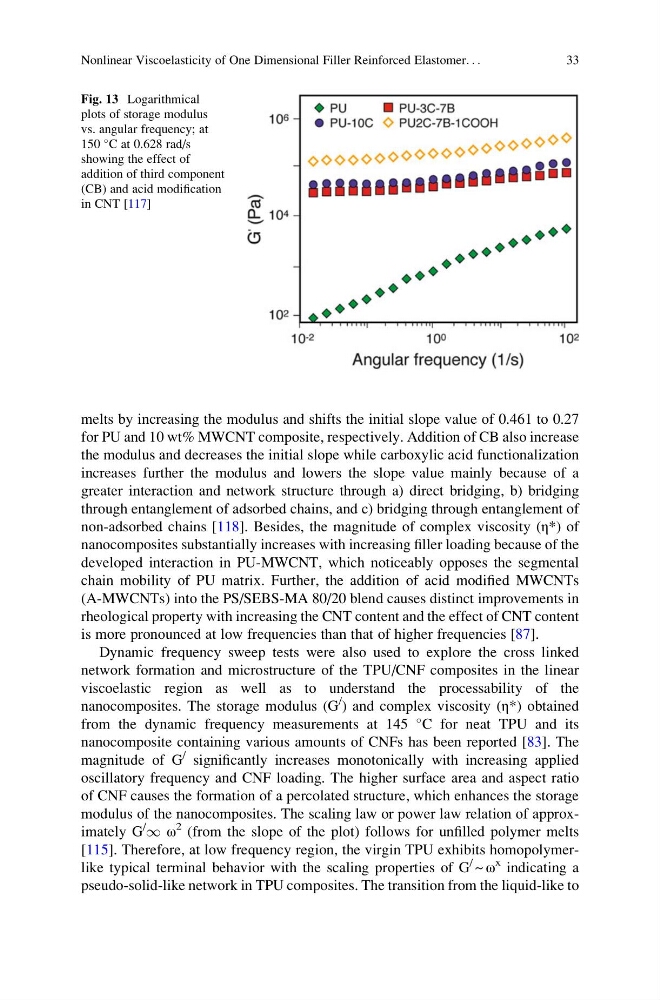
melts by increasing the modulus and shifts the initial slope value of 0.461 to 0.27
for PU and 10 wt% MWCNT composite, respectively. Addition of CB also increase
the modulus and decreases the initial slope while carboxylic acid functionalization
increases further the modulus and lowers the slope value mainly because of a
greater interaction and network structure through a) direct bridging, b) bridging
through entanglement of adsorbed chains, and c) bridging through entanglement of
non-adsorbed chains [118]. Besides, the magnitude of complex viscosity (η*) of
nanocomposites substantially increases with increasing filler loading because of the
developed interaction in PU-MWCNT, which noticeably opposes the segmental
chain mobility of PU matrix. Further, the addition of acid modified MWCNTs
(A-MWCNTs) into the PS/SEBS-MA 80/20 blend causes distinct improvements in
rheological property with increasing the CNT content and the effect of CNT content
is more pronounced at low frequencies than that of higher frequencies [87].
Dynamic frequency sweep tests were also used to explore the cross linked
network formation and microstructure of the TPU/CNF composites in the linear
viscoelastic region as well as to understand the processability of the
nanocomposites. The storage modulus (G
/
) and complex viscosity (η*) obtained
from the dynamic frequency measurements at 145
C for neat TPU and its
nanocomposite containing various amounts of CNFs has been reported [83]. The
magnitude of G
/ significantly increases monotonically with increasing applied
oscillatory frequency and CNF loading. The higher surface area and aspect ratio
of CNF causes the formation of a percolated structure, which enhances the storage
modulus of the nanocomposites. The scaling law or power law relation of approximately G
/
1 ω
2 (from the slope of the plot) follows for unfilled polymer melts
[115]. Therefore, at low frequency region, the virgin TPU exhibits homopolymerlike typical terminal behavior with the scaling properties of G
/ ~ ω
x indicating a
pseudo-solid-like network in TPU composites. The transition from the liquid-like to
Fig. 13 Logarithmical
plots of storage modulus
vs. angular frequency; at
150
C at 0.628 rad/s
showing the effect of
addition of third component
(CB) and acid modification
in CNT [117]
Nonlinear Viscoelasticity of One Dimensional Filler Reinforced Elastomer. . .
33
for PU and 10 wt% MWCNT composite, respectively. Addition of CB also increase
the modulus and decreases the initial slope while carboxylic acid functionalization
increases further the modulus and lowers the slope value mainly because of a
greater interaction and network structure through a) direct bridging, b) bridging
through entanglement of adsorbed chains, and c) bridging through entanglement of
non-adsorbed chains [118]. Besides, the magnitude of complex viscosity (η*) of
nanocomposites substantially increases with increasing filler loading because of the
developed interaction in PU-MWCNT, which noticeably opposes the segmental
chain mobility of PU matrix. Further, the addition of acid modified MWCNTs
(A-MWCNTs) into the PS/SEBS-MA 80/20 blend causes distinct improvements in
rheological property with increasing the CNT content and the effect of CNT content
is more pronounced at low frequencies than that of higher frequencies [87].
Dynamic frequency sweep tests were also used to explore the cross linked
network formation and microstructure of the TPU/CNF composites in the linear
viscoelastic region as well as to understand the processability of the
nanocomposites. The storage modulus (G
/
) and complex viscosity (η*) obtained
from the dynamic frequency measurements at 145
C for neat TPU and its
nanocomposite containing various amounts of CNFs has been reported [83]. The
magnitude of G
/ significantly increases monotonically with increasing applied
oscillatory frequency and CNF loading. The higher surface area and aspect ratio
of CNF causes the formation of a percolated structure, which enhances the storage
modulus of the nanocomposites. The scaling law or power law relation of approximately G
/
1 ω
2 (from the slope of the plot) follows for unfilled polymer melts
[115]. Therefore, at low frequency region, the virgin TPU exhibits homopolymerlike typical terminal behavior with the scaling properties of G
/ ~ ω
x indicating a
pseudo-solid-like network in TPU composites. The transition from the liquid-like to
Fig. 13 Logarithmical
plots of storage modulus
vs. angular frequency; at
150
C at 0.628 rad/s
showing the effect of
addition of third component
(CB) and acid modification
in CNT [117]
Nonlinear Viscoelasticity of One Dimensional Filler Reinforced Elastomer. . .
33