

% crit )
β
, where wt% crit is the rheological percolation threshold and β is the critical
percolation exponent and the study indicates a percolation threshold of 0.41 % for
this system [109]. Viscoelastic measurements are highly susceptible to the nanoscale and mesoscale structure of the nanocomposites and are an influential method
to investigate the state of dispersion in such materials [113, 114].
Dispersion can also be controlled by using a third component called
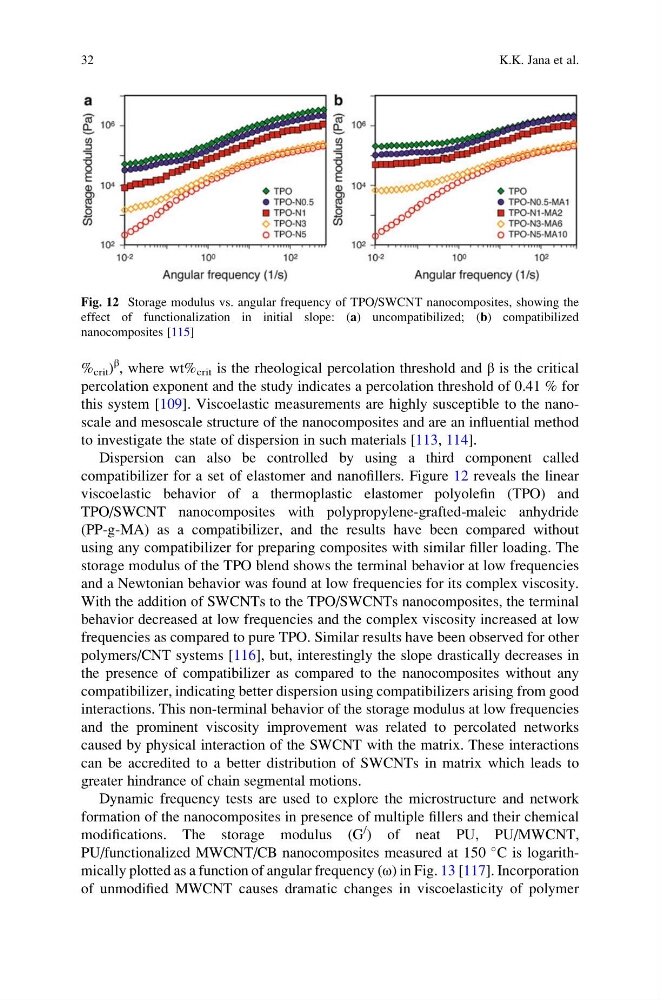
compatibilizer for a set of elastomer and nanofillers. Figure 12 reveals the linear
viscoelastic behavior of a thermoplastic elastomer polyolefin (TPO) and
TPO/SWCNT nanocomposites with polypropylene-grafted-maleic anhydride
(PP-g-MA) as a compatibilizer, and the results have been compared without
using any compatibilizer for preparing composites with similar filler loading. The
storage modulus of the TPO blend shows the terminal behavior at low frequencies
and a Newtonian behavior was found at low frequencies for its complex viscosity.
With the addition of SWCNTs to the TPO/SWCNTs nanocomposites, the terminal
behavior decreased at low frequencies and the complex viscosity increased at low
frequencies as compared to pure TPO. Similar results have been observed for other
polymers/CNT systems [116], but, interestingly the slope drastically decreases in
the presence of compatibilizer as compared to the nanocomposites without any
compatibilizer, indicating better dispersion using compatibilizers arising from good
interactions. This non-terminal behavior of the storage modulus at low frequencies
and the prominent viscosity improvement was related to percolated networks
caused by physical interaction of the SWCNT with the matrix. These interactions
can be accredited to a better distribution of SWCNTs in matrix which leads to
greater hindrance of chain segmental motions.
Dynamic frequency tests are used to explore the microstructure and network
formation of the nanocomposites in presence of multiple fillers and their chemical
modifications. The storage modulus (G
/
) of neat PU, PU/MWCNT,
PU/functionalized MWCNT/CB nanocomposites measured at 150
C is logarithmically plotted as a function of angular frequency (ω) in Fig. 13 [117]. Incorporation
of unmodified MWCNT causes dramatic changes in viscoelasticity of polymer
Fig. 12 Storage modulus vs. angular frequency of TPO/SWCNT nanocomposites, showing the
effect of functionalization in initial slope: (a) uncompatibilized; (b) compatibilized
nanocomposites [115]
32
K.K. Jana et al.
β
, where wt% crit is the rheological percolation threshold and β is the critical
percolation exponent and the study indicates a percolation threshold of 0.41 % for
this system [109]. Viscoelastic measurements are highly susceptible to the nanoscale and mesoscale structure of the nanocomposites and are an influential method
to investigate the state of dispersion in such materials [113, 114].
Dispersion can also be controlled by using a third component called
compatibilizer for a set of elastomer and nanofillers. Figure 12 reveals the linear
viscoelastic behavior of a thermoplastic elastomer polyolefin (TPO) and
TPO/SWCNT nanocomposites with polypropylene-grafted-maleic anhydride
(PP-g-MA) as a compatibilizer, and the results have been compared without
using any compatibilizer for preparing composites with similar filler loading. The
storage modulus of the TPO blend shows the terminal behavior at low frequencies
and a Newtonian behavior was found at low frequencies for its complex viscosity.
With the addition of SWCNTs to the TPO/SWCNTs nanocomposites, the terminal
behavior decreased at low frequencies and the complex viscosity increased at low
frequencies as compared to pure TPO. Similar results have been observed for other
polymers/CNT systems [116], but, interestingly the slope drastically decreases in
the presence of compatibilizer as compared to the nanocomposites without any
compatibilizer, indicating better dispersion using compatibilizers arising from good
interactions. This non-terminal behavior of the storage modulus at low frequencies
and the prominent viscosity improvement was related to percolated networks
caused by physical interaction of the SWCNT with the matrix. These interactions
can be accredited to a better distribution of SWCNTs in matrix which leads to
greater hindrance of chain segmental motions.
Dynamic frequency tests are used to explore the microstructure and network
formation of the nanocomposites in presence of multiple fillers and their chemical
modifications. The storage modulus (G
/
) of neat PU, PU/MWCNT,
PU/functionalized MWCNT/CB nanocomposites measured at 150
C is logarithmically plotted as a function of angular frequency (ω) in Fig. 13 [117]. Incorporation
of unmodified MWCNT causes dramatic changes in viscoelasticity of polymer
Fig. 12 Storage modulus vs. angular frequency of TPO/SWCNT nanocomposites, showing the
effect of functionalization in initial slope: (a) uncompatibilized; (b) compatibilized
nanocomposites [115]
32
K.K. Jana et al.