

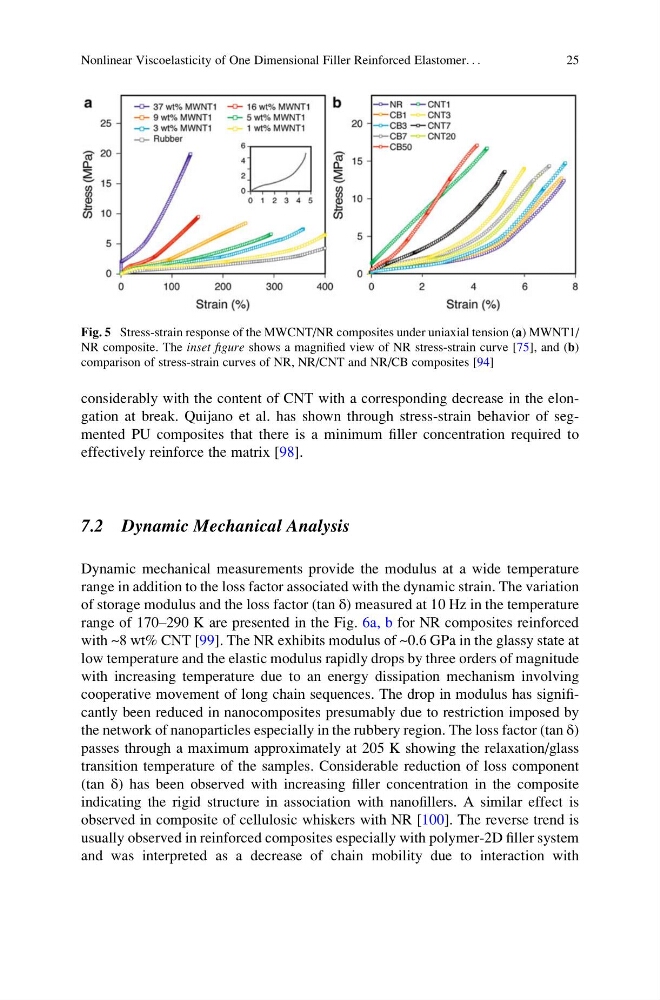
considerably with the content of CNT with a corresponding decrease in the elongation at break. Quijano et al. has shown through stress-strain behavior of segmented PU composites that there is a minimum filler concentration required to
effectively reinforce the matrix [98].
7.2 Dynamic Mechanical Analysis
Dynamic mechanical measurements provide the modulus at a wide temperature
range in addition to the loss factor associated with the dynamic strain. The variation
of storage modulus and the loss factor (tan δ) measured at 10 Hz in the temperature
range of 170–290 K are presented in the Fig. 6a, b for NR composites reinforced
with ~8 wt% CNT [99]. The NR exhibits modulus of ~0.6 GPa in the glassy state at
low temperature and the elastic modulus rapidly drops by three orders of magnitude
with increasing temperature due to an energy dissipation mechanism involving
cooperative movement of long chain sequences. The drop in modulus has significantly been reduced in nanocomposites presumably due to restriction imposed by
the network of nanoparticles especially in the rubbery region. The loss factor (tan δ)
passes through a maximum approximately at 205 K showing the relaxation/glass
transition temperature of the samples. Considerable reduction of loss component
(tan δ) has been observed with increasing filler concentration in the composite
indicating the rigid structure in association with nanofillers. A similar effect is
observed in composite of cellulosic whiskers with NR [100]. The reverse trend is
usually observed in reinforced composites especially with polymer-2D filler system
and was interpreted as a decrease of chain mobility due to interaction with
Fig. 5 Stress-strain response of the MWCNT/NR composites under uniaxial tension (a) MWNT1/
NR composite. The inset figure shows a magnified view of NR stress-strain curve [75], and (b)
comparison of stress-strain curves of NR, NR/CNT and NR/CB composites [94]
Nonlinear Viscoelasticity of One Dimensional Filler Reinforced Elastomer. . .
25
effectively reinforce the matrix [98].
7.2 Dynamic Mechanical Analysis
Dynamic mechanical measurements provide the modulus at a wide temperature
range in addition to the loss factor associated with the dynamic strain. The variation
of storage modulus and the loss factor (tan δ) measured at 10 Hz in the temperature
range of 170–290 K are presented in the Fig. 6a, b for NR composites reinforced
with ~8 wt% CNT [99]. The NR exhibits modulus of ~0.6 GPa in the glassy state at
low temperature and the elastic modulus rapidly drops by three orders of magnitude
with increasing temperature due to an energy dissipation mechanism involving
cooperative movement of long chain sequences. The drop in modulus has significantly been reduced in nanocomposites presumably due to restriction imposed by
the network of nanoparticles especially in the rubbery region. The loss factor (tan δ)
passes through a maximum approximately at 205 K showing the relaxation/glass
transition temperature of the samples. Considerable reduction of loss component
(tan δ) has been observed with increasing filler concentration in the composite
indicating the rigid structure in association with nanofillers. A similar effect is
observed in composite of cellulosic whiskers with NR [100]. The reverse trend is
usually observed in reinforced composites especially with polymer-2D filler system
and was interpreted as a decrease of chain mobility due to interaction with
Fig. 5 Stress-strain response of the MWCNT/NR composites under uniaxial tension (a) MWNT1/
NR composite. The inset figure shows a magnified view of NR stress-strain curve [75], and (b)
comparison of stress-strain curves of NR, NR/CNT and NR/CB composites [94]
Nonlinear Viscoelasticity of One Dimensional Filler Reinforced Elastomer. . .
25