

(trimethylene terephthalate-b-tetramethylene oxide) elastomer/SWCNT composites exhibit slightly higher melting temperature and crystallinity as compared to
pure elastomer [90]. With different weight percentages of CNF, DSC thermograms
of neat vistamaxx 6102FL elastomer (VM1) and its nanocomposites exhibit no
considerable changes in T m and heat of fusion [91] where there is no interaction
against strong effect observed in thermoplastic systems where specific interactions
exist [92, 93].
7 Mechanical Properties
7.1 Tensile Testing
Tensile testing through uniaxial stretching compares the strength of composite
against pure elastomer. Figure 5a shows the stress-strain curve of NR composites
with different concentration of MWCNT [75]. The modulus increases while elongations at break decrease consistently with increasing filler concentration for all the
composites as compared to neat NR indicating CNT as a good reinforcing agent
while poor interactions with elastomer lead to the failure at early stage for higher
concentration of filler. On the other hand, the improvement in modulus using
nanofiller like CNT is significantly higher in comparison to conventional filler
like CB of similar concentrations (Fig. 5b) confirming the efficacy of the nanofiller
with greater surface area than that of larger particle as filler with relatively lower
surface area per unit volume [94]. The high aspect ratio and highly anisotropic
nature of nanofiller as compared to macro-filler (CB) helps nanocomposite of
elastomer improving the mechanical properties [95, 96]. Substantial improvement
in stiffness of the nanocomposites using high-modulus fillers having high aspect
ratio have been reported by Paul et al. [97]. Moreover, the tensile strength increased
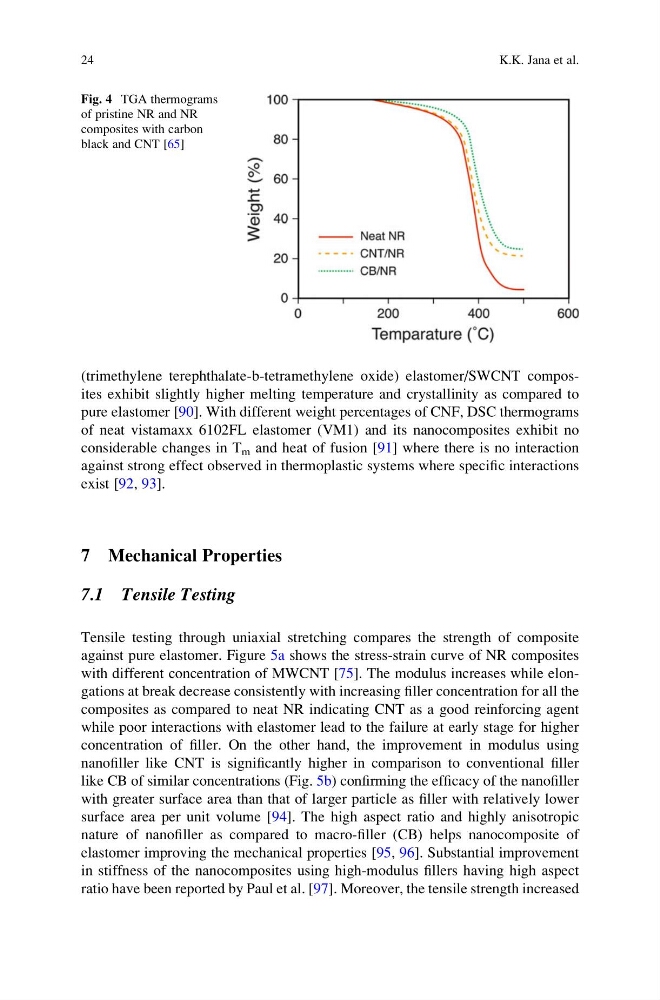
Fig. 4 TGA thermograms
of pristine NR and NR
composites with carbon
black and CNT [65]
24
K.K. Jana et al.
pure elastomer [90]. With different weight percentages of CNF, DSC thermograms
of neat vistamaxx 6102FL elastomer (VM1) and its nanocomposites exhibit no
considerable changes in T m and heat of fusion [91] where there is no interaction
against strong effect observed in thermoplastic systems where specific interactions
exist [92, 93].
7 Mechanical Properties
7.1 Tensile Testing
Tensile testing through uniaxial stretching compares the strength of composite
against pure elastomer. Figure 5a shows the stress-strain curve of NR composites
with different concentration of MWCNT [75]. The modulus increases while elongations at break decrease consistently with increasing filler concentration for all the
composites as compared to neat NR indicating CNT as a good reinforcing agent
while poor interactions with elastomer lead to the failure at early stage for higher
concentration of filler. On the other hand, the improvement in modulus using
nanofiller like CNT is significantly higher in comparison to conventional filler
like CB of similar concentrations (Fig. 5b) confirming the efficacy of the nanofiller
with greater surface area than that of larger particle as filler with relatively lower
surface area per unit volume [94]. The high aspect ratio and highly anisotropic
nature of nanofiller as compared to macro-filler (CB) helps nanocomposite of
elastomer improving the mechanical properties [95, 96]. Substantial improvement
in stiffness of the nanocomposites using high-modulus fillers having high aspect
ratio have been reported by Paul et al. [97]. Moreover, the tensile strength increased
Fig. 4 TGA thermograms
of pristine NR and NR
composites with carbon
black and CNT [65]
24
K.K. Jana et al.