

regular dispersion of CNTs in a polymer matrix [86]. However, the entanglement of
MWCNTs can be observed forming a suitable nanotube network having at least
2.5 wt% of MWCNTs in the matrix. The biphasic structure and distribution of
CNTs in the composites have also been observed by many groups [87].
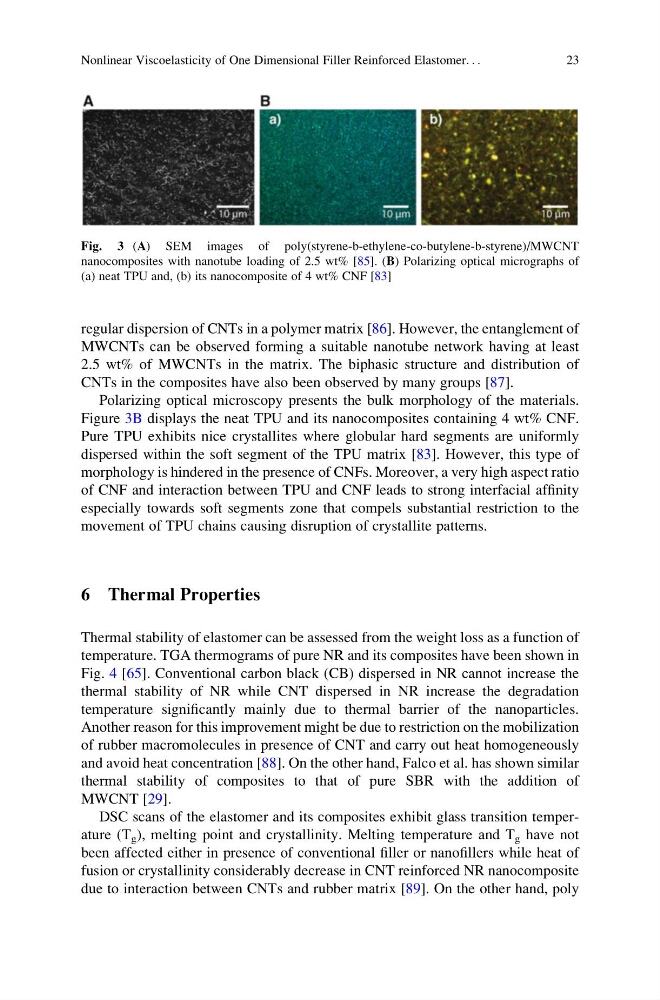
Polarizing optical microscopy presents the bulk morphology of the materials.
Figure 3B displays the neat TPU and its nanocomposites containing 4 wt% CNF.
Pure TPU exhibits nice crystallites where globular hard segments are uniformly
dispersed within the soft segment of the TPU matrix [83]. However, this type of
morphology is hindered in the presence of CNFs. Moreover, a very high aspect ratio
of CNF and interaction between TPU and CNF leads to strong interfacial affinity
especially towards soft segments zone that compels substantial restriction to the
movement of TPU chains causing disruption of crystallite patterns.
6 Thermal Properties
Thermal stability of elastomer can be assessed from the weight loss as a function of
temperature. TGA thermograms of pure NR and its composites have been shown in
Fig. 4 [65]. Conventional carbon black (CB) dispersed in NR cannot increase the
thermal stability of NR while CNT dispersed in NR increase the degradation
temperature significantly mainly due to thermal barrier of the nanoparticles.
Another reason for this improvement might be due to restriction on the mobilization
of rubber macromolecules in presence of CNT and carry out heat homogeneously
and avoid heat concentration [88]. On the other hand, Falco et al. has shown similar
thermal stability of composites to that of pure SBR with the addition of
MWCNT [29].
DSC scans of the elastomer and its composites exhibit glass transition temperature (T g ), melting point and crystallinity. Melting temperature and T g have not
been affected either in presence of conventional filler or nanofillers while heat of
fusion or crystallinity considerably decrease in CNT reinforced NR nanocomposite
due to interaction between CNTs and rubber matrix [89]. On the other hand, poly
Fig. 3 (A) SEM images of poly(styrene-b-ethylene-co-butylene-b-styrene)/MWCNT
nanocomposites with nanotube loading of 2.5 wt% [85]. (B) Polarizing optical micrographs of
(a) neat TPU and, (b) its nanocomposite of 4 wt% CNF [83]
Nonlinear Viscoelasticity of One Dimensional Filler Reinforced Elastomer. . .
23
MWCNTs can be observed forming a suitable nanotube network having at least
2.5 wt% of MWCNTs in the matrix. The biphasic structure and distribution of
CNTs in the composites have also been observed by many groups [87].
Polarizing optical microscopy presents the bulk morphology of the materials.
Figure 3B displays the neat TPU and its nanocomposites containing 4 wt% CNF.
Pure TPU exhibits nice crystallites where globular hard segments are uniformly
dispersed within the soft segment of the TPU matrix [83]. However, this type of
morphology is hindered in the presence of CNFs. Moreover, a very high aspect ratio
of CNF and interaction between TPU and CNF leads to strong interfacial affinity
especially towards soft segments zone that compels substantial restriction to the
movement of TPU chains causing disruption of crystallite patterns.
6 Thermal Properties
Thermal stability of elastomer can be assessed from the weight loss as a function of
temperature. TGA thermograms of pure NR and its composites have been shown in
Fig. 4 [65]. Conventional carbon black (CB) dispersed in NR cannot increase the
thermal stability of NR while CNT dispersed in NR increase the degradation
temperature significantly mainly due to thermal barrier of the nanoparticles.
Another reason for this improvement might be due to restriction on the mobilization
of rubber macromolecules in presence of CNT and carry out heat homogeneously
and avoid heat concentration [88]. On the other hand, Falco et al. has shown similar
thermal stability of composites to that of pure SBR with the addition of
MWCNT [29].
DSC scans of the elastomer and its composites exhibit glass transition temperature (T g ), melting point and crystallinity. Melting temperature and T g have not
been affected either in presence of conventional filler or nanofillers while heat of
fusion or crystallinity considerably decrease in CNT reinforced NR nanocomposite
due to interaction between CNTs and rubber matrix [89]. On the other hand, poly
Fig. 3 (A) SEM images of poly(styrene-b-ethylene-co-butylene-b-styrene)/MWCNT
nanocomposites with nanotube loading of 2.5 wt% [85]. (B) Polarizing optical micrographs of
(a) neat TPU and, (b) its nanocomposite of 4 wt% CNF [83]
Nonlinear Viscoelasticity of One Dimensional Filler Reinforced Elastomer. . .
23