

shear viscosity curve at a reference temperature and the knowledge of the activation
energy Ea, the shear viscosity function at other temperatures can easily be calculated. As mentioned above, apparent activation energy data can be obtained by
repeating a single rate viscosity test at several temperatures and by treating the
results with the Arrhenius equation.
4.2.2 Dynamic Functions
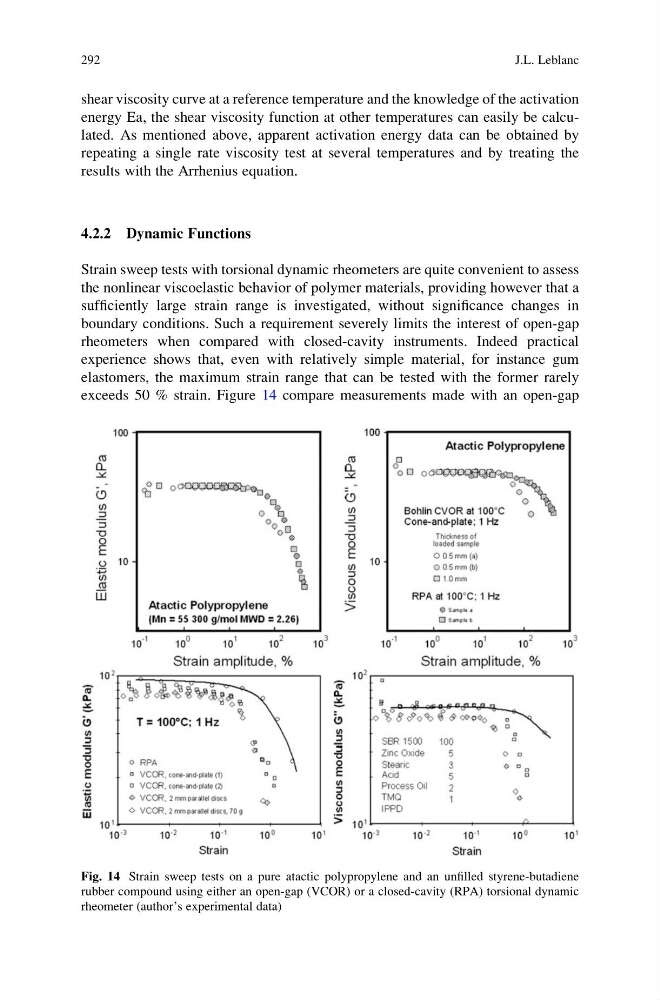
Strain sweep tests with torsional dynamic rheometers are quite convenient to assess
the nonlinear viscoelastic behavior of polymer materials, providing however that a
sufficiently large strain range is investigated, without significance changes in
boundary conditions. Such a requirement severely limits the interest of open-gap
rheometers when compared with closed-cavity instruments. Indeed practical
experience shows that, even with relatively simple material, for instance gum
elastomers, the maximum strain range that can be tested with the former rarely
exceeds 50 % strain. Figure 14 compare measurements made with an open-gap
Fig. 14 Strain sweep tests on a pure atactic polypropylene and an unfilled styrene-butadiene
rubber compound using either an open-gap (VCOR) or a closed-cavity (RPA) torsional dynamic
rheometer (author’s experimental data)
292
J.L. Leblanc
energy Ea, the shear viscosity function at other temperatures can easily be calculated. As mentioned above, apparent activation energy data can be obtained by
repeating a single rate viscosity test at several temperatures and by treating the
results with the Arrhenius equation.
4.2.2 Dynamic Functions
Strain sweep tests with torsional dynamic rheometers are quite convenient to assess
the nonlinear viscoelastic behavior of polymer materials, providing however that a
sufficiently large strain range is investigated, without significance changes in
boundary conditions. Such a requirement severely limits the interest of open-gap
rheometers when compared with closed-cavity instruments. Indeed practical
experience shows that, even with relatively simple material, for instance gum
elastomers, the maximum strain range that can be tested with the former rarely
exceeds 50 % strain. Figure 14 compare measurements made with an open-gap
Fig. 14 Strain sweep tests on a pure atactic polypropylene and an unfilled styrene-butadiene
rubber compound using either an open-gap (VCOR) or a closed-cavity (RPA) torsional dynamic
rheometer (author’s experimental data)
292
J.L. Leblanc