

4.2 Material Functions in the Nonlinear Viscoelastic Range
4.2.1 Shear Viscosity Function
The shear thinning behavior, as generally observed with polymer systems, is a
typical nonlinear viscoelastic effect, so that by combining the Carreau-Yasuda and
the Arrhenius equations a general model for the shear viscosity function can be
written as follows:
η _
γ, T
ð
Þ ¼ η 0 T
ð Þ Â exp
Ea
R
1
T
À
1
T 0
 1 þ λ _
γ
ð Þ
a
½
nÀ1
ð
Þ=a
ð8Þ
Such an equation implies that it is essentially the pseudo-Newtonian viscosity,
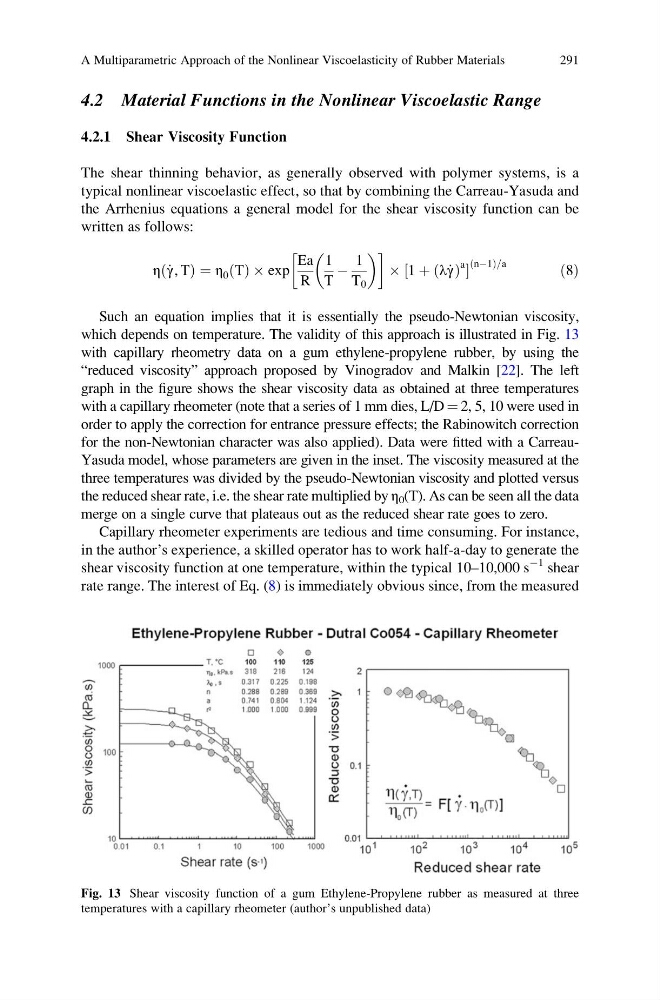
which depends on temperature. The validity of this approach is illustrated in Fig. 13
with capillary rheometry data on a gum ethylene-propylene rubber, by using the
“reduced viscosity” approach proposed by Vinogradov and Malkin [22]. The left
graph in the figure shows the shear viscosity data as obtained at three temperatures
with a capillary rheometer (note that a series of 1 mm dies, L/D ¼ 2, 5, 10 were used in
order to apply the correction for entrance pressure effects; the Rabinowitch correction
for the non-Newtonian character was also applied). Data were fitted with a CarreauYasuda model, whose parameters are given in the inset. The viscosity measured at the
three temperatures was divided by the pseudo-Newtonian viscosity and plotted versus
the reduced shear rate, i.e. the shear rate multiplied by η 0 (T). As can be seen all the data
merge on a single curve that plateaus out as the reduced shear rate goes to zero.
Capillary rheometer experiments are tedious and time consuming. For instance,
in the author’s experience, a skilled operator has to work half-a-day to generate the
shear viscosity function at one temperature, within the typical 10–10,000 s
À1 shear
rate range. The interest of Eq. (8) is immediately obvious since, from the measured
Fig. 13 Shear viscosity function of a gum Ethylene-Propylene rubber as measured at three
temperatures with a capillary rheometer (author’s unpublished data)
A Multiparametric Approach of the Nonlinear Viscoelasticity of Rubber Materials
291
4.2.1 Shear Viscosity Function
The shear thinning behavior, as generally observed with polymer systems, is a
typical nonlinear viscoelastic effect, so that by combining the Carreau-Yasuda and
the Arrhenius equations a general model for the shear viscosity function can be
written as follows:
η _
γ, T
ð
Þ ¼ η 0 T
ð Þ Â exp
Ea
R
1
T
À
1
T 0
 1 þ λ _
γ
ð Þ
a
½
nÀ1
ð
Þ=a
ð8Þ
Such an equation implies that it is essentially the pseudo-Newtonian viscosity,
which depends on temperature. The validity of this approach is illustrated in Fig. 13
with capillary rheometry data on a gum ethylene-propylene rubber, by using the
“reduced viscosity” approach proposed by Vinogradov and Malkin [22]. The left
graph in the figure shows the shear viscosity data as obtained at three temperatures
with a capillary rheometer (note that a series of 1 mm dies, L/D ¼ 2, 5, 10 were used in
order to apply the correction for entrance pressure effects; the Rabinowitch correction
for the non-Newtonian character was also applied). Data were fitted with a CarreauYasuda model, whose parameters are given in the inset. The viscosity measured at the
three temperatures was divided by the pseudo-Newtonian viscosity and plotted versus
the reduced shear rate, i.e. the shear rate multiplied by η 0 (T). As can be seen all the data
merge on a single curve that plateaus out as the reduced shear rate goes to zero.
Capillary rheometer experiments are tedious and time consuming. For instance,
in the author’s experience, a skilled operator has to work half-a-day to generate the
shear viscosity function at one temperature, within the typical 10–10,000 s
À1 shear
rate range. The interest of Eq. (8) is immediately obvious since, from the measured
Fig. 13 Shear viscosity function of a gum Ethylene-Propylene rubber as measured at three
temperatures with a capillary rheometer (author’s unpublished data)
A Multiparametric Approach of the Nonlinear Viscoelasticity of Rubber Materials
291