

(VCOR-Bohlin) and a closed-cavity (RPA-Alpha Technology) rheometers. The
upper graphs show elastic and viscous moduli as measured during strain sweep
experiments on a pure atactic polypropylene (aPP) sample, whilst the lower graphs
display results obtained on an unfilled rubber compound. As can be seen, with aPP
both rheometers yield comparable G
0 and G
00 results in the linear viscoelastic region
but, whilst the closed-cavity instrument gives quite reproducible results in the
nonlinear region, results with the open-gap tester are doubtful above around 30 %
strain, likely due to poor boundary conditions. When a (unfilled) compound is
tested, results with the open-gap rheometer appear to suffer from an excessive
experimental scatter when either different test geometries are used (i.e., cone-plate
and parallel discs) or when tests are repeated with the same geometry. In contrast, a
smooth variation from the linear to the nonlinear region is observed with the closedcavity tester. Similar observations were reported on a series of gum Natural Rubber
grades [14] and, in the author’s experience with open-gap rheometers, it is practically impossible to test highly filled rubber compounds in the nonlinear range,
because their high stiffness makes hardly possible a reproducible loading of the
material in the testing gap.
With a closed-cavity dynamic torsional rheometer, typical nonlinear viscoelastic
experiments are Strain Sweep (SS) tests in the widest strain range at fixed frequency
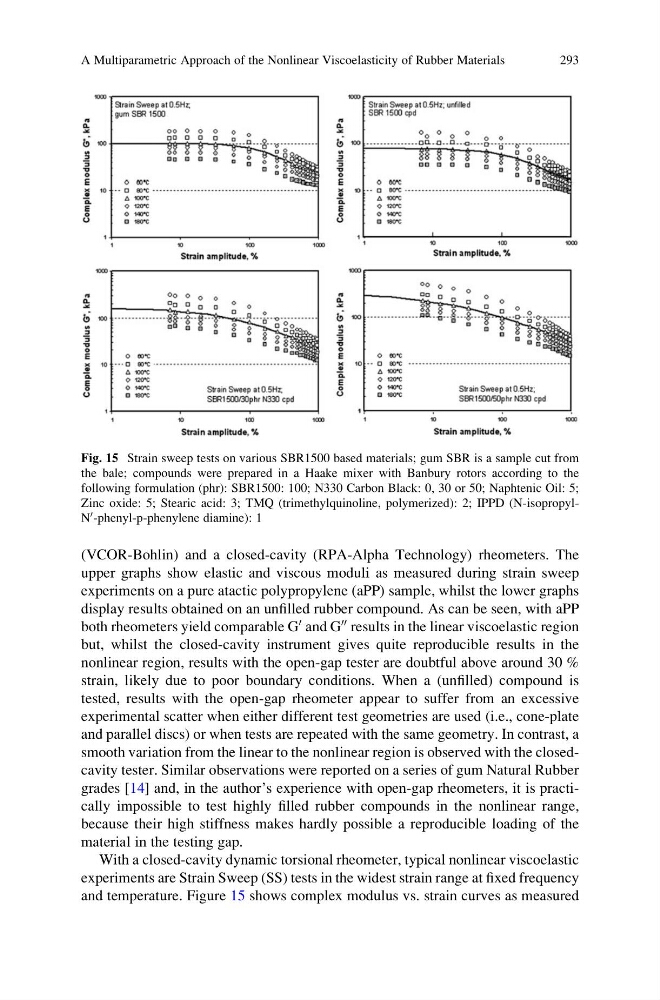
and temperature. Figure 15 shows complex modulus vs. strain curves as measured
Fig. 15 Strain sweep tests on various SBR1500 based materials; gum SBR is a sample cut from
the bale; compounds were prepared in a Haake mixer with Banbury rotors according to the
following formulation (phr): SBR1500: 100; N330 Carbon Black: 0, 30 or 50; Naphtenic Oil: 5;
Zinc oxide: 5; Stearic acid: 3; TMQ (trimethylquinoline, polymerized): 2; IPPD (N-isopropylN
0 -phenyl-p-phenylene diamine): 1
A Multiparametric Approach of the Nonlinear Viscoelasticity of Rubber Materials
293
upper graphs show elastic and viscous moduli as measured during strain sweep
experiments on a pure atactic polypropylene (aPP) sample, whilst the lower graphs
display results obtained on an unfilled rubber compound. As can be seen, with aPP
both rheometers yield comparable G
0 and G
00 results in the linear viscoelastic region
but, whilst the closed-cavity instrument gives quite reproducible results in the
nonlinear region, results with the open-gap tester are doubtful above around 30 %
strain, likely due to poor boundary conditions. When a (unfilled) compound is
tested, results with the open-gap rheometer appear to suffer from an excessive
experimental scatter when either different test geometries are used (i.e., cone-plate
and parallel discs) or when tests are repeated with the same geometry. In contrast, a
smooth variation from the linear to the nonlinear region is observed with the closedcavity tester. Similar observations were reported on a series of gum Natural Rubber
grades [14] and, in the author’s experience with open-gap rheometers, it is practically impossible to test highly filled rubber compounds in the nonlinear range,
because their high stiffness makes hardly possible a reproducible loading of the
material in the testing gap.
With a closed-cavity dynamic torsional rheometer, typical nonlinear viscoelastic
experiments are Strain Sweep (SS) tests in the widest strain range at fixed frequency
and temperature. Figure 15 shows complex modulus vs. strain curves as measured
Fig. 15 Strain sweep tests on various SBR1500 based materials; gum SBR is a sample cut from
the bale; compounds were prepared in a Haake mixer with Banbury rotors according to the
following formulation (phr): SBR1500: 100; N330 Carbon Black: 0, 30 or 50; Naphtenic Oil: 5;
Zinc oxide: 5; Stearic acid: 3; TMQ (trimethylquinoline, polymerized): 2; IPPD (N-isopropylN
0 -phenyl-p-phenylene diamine): 1
A Multiparametric Approach of the Nonlinear Viscoelasticity of Rubber Materials
293