

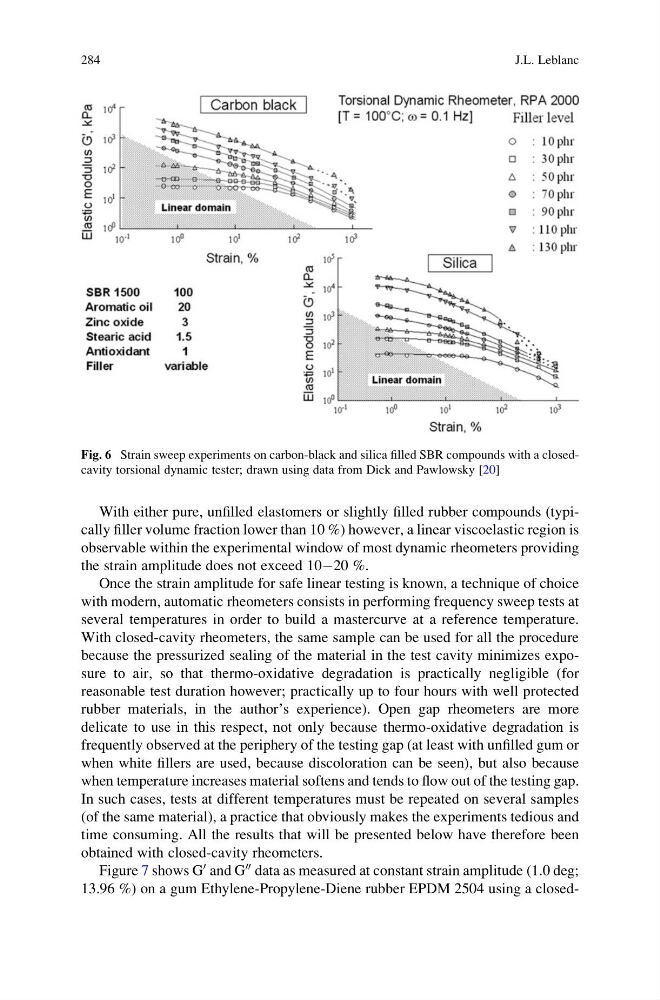
With either pure, unfilled elastomers or slightly filled rubber compounds (typically filler volume fraction lower than 10 %) however, a linear viscoelastic region is
observable within the experimental window of most dynamic rheometers providing
the strain amplitude does not exceed 10À20 %.
Once the strain amplitude for safe linear testing is known, a technique of choice
with modern, automatic rheometers consists in performing frequency sweep tests at
several temperatures in order to build a mastercurve at a reference temperature.
With closed-cavity rheometers, the same sample can be used for all the procedure
because the pressurized sealing of the material in the test cavity minimizes exposure to air, so that thermo-oxidative degradation is practically negligible (for
reasonable test duration however; practically up to four hours with well protected
rubber materials, in the author’s experience). Open gap rheometers are more
delicate to use in this respect, not only because thermo-oxidative degradation is
frequently observed at the periphery of the testing gap (at least with unfilled gum or
when white fillers are used, because discoloration can be seen), but also because
when temperature increases material softens and tends to flow out of the testing gap.
In such cases, tests at different temperatures must be repeated on several samples
(of the same material), a practice that obviously makes the experiments tedious and
time consuming. All the results that will be presented below have therefore been
obtained with closed-cavity rheometers.
Figure 7 shows G
0 and G
00 data as measured at constant strain amplitude (1.0 deg;
13.96 %) on a gum Ethylene-Propylene-Diene rubber EPDM 2504 using a closedFig. 6 Strain sweep experiments on carbon-black and silica filled SBR compounds with a closedcavity torsional dynamic tester; drawn using data from Dick and Pawlowsky [20]
284
J.L. Leblanc
observable within the experimental window of most dynamic rheometers providing
the strain amplitude does not exceed 10À20 %.
Once the strain amplitude for safe linear testing is known, a technique of choice
with modern, automatic rheometers consists in performing frequency sweep tests at
several temperatures in order to build a mastercurve at a reference temperature.
With closed-cavity rheometers, the same sample can be used for all the procedure
because the pressurized sealing of the material in the test cavity minimizes exposure to air, so that thermo-oxidative degradation is practically negligible (for
reasonable test duration however; practically up to four hours with well protected
rubber materials, in the author’s experience). Open gap rheometers are more
delicate to use in this respect, not only because thermo-oxidative degradation is
frequently observed at the periphery of the testing gap (at least with unfilled gum or
when white fillers are used, because discoloration can be seen), but also because
when temperature increases material softens and tends to flow out of the testing gap.
In such cases, tests at different temperatures must be repeated on several samples
(of the same material), a practice that obviously makes the experiments tedious and
time consuming. All the results that will be presented below have therefore been
obtained with closed-cavity rheometers.
Figure 7 shows G
0 and G
00 data as measured at constant strain amplitude (1.0 deg;
13.96 %) on a gum Ethylene-Propylene-Diene rubber EPDM 2504 using a closedFig. 6 Strain sweep experiments on carbon-black and silica filled SBR compounds with a closedcavity torsional dynamic tester; drawn using data from Dick and Pawlowsky [20]
284
J.L. Leblanc