

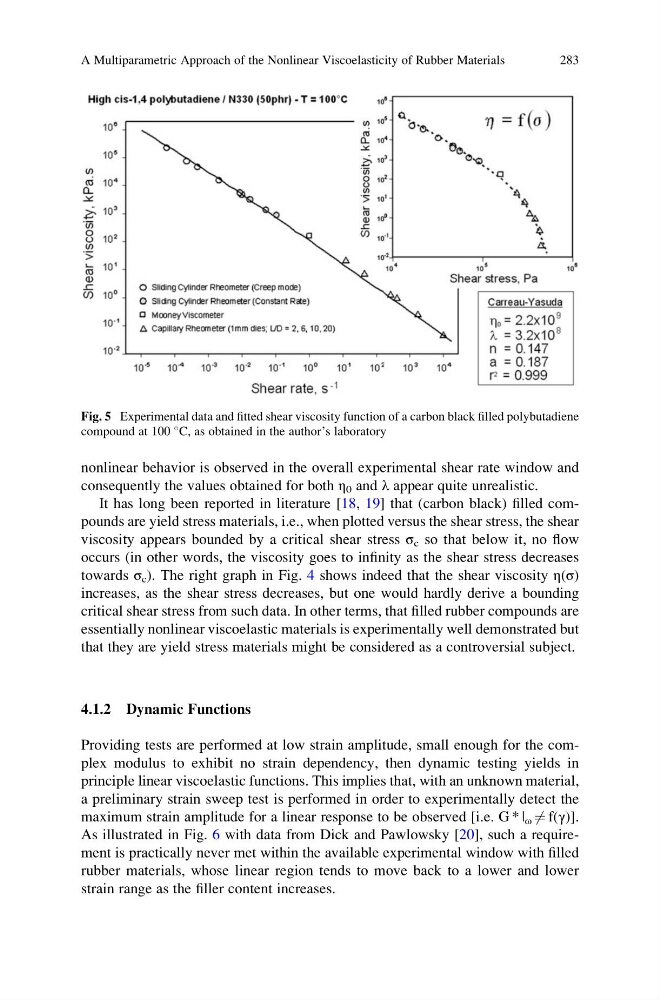
nonlinear behavior is observed in the overall experimental shear rate window and
consequently the values obtained for both η 0 and λ appear quite unrealistic.
It has long been reported in literature [18, 19] that (carbon black) filled compounds are yield stress materials, i.e., when plotted versus the shear stress, the shear
viscosity appears bounded by a critical shear stress σ c so that below it, no flow
occurs (in other words, the viscosity goes to infinity as the shear stress decreases
towards σ c ). The right graph in Fig. 4 shows indeed that the shear viscosity η(σ)
increases, as the shear stress decreases, but one would hardly derive a bounding
critical shear stress from such data. In other terms, that filled rubber compounds are
essentially nonlinear viscoelastic materials is experimentally well demonstrated but
that they are yield stress materials might be considered as a controversial subject.
4.1.2 Dynamic Functions
Providing tests are performed at low strain amplitude, small enough for the complex modulus to exhibit no strain dependency, then dynamic testing yields in
principle linear viscoelastic functions. This implies that, with an unknown material,
a preliminary strain sweep test is performed in order to experimentally detect the
maximum strain amplitude for a linear response to be observed [i.e. G * | ω 6 ¼ f(γ)].
As illustrated in Fig. 6 with data from Dick and Pawlowsky [20], such a requirement is practically never met within the available experimental window with filled
rubber materials, whose linear region tends to move back to a lower and lower
strain range as the filler content increases.
Fig. 5 Experimental data and fitted shear viscosity function of a carbon black filled polybutadiene
compound at 100
C, as obtained in the author’s laboratory
A Multiparametric Approach of the Nonlinear Viscoelasticity of Rubber Materials
283
consequently the values obtained for both η 0 and λ appear quite unrealistic.
It has long been reported in literature [18, 19] that (carbon black) filled compounds are yield stress materials, i.e., when plotted versus the shear stress, the shear
viscosity appears bounded by a critical shear stress σ c so that below it, no flow
occurs (in other words, the viscosity goes to infinity as the shear stress decreases
towards σ c ). The right graph in Fig. 4 shows indeed that the shear viscosity η(σ)
increases, as the shear stress decreases, but one would hardly derive a bounding
critical shear stress from such data. In other terms, that filled rubber compounds are
essentially nonlinear viscoelastic materials is experimentally well demonstrated but
that they are yield stress materials might be considered as a controversial subject.
4.1.2 Dynamic Functions
Providing tests are performed at low strain amplitude, small enough for the complex modulus to exhibit no strain dependency, then dynamic testing yields in
principle linear viscoelastic functions. This implies that, with an unknown material,
a preliminary strain sweep test is performed in order to experimentally detect the
maximum strain amplitude for a linear response to be observed [i.e. G * | ω 6 ¼ f(γ)].
As illustrated in Fig. 6 with data from Dick and Pawlowsky [20], such a requirement is practically never met within the available experimental window with filled
rubber materials, whose linear region tends to move back to a lower and lower
strain range as the filler content increases.
Fig. 5 Experimental data and fitted shear viscosity function of a carbon black filled polybutadiene
compound at 100
C, as obtained in the author’s laboratory
A Multiparametric Approach of the Nonlinear Viscoelasticity of Rubber Materials
283