

steady state shear conditions are relatively easy to establish with appropriate
instruments in laboratory conditions but steady state extensional conditions require
that an initial reference length (of the material) is growing exponentially with time.
There are thus inherent complexities in assessing extensional viscosity, whose
detailed discussion is outside the scope of this chapter but is found in many
textbooks [6, 7]. Practically extensional rheometry is limited to very delicate and
tedious laboratory practices, on a limited number of polymer systems.
In order to observe the full shear viscosity function of a pure, homogeneous
polymer, several decades of shear rate must be investigated. It follows that several
instruments are needed, with commercial devices available only for the low-tomedium shear rate range (i.e. rotational rheometers, cone-plate or parallel disks;
10
À2 to 10
1 s
À1 ) and the medium-to-high range (i.e. extrusion rheometers, capillary
or slit die; 10
1 to 10
3 s
À1 ). The very low shear range, where the so-called pseudoNewtonian plateau can expectedly be observed, requires laboratory prototype
instruments such as the so-called “sandwich” rheometer [8–10] or the sliding
cylinder rheometer [11, 12], operated either in creep (i.e. under the action of a
dead-weight) or in constant rate mode (through the action of a rate-controlled ram).
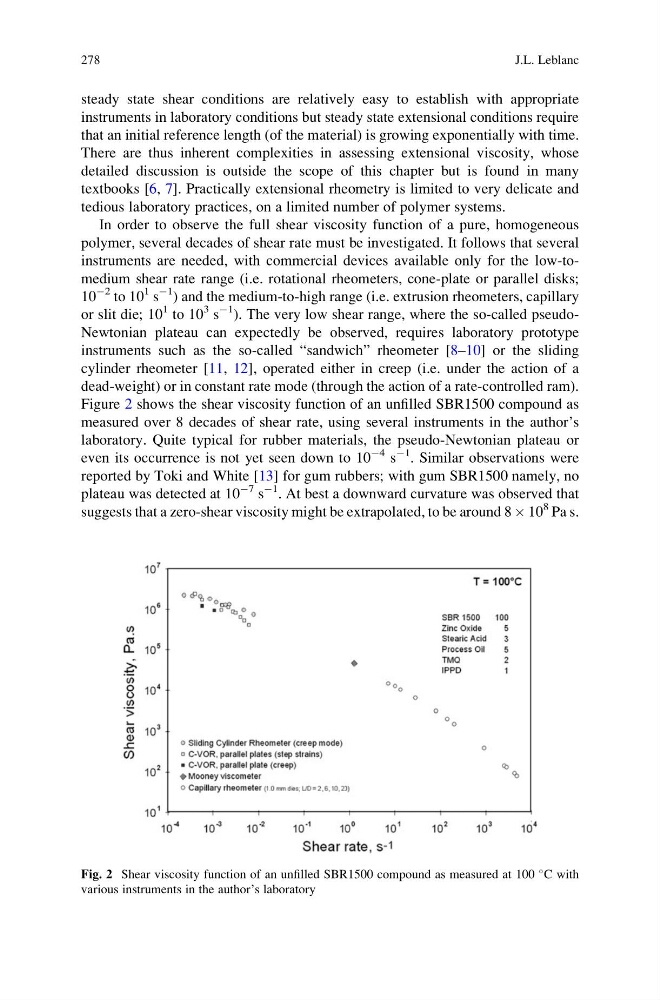
Figure 2 shows the shear viscosity function of an unfilled SBR1500 compound as
measured over 8 decades of shear rate, using several instruments in the author’s
laboratory. Quite typical for rubber materials, the pseudo-Newtonian plateau or
even its occurrence is not yet seen down to 10
À4 s
À1 . Similar observations were
reported by Toki and White [13] for gum rubbers; with gum SBR1500 namely, no
plateau was detected at 10
À7 s
À1 . At best a downward curvature was observed that
suggests that a zero-shear viscosity might be extrapolated, to be around 8 Â 10
8 Pa s.
Fig. 2 Shear viscosity function of an unfilled SBR1500 compound as measured at 100
C with
various instruments in the author’s laboratory
278
J.L. Leblanc
instruments in laboratory conditions but steady state extensional conditions require
that an initial reference length (of the material) is growing exponentially with time.
There are thus inherent complexities in assessing extensional viscosity, whose
detailed discussion is outside the scope of this chapter but is found in many
textbooks [6, 7]. Practically extensional rheometry is limited to very delicate and
tedious laboratory practices, on a limited number of polymer systems.
In order to observe the full shear viscosity function of a pure, homogeneous
polymer, several decades of shear rate must be investigated. It follows that several
instruments are needed, with commercial devices available only for the low-tomedium shear rate range (i.e. rotational rheometers, cone-plate or parallel disks;
10
À2 to 10
1 s
À1 ) and the medium-to-high range (i.e. extrusion rheometers, capillary
or slit die; 10
1 to 10
3 s
À1 ). The very low shear range, where the so-called pseudoNewtonian plateau can expectedly be observed, requires laboratory prototype
instruments such as the so-called “sandwich” rheometer [8–10] or the sliding
cylinder rheometer [11, 12], operated either in creep (i.e. under the action of a
dead-weight) or in constant rate mode (through the action of a rate-controlled ram).
Figure 2 shows the shear viscosity function of an unfilled SBR1500 compound as
measured over 8 decades of shear rate, using several instruments in the author’s
laboratory. Quite typical for rubber materials, the pseudo-Newtonian plateau or
even its occurrence is not yet seen down to 10
À4 s
À1 . Similar observations were
reported by Toki and White [13] for gum rubbers; with gum SBR1500 namely, no
plateau was detected at 10
À7 s
À1 . At best a downward curvature was observed that
suggests that a zero-shear viscosity might be extrapolated, to be around 8 Â 10
8 Pa s.
Fig. 2 Shear viscosity function of an unfilled SBR1500 compound as measured at 100
C with
various instruments in the author’s laboratory
278
J.L. Leblanc