

It thus appears that, in sharp contrast with (some) molten thermoplastic polymers,
there is nearly no experimental evidence of a linear viscoelastic region for rubber
materials, whatever low is the shear rate range investigated.
3.2 Dynamic Functions
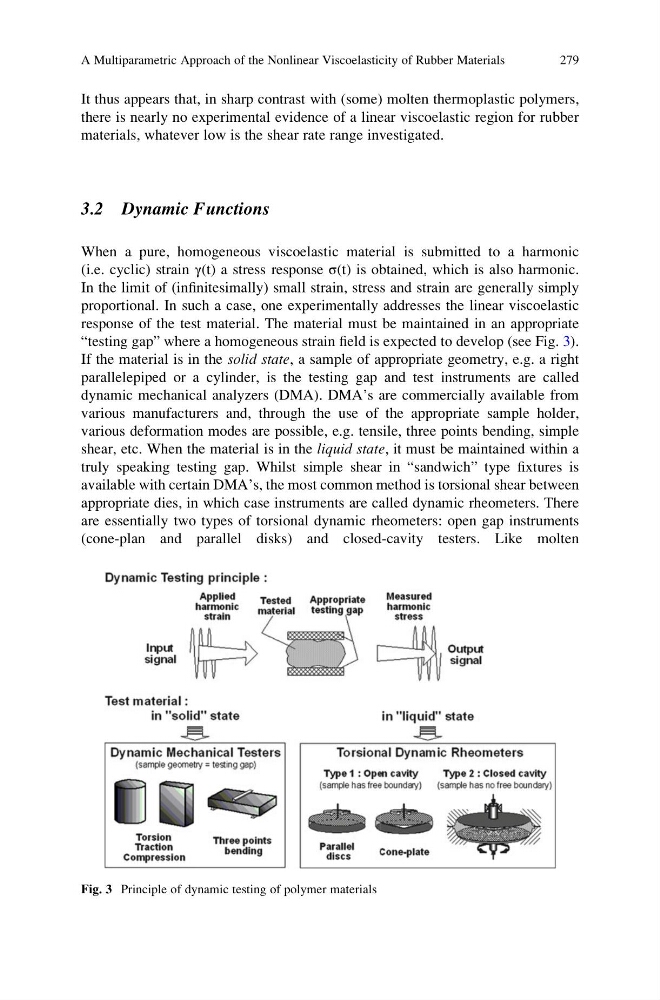
When a pure, homogeneous viscoelastic material is submitted to a harmonic
(i.e. cyclic) strain γ(t) a stress response σ(t) is obtained, which is also harmonic.
In the limit of (infinitesimally) small strain, stress and strain are generally simply
proportional. In such a case, one experimentally addresses the linear viscoelastic
response of the test material. The material must be maintained in an appropriate
“testing gap” where a homogeneous strain field is expected to develop (see Fig. 3).
If the material is in the solid state, a sample of appropriate geometry, e.g. a right
parallelepiped or a cylinder, is the testing gap and test instruments are called
dynamic mechanical analyzers (DMA). DMA’s are commercially available from
various manufacturers and, through the use of the appropriate sample holder,
various deformation modes are possible, e.g. tensile, three points bending, simple
shear, etc. When the material is in the liquid state, it must be maintained within a
truly speaking testing gap. Whilst simple shear in “sandwich” type fixtures is
available with certain DMA’s, the most common method is torsional shear between
appropriate dies, in which case instruments are called dynamic rheometers. There
are essentially two types of torsional dynamic rheometers: open gap instruments
(cone-plan and parallel disks) and closed-cavity testers. Like molten
Fig. 3 Principle of dynamic testing of polymer materials
A Multiparametric Approach of the Nonlinear Viscoelasticity of Rubber Materials
279
there is nearly no experimental evidence of a linear viscoelastic region for rubber
materials, whatever low is the shear rate range investigated.
3.2 Dynamic Functions
When a pure, homogeneous viscoelastic material is submitted to a harmonic
(i.e. cyclic) strain γ(t) a stress response σ(t) is obtained, which is also harmonic.
In the limit of (infinitesimally) small strain, stress and strain are generally simply
proportional. In such a case, one experimentally addresses the linear viscoelastic
response of the test material. The material must be maintained in an appropriate
“testing gap” where a homogeneous strain field is expected to develop (see Fig. 3).
If the material is in the solid state, a sample of appropriate geometry, e.g. a right
parallelepiped or a cylinder, is the testing gap and test instruments are called
dynamic mechanical analyzers (DMA). DMA’s are commercially available from
various manufacturers and, through the use of the appropriate sample holder,
various deformation modes are possible, e.g. tensile, three points bending, simple
shear, etc. When the material is in the liquid state, it must be maintained within a
truly speaking testing gap. Whilst simple shear in “sandwich” type fixtures is
available with certain DMA’s, the most common method is torsional shear between
appropriate dies, in which case instruments are called dynamic rheometers. There
are essentially two types of torsional dynamic rheometers: open gap instruments
(cone-plan and parallel disks) and closed-cavity testers. Like molten
Fig. 3 Principle of dynamic testing of polymer materials
A Multiparametric Approach of the Nonlinear Viscoelasticity of Rubber Materials
279