

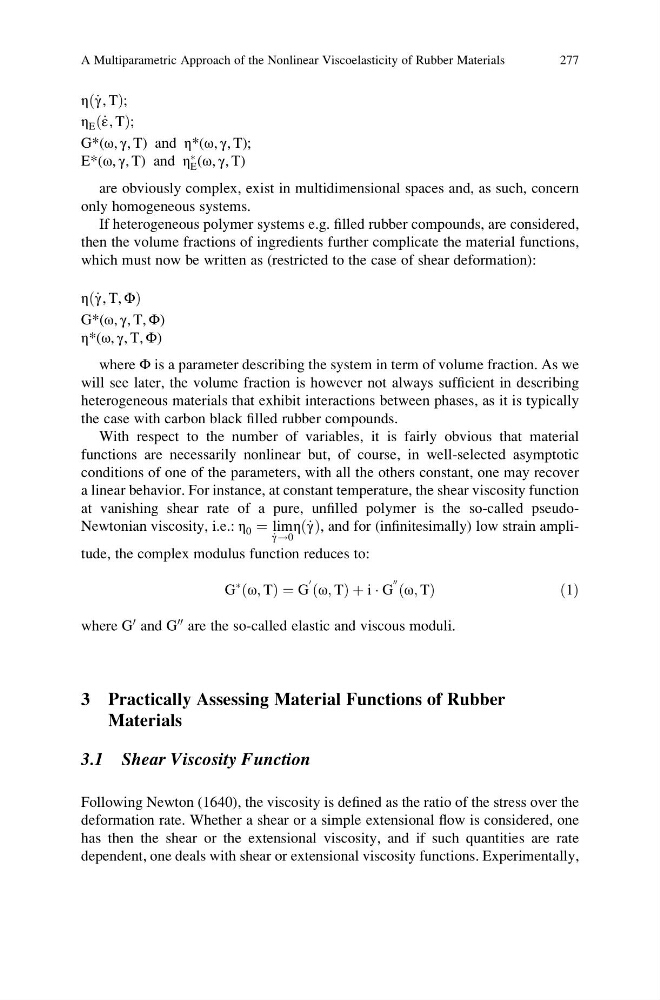
ηð_ γ, TÞ;
η E ð_ ε, TÞ;
G*(ω, γ, T) and η*(ω, γ, T);
E*(ω, γ, T) and η
Ã
E (ω, γ, T)
are obviously complex, exist in multidimensional spaces and, as such, concern
only homogeneous systems.
If heterogeneous polymer systems e.g. filled rubber compounds, are considered,
then the volume fractions of ingredients further complicate the material functions,
which must now be written as (restricted to the case of shear deformation):
ηð_ γ, T, ΦÞ
G*(ω, γ, T, Φ)
η*(ω, γ, T, Φ)
where Φ is a parameter describing the system in term of volume fraction. As we
will see later, the volume fraction is however not always sufficient in describing
heterogeneous materials that exhibit interactions between phases, as it is typically
the case with carbon black filled rubber compounds.
With respect to the number of variables, it is fairly obvious that material
functions are necessarily nonlinear but, of course, in well-selected asymptotic
conditions of one of the parameters, with all the others constant, one may recover
a linear behavior. For instance, at constant temperature, the shear viscosity function
at vanishing shear rate of a pure, unfilled polymer is the so-called pseudoNewtonian viscosity, i.e.: η 0 ¼ lim
_
γ!0
η _
γ
ð Þ, and for (infinitesimally) low strain amplitude, the complex modulus function reduces to:
G
Ã
ω; T
ð
Þ ¼ G
0 ω; T
ð
Þþi Á G
00 ω; T
ð
Þ
ð1Þ
where G
0 and G
00 are the so-called elastic and viscous moduli.
3 Practically Assessing Material Functions of Rubber
Materials
3.1 Shear Viscosity Function
Following Newton (1640), the viscosity is defined as the ratio of the stress over the
deformation rate. Whether a shear or a simple extensional flow is considered, one
has then the shear or the extensional viscosity, and if such quantities are rate
dependent, one deals with shear or extensional viscosity functions. Experimentally,
A Multiparametric Approach of the Nonlinear Viscoelasticity of Rubber Materials
277
η E ð_ ε, TÞ;
G*(ω, γ, T) and η*(ω, γ, T);
E*(ω, γ, T) and η
Ã
E (ω, γ, T)
are obviously complex, exist in multidimensional spaces and, as such, concern
only homogeneous systems.
If heterogeneous polymer systems e.g. filled rubber compounds, are considered,
then the volume fractions of ingredients further complicate the material functions,
which must now be written as (restricted to the case of shear deformation):
ηð_ γ, T, ΦÞ
G*(ω, γ, T, Φ)
η*(ω, γ, T, Φ)
where Φ is a parameter describing the system in term of volume fraction. As we
will see later, the volume fraction is however not always sufficient in describing
heterogeneous materials that exhibit interactions between phases, as it is typically
the case with carbon black filled rubber compounds.
With respect to the number of variables, it is fairly obvious that material
functions are necessarily nonlinear but, of course, in well-selected asymptotic
conditions of one of the parameters, with all the others constant, one may recover
a linear behavior. For instance, at constant temperature, the shear viscosity function
at vanishing shear rate of a pure, unfilled polymer is the so-called pseudoNewtonian viscosity, i.e.: η 0 ¼ lim
_
γ!0
η _
γ
ð Þ, and for (infinitesimally) low strain amplitude, the complex modulus function reduces to:
G
Ã
ω; T
ð
Þ ¼ G
0 ω; T
ð
Þþi Á G
00 ω; T
ð
Þ
ð1Þ
where G
0 and G
00 are the so-called elastic and viscous moduli.
3 Practically Assessing Material Functions of Rubber
Materials
3.1 Shear Viscosity Function
Following Newton (1640), the viscosity is defined as the ratio of the stress over the
deformation rate. Whether a shear or a simple extensional flow is considered, one
has then the shear or the extensional viscosity, and if such quantities are rate
dependent, one deals with shear or extensional viscosity functions. Experimentally,
A Multiparametric Approach of the Nonlinear Viscoelasticity of Rubber Materials
277