

S ¼
1
E 1
f
S
1 þ
l 0
2
H
S
1 þ
l
S
1
2
H 0
!
þ
1
2E 1
X þ1
i¼1
Àl
S
i H
C
iþ1 þ l
S
iþ1 H
C
i þ l
C
i H
S
iþ1 À l
C
iþ1 H
S
i
Â
Ã
ð154Þ
L ¼
1
E 1
f
C
1 þ
l 0
2
H
C
1 þ
l
C
1
2
H 0
!
þ
1
2E 1
X þ1
i¼1
Àl
S
i H
S
iþ1 þ l
S
iþ1 H
S
i þ l
C
i H
C
iþ1 À l
C
iþ1 H
C
i
Â
Ã
ð155Þ
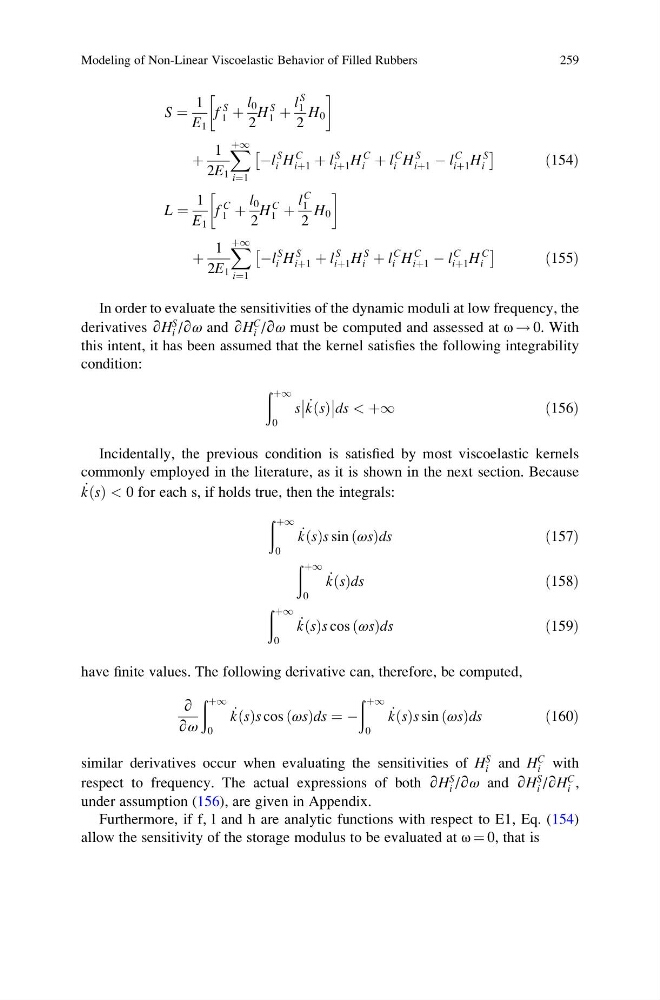
In order to evaluate the sensitivities of the dynamic moduli at low frequency, the
derivatives ∂H
S
i /∂ω and ∂H
C
i /∂ω must be computed and assessed at ω ! 0. With
this intent, it has been assumed that the kernel satisfies the following integrability
condition:
ð þ1
0
s _
k s
ð Þ
ds < þ1
ð156Þ
Incidentally, the previous condition is satisfied by most viscoelastic kernels
commonly employed in the literature, as it is shown in the next section. Because
_
k s
ð Þ < 0 for each s, if holds true, then the integrals:
ð þ1
0
_
k s
ð Þs sin ωs
ð Þds
ð157Þ
ð þ1
0
_
k s
ð Þds
ð158Þ
ð þ1
0
_
k s
ð Þs cos ωs
ð Þds
ð159Þ
have finite values. The following derivative can, therefore, be computed,
∂
∂ω
ð þ1
0
_
k s
ð Þs cos ωs
ð Þds ¼ À
ð þ1
0
_
k s
ð Þs sin ωs
ð Þds
ð160Þ
similar derivatives occur when evaluating the sensitivities of H
S
i and H
C
i with
respect to frequency. The actual expressions of both ∂H
S
i /∂ω and ∂H
S
i /∂H
C
i ,
under assumption (156), are given in Appendix.
Furthermore, if f, l and h are analytic functions with respect to E1, Eq. (154)
allow the sensitivity of the storage modulus to be evaluated at ω ¼ 0, that is
Modeling of Non-Linear Viscoelastic Behavior of Filled Rubbers
259
1
E 1
f
S
1 þ
l 0
2
H
S
1 þ
l
S
1
2
H 0
!
þ
1
2E 1
X þ1
i¼1
Àl
S
i H
C
iþ1 þ l
S
iþ1 H
C
i þ l
C
i H
S
iþ1 À l
C
iþ1 H
S
i
Â
Ã
ð154Þ
L ¼
1
E 1
f
C
1 þ
l 0
2
H
C
1 þ
l
C
1
2
H 0
!
þ
1
2E 1
X þ1
i¼1
Àl
S
i H
S
iþ1 þ l
S
iþ1 H
S
i þ l
C
i H
C
iþ1 À l
C
iþ1 H
C
i
Â
Ã
ð155Þ
In order to evaluate the sensitivities of the dynamic moduli at low frequency, the
derivatives ∂H
S
i /∂ω and ∂H
C
i /∂ω must be computed and assessed at ω ! 0. With
this intent, it has been assumed that the kernel satisfies the following integrability
condition:
ð þ1
0
s _
k s
ð Þ
ds < þ1
ð156Þ
Incidentally, the previous condition is satisfied by most viscoelastic kernels
commonly employed in the literature, as it is shown in the next section. Because
_
k s
ð Þ < 0 for each s, if holds true, then the integrals:
ð þ1
0
_
k s
ð Þs sin ωs
ð Þds
ð157Þ
ð þ1
0
_
k s
ð Þds
ð158Þ
ð þ1
0
_
k s
ð Þs cos ωs
ð Þds
ð159Þ
have finite values. The following derivative can, therefore, be computed,
∂
∂ω
ð þ1
0
_
k s
ð Þs cos ωs
ð Þds ¼ À
ð þ1
0
_
k s
ð Þs sin ωs
ð Þds
ð160Þ
similar derivatives occur when evaluating the sensitivities of H
S
i and H
C
i with
respect to frequency. The actual expressions of both ∂H
S
i /∂ω and ∂H
S
i /∂H
C
i ,
under assumption (156), are given in Appendix.
Furthermore, if f, l and h are analytic functions with respect to E1, Eq. (154)
allow the sensitivity of the storage modulus to be evaluated at ω ¼ 0, that is
Modeling of Non-Linear Viscoelastic Behavior of Filled Rubbers
259