

∂S
∂ω
ω¼0
¼
l 0
2E 1
∂H
S
1
∂ω
ω¼0
þ
1
2E 1
X 1
i¼1
À
∂l
S
i
∂ω
H
C
iþ1 À l
S
i
∂H
C
iþ1
∂ω
þ
∂l
C
iþ1
∂ω
H
C
i þ l
S
iþ1
∂H
C
i
∂ω
!
ω¼0
þ
1
2E 1
X 1
i¼1
∂l
C
i
∂ω
H
S
iþ1 þ l
C
i
∂H
S
iþ1
∂ω
À
∂l
C
iþ1
∂ω
H
S
i À l
C
iþ1
∂H
S
i
∂ω
!
ω¼0
¼ 0
ð161Þ
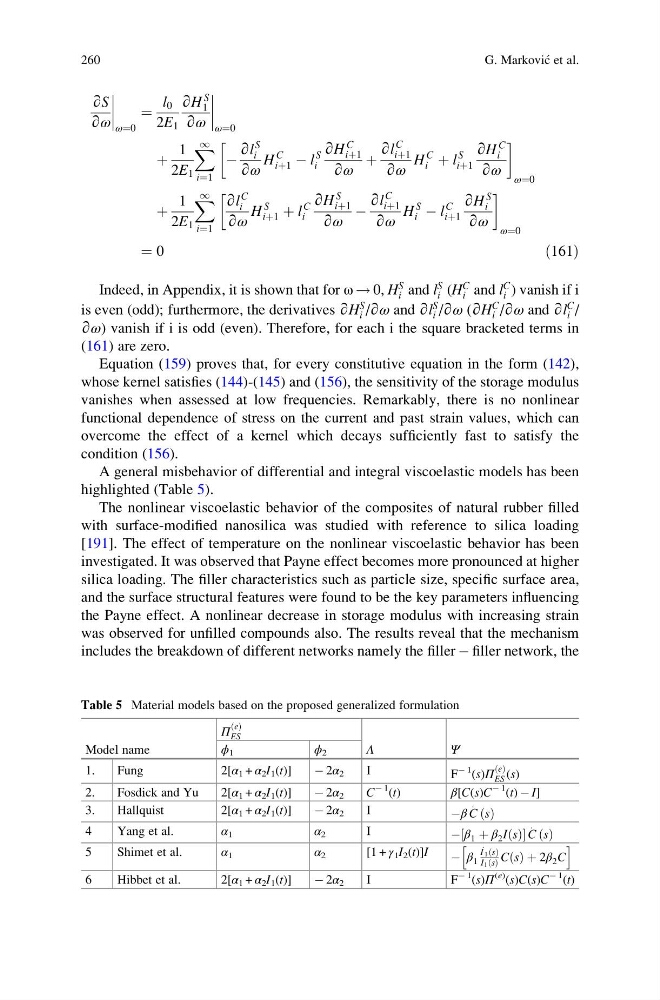
Indeed, in Appendix, it is shown that for ω ! 0, H
S
i and l
S
i (H
C
i and l
C
i ) vanish if i
is even (odd); furthermore, the derivatives ∂H
S
i /∂ω and ∂l
S
i /∂ω (∂H
C
i /∂ω and ∂l
C
i /
∂ω) vanish if i is odd (even). Therefore, for each i the square bracketed terms in
(161) are zero.
Equation (159) proves that, for every constitutive equation in the form (142),
whose kernel satisfies (144)-(145) and (156), the sensitivity of the storage modulus
vanishes when assessed at low frequencies. Remarkably, there is no nonlinear
functional dependence of stress on the current and past strain values, which can
overcome the effect of a kernel which decays sufficiently fast to satisfy the
condition (156).
A general misbehavior of differential and integral viscoelastic models has been
highlighted (Table 5).
The nonlinear viscoelastic behavior of the composites of natural rubber filled
with surface-modified nanosilica was studied with reference to silica loading
[191]. The effect of temperature on the nonlinear viscoelastic behavior has been
investigated. It was observed that Payne effect becomes more pronounced at higher
silica loading. The filler characteristics such as particle size, specific surface area,
and the surface structural features were found to be the key parameters influencing
the Payne effect. A nonlinear decrease in storage modulus with increasing strain
was observed for unfilled compounds also. The results reveal that the mechanism
includes the breakdown of different networks namely the filler À filler network, the
Table 5 Material models based on the proposed generalized formulation
Model name
Π
ðeÞ
ES
Λ
Ψ
ϕ 1
ϕ 2
1.
Fung
2[α 1 + α 2 I 1 (t)]
À 2α 2
I
F
À 1
(s)Π
ðeÞ
ES (s)
2.
Fosdick and Yu
2[α 1 + α 2 I 1 (t)]
À 2α 2
C
À 1
(t)
β[C(s)C
À 1
(t) À I]
3.
Hallquist
2[α 1 + α 2 I 1 (t)]
À 2α 2
I
Àβ C
:
s
ð Þ
4
Yang et al.
α 1
α 2
I
À β 1 þ β 2 I s
ð Þ
½
C
:
s
ð Þ
5
Shimet et al.
α 1
α 2
[1 + γ 1 I 2 (t)]I
À β 1
_
I 1 s
ð Þ
I1 s
ð Þ C s
ð Þ þ 2β 2 C
h
i
6
Hibbet et al.
2[α 1 + α 2 I 1 (t)]
À 2α 2
I
F
À 1
(s)Π
(e) (s)C(s)C
À 1
(t)
260
G. Markovic ´ et al.
∂ω
ω¼0
¼
l 0
2E 1
∂H
S
1
∂ω
ω¼0
þ
1
2E 1
X 1
i¼1
À
∂l
S
i
∂ω
H
C
iþ1 À l
S
i
∂H
C
iþ1
∂ω
þ
∂l
C
iþ1
∂ω
H
C
i þ l
S
iþ1
∂H
C
i
∂ω
!
ω¼0
þ
1
2E 1
X 1
i¼1
∂l
C
i
∂ω
H
S
iþ1 þ l
C
i
∂H
S
iþ1
∂ω
À
∂l
C
iþ1
∂ω
H
S
i À l
C
iþ1
∂H
S
i
∂ω
!
ω¼0
¼ 0
ð161Þ
Indeed, in Appendix, it is shown that for ω ! 0, H
S
i and l
S
i (H
C
i and l
C
i ) vanish if i
is even (odd); furthermore, the derivatives ∂H
S
i /∂ω and ∂l
S
i /∂ω (∂H
C
i /∂ω and ∂l
C
i /
∂ω) vanish if i is odd (even). Therefore, for each i the square bracketed terms in
(161) are zero.
Equation (159) proves that, for every constitutive equation in the form (142),
whose kernel satisfies (144)-(145) and (156), the sensitivity of the storage modulus
vanishes when assessed at low frequencies. Remarkably, there is no nonlinear
functional dependence of stress on the current and past strain values, which can
overcome the effect of a kernel which decays sufficiently fast to satisfy the
condition (156).
A general misbehavior of differential and integral viscoelastic models has been
highlighted (Table 5).
The nonlinear viscoelastic behavior of the composites of natural rubber filled
with surface-modified nanosilica was studied with reference to silica loading
[191]. The effect of temperature on the nonlinear viscoelastic behavior has been
investigated. It was observed that Payne effect becomes more pronounced at higher
silica loading. The filler characteristics such as particle size, specific surface area,
and the surface structural features were found to be the key parameters influencing
the Payne effect. A nonlinear decrease in storage modulus with increasing strain
was observed for unfilled compounds also. The results reveal that the mechanism
includes the breakdown of different networks namely the filler À filler network, the
Table 5 Material models based on the proposed generalized formulation
Model name
Π
ðeÞ
ES
Λ
Ψ
ϕ 1
ϕ 2
1.
Fung
2[α 1 + α 2 I 1 (t)]
À 2α 2
I
F
À 1
(s)Π
ðeÞ
ES (s)
2.
Fosdick and Yu
2[α 1 + α 2 I 1 (t)]
À 2α 2
C
À 1
(t)
β[C(s)C
À 1
(t) À I]
3.
Hallquist
2[α 1 + α 2 I 1 (t)]
À 2α 2
I
Àβ C
:
s
ð Þ
4
Yang et al.
α 1
α 2
I
À β 1 þ β 2 I s
ð Þ
½
C
:
s
ð Þ
5
Shimet et al.
α 1
α 2
[1 + γ 1 I 2 (t)]I
À β 1
_
I 1 s
ð Þ
I1 s
ð Þ C s
ð Þ þ 2β 2 C
h
i
6
Hibbet et al.
2[α 1 + α 2 I 1 (t)]
À 2α 2
I
F
À 1
(s)Π
(e) (s)C(s)C
À 1
(t)
260
G. Markovic ´ et al.