

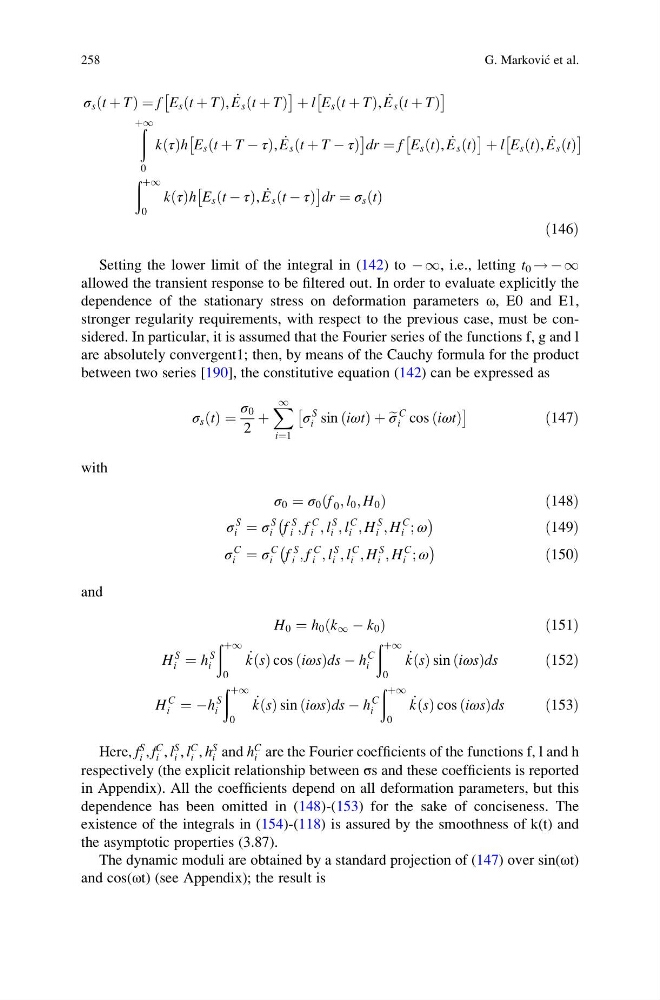
σ s t þ T
ð
Þ¼f E s t þ T
ð
Þ, _
E s t þ T
ð
Þ
Â
à þ l E s t þ T
ð
Þ, _
E s t þ T
ð
Þ
Â
Ã
ð
þ1
0
k τ
ð Þh E s t þ T À τ
ð
Þ , _
E s t þ T À τ
ð
Þ
Â
Ã
dr ¼ f E s t
ð Þ, _
E s t
ð Þ
Â
à þ l E s t
ð Þ, _
E s t
ð Þ
Â
Ã
ð þ1
0
k τ
ð Þh E s t À τ
ð
Þ, _
E s t À τ
ð
Þ
Â
Ã
dr ¼ σ s t
ð Þ
ð146Þ
Setting the lower limit of the integral in (142) to À 1, i.e., letting t 0 ! À 1
allowed the transient response to be filtered out. In order to evaluate explicitly the
dependence of the stationary stress on deformation parameters ω, E0 and E1,
stronger regularity requirements, with respect to the previous case, must be considered. In particular, it is assumed that the Fourier series of the functions f, g and l
are absolutely convergent1; then, by means of the Cauchy formula for the product
between two series [190], the constitutive equation (142) can be expressed as
σ s t
ð Þ ¼
σ 0
2
þ
X 1
i¼1
σ
S
i sin iωt
ð Þþ e
σ
C
i cos iωt
ð Þ
Â
Ã
ð147Þ
with
σ 0 ¼ σ 0 f 0 ; l 0 ; H 0
ð
Þ
ð 148Þ
σ
S
i ¼ σ
S
i f
S
i ; f
C
i ; l
S
i ; l
C
i ; H
S
i ; H
C
i ; ω
À
Á
ð149Þ
σ
C
i ¼ σ
C
i f
S
i ; f
C
i ; l
S
i ; l
C
i ; H
S
i ; H
C
i ; ω
À
Á
ð150Þ
and
H 0 ¼ h 0 k 1 À k 0
ð
Þ
ð 151Þ
H
S
i ¼ h
S
i
ð þ1
0
_
k s
ð Þ cos iωs
ð Þds À h
C
i
ð þ1
0
_
k s
ð Þ sin iωs
ð Þds
ð152Þ
H
C
i ¼ Àh
S
i
ð þ1
0
_
k s
ð Þ sin iωs
ð Þds À h
C
i
ð þ1
0
_
k s
ð Þ cos iωs
ð Þds
ð153Þ
Here, f
S
i , f
C
i , l
S
i , l
C
i , h
S
i and h
C
i are the Fourier coefficients of the functions f, l and h
respectively (the explicit relationship between σs and these coefficients is reported
in Appendix). All the coefficients depend on all deformation parameters, but this
dependence has been omitted in (148)-(153) for the sake of conciseness. The
existence of the integrals in (154)-(118) is assured by the smoothness of k(t) and
the asymptotic properties (3.87).
The dynamic moduli are obtained by a standard projection of (147) over sin(ωt)
and cos(ωt) (see Appendix); the result is
258
G. Markovic ´ et al.
ð
Þ¼f E s t þ T
ð
Þ, _
E s t þ T
ð
Þ
Â
à þ l E s t þ T
ð
Þ, _
E s t þ T
ð
Þ
Â
Ã
ð
þ1
0
k τ
ð Þh E s t þ T À τ
ð
Þ , _
E s t þ T À τ
ð
Þ
Â
Ã
dr ¼ f E s t
ð Þ, _
E s t
ð Þ
Â
à þ l E s t
ð Þ, _
E s t
ð Þ
Â
Ã
ð þ1
0
k τ
ð Þh E s t À τ
ð
Þ, _
E s t À τ
ð
Þ
Â
Ã
dr ¼ σ s t
ð Þ
ð146Þ
Setting the lower limit of the integral in (142) to À 1, i.e., letting t 0 ! À 1
allowed the transient response to be filtered out. In order to evaluate explicitly the
dependence of the stationary stress on deformation parameters ω, E0 and E1,
stronger regularity requirements, with respect to the previous case, must be considered. In particular, it is assumed that the Fourier series of the functions f, g and l
are absolutely convergent1; then, by means of the Cauchy formula for the product
between two series [190], the constitutive equation (142) can be expressed as
σ s t
ð Þ ¼
σ 0
2
þ
X 1
i¼1
σ
S
i sin iωt
ð Þþ e
σ
C
i cos iωt
ð Þ
Â
Ã
ð147Þ
with
σ 0 ¼ σ 0 f 0 ; l 0 ; H 0
ð
Þ
ð 148Þ
σ
S
i ¼ σ
S
i f
S
i ; f
C
i ; l
S
i ; l
C
i ; H
S
i ; H
C
i ; ω
À
Á
ð149Þ
σ
C
i ¼ σ
C
i f
S
i ; f
C
i ; l
S
i ; l
C
i ; H
S
i ; H
C
i ; ω
À
Á
ð150Þ
and
H 0 ¼ h 0 k 1 À k 0
ð
Þ
ð 151Þ
H
S
i ¼ h
S
i
ð þ1
0
_
k s
ð Þ cos iωs
ð Þds À h
C
i
ð þ1
0
_
k s
ð Þ sin iωs
ð Þds
ð152Þ
H
C
i ¼ Àh
S
i
ð þ1
0
_
k s
ð Þ sin iωs
ð Þds À h
C
i
ð þ1
0
_
k s
ð Þ cos iωs
ð Þds
ð153Þ
Here, f
S
i , f
C
i , l
S
i , l
C
i , h
S
i and h
C
i are the Fourier coefficients of the functions f, l and h
respectively (the explicit relationship between σs and these coefficients is reported
in Appendix). All the coefficients depend on all deformation parameters, but this
dependence has been omitted in (148)-(153) for the sake of conciseness. The
existence of the integrals in (154)-(118) is assured by the smoothness of k(t) and
the asymptotic properties (3.87).
The dynamic moduli are obtained by a standard projection of (147) over sin(ωt)
and cos(ωt) (see Appendix); the result is
258
G. Markovic ´ et al.