

S ¼
X 1
i¼0
X i
n¼0
ω
iÀnE
i
1
n! i À n
ð
Þ!
g
i, iÀn E 0
ð Þ
ð 1
À1
sin πs
ð Þ
nþ1
cos πs
ð Þ
iÀn ds
ð139Þ
L ¼
X 1
i¼0
X i
n¼0
ω
iÀnE
i
1
n! i À n
ð
Þ!
g
i, iÀn E 0
ð Þ
ð 1
À1
sin πs
ð Þ
n
cos πs
ð Þ
iÀnþ1 ds
ð140Þ
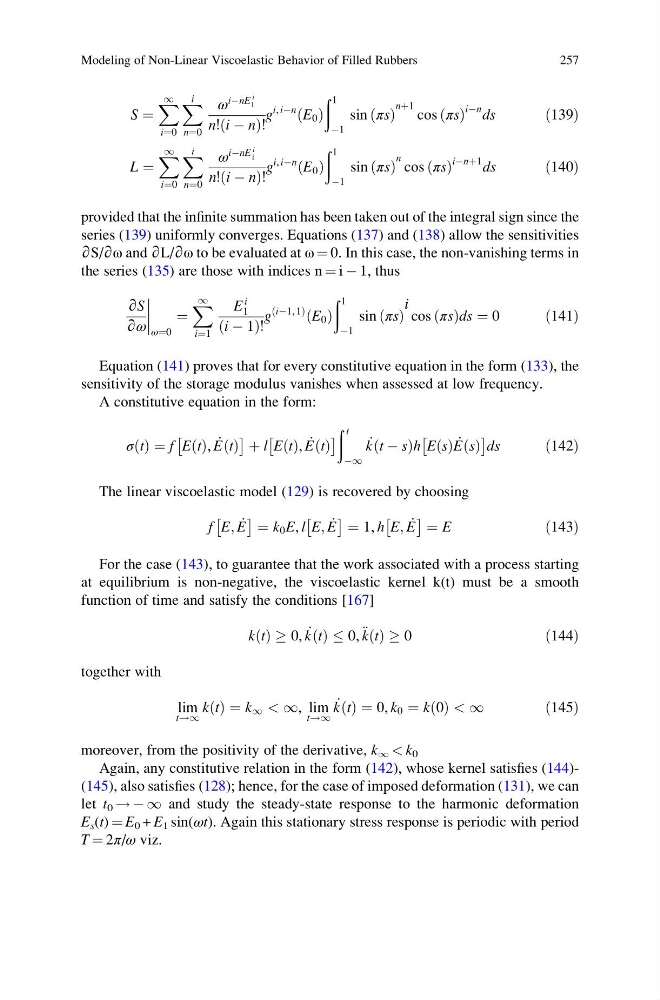
provided that the infinite summation has been taken out of the integral sign since the
series (139) uniformly converges. Equations (137) and (138) allow the sensitivities
∂S/∂ω and ∂L/∂ω to be evaluated at ω ¼ 0. In this case, the non-vanishing terms in
the series (135) are those with indices n ¼ i À 1, thus
∂S
∂ω
ω¼0
¼
X 1
i¼1
E
i
1
i À 1
ð
Þ!
g
iÀ1, 1
ð
Þ E 0
ð Þ
ð 1
À1
sin πs
ð Þ
i
cos πs
ð Þds ¼ 0
ð141Þ
Equation (141) proves that for every constitutive equation in the form (133), the
sensitivity of the storage modulus vanishes when assessed at low frequency.
A constitutive equation in the form:
σ t
ð Þ ¼ f E t
ð Þ, _
E t
ð Þ
Â
à þ l E t
ð Þ, _
E t
ð Þ
Â
Ã
ð t
À1
_
k t À s
ð
Þh E s
ð Þ _
E s
ð Þ
Â
Ã
ds
ð142Þ
The linear viscoelastic model (129) is recovered by choosing
f E; _
E
Â
à ¼ k 0 E, l E; _
E
Â
à ¼ 1, h E; _
E
Â
à ¼ E
ð143Þ
For the case (143), to guarantee that the work associated with a process starting
at equilibrium is non-negative, the viscoelastic kernel k(t) must be a smooth
function of time and satisfy the conditions [167]
k t
ð Þ ! 0, _
k t
ð Þ 0, € k t
ð Þ ! 0
ð144Þ
together with
lim
t!1
k t
ð Þ ¼ k 1 < 1, lim
t!1
_
k t
ð Þ ¼ 0, k 0 ¼ k 0
ð Þ < 1
ð 145Þ
moreover, from the positivity of the derivative, k 1 < k 0
Again, any constitutive relation in the form (142), whose kernel satisfies (144)(145), also satisfies (128); hence, for the case of imposed deformation (131), we can
let t 0 ! À 1 and study the steady-state response to the harmonic deformation
E s (t) ¼ E 0 + E 1 sin(ωt). Again this stationary stress response is periodic with period
T ¼ 2π/ω viz.
Modeling of Non-Linear Viscoelastic Behavior of Filled Rubbers
257
X 1
i¼0
X i
n¼0
ω
iÀnE
i
1
n! i À n
ð
Þ!
g
i, iÀn E 0
ð Þ
ð 1
À1
sin πs
ð Þ
nþ1
cos πs
ð Þ
iÀn ds
ð139Þ
L ¼
X 1
i¼0
X i
n¼0
ω
iÀnE
i
1
n! i À n
ð
Þ!
g
i, iÀn E 0
ð Þ
ð 1
À1
sin πs
ð Þ
n
cos πs
ð Þ
iÀnþ1 ds
ð140Þ
provided that the infinite summation has been taken out of the integral sign since the
series (139) uniformly converges. Equations (137) and (138) allow the sensitivities
∂S/∂ω and ∂L/∂ω to be evaluated at ω ¼ 0. In this case, the non-vanishing terms in
the series (135) are those with indices n ¼ i À 1, thus
∂S
∂ω
ω¼0
¼
X 1
i¼1
E
i
1
i À 1
ð
Þ!
g
iÀ1, 1
ð
Þ E 0
ð Þ
ð 1
À1
sin πs
ð Þ
i
cos πs
ð Þds ¼ 0
ð141Þ
Equation (141) proves that for every constitutive equation in the form (133), the
sensitivity of the storage modulus vanishes when assessed at low frequency.
A constitutive equation in the form:
σ t
ð Þ ¼ f E t
ð Þ, _
E t
ð Þ
Â
à þ l E t
ð Þ, _
E t
ð Þ
Â
Ã
ð t
À1
_
k t À s
ð
Þh E s
ð Þ _
E s
ð Þ
Â
Ã
ds
ð142Þ
The linear viscoelastic model (129) is recovered by choosing
f E; _
E
Â
à ¼ k 0 E, l E; _
E
Â
à ¼ 1, h E; _
E
Â
à ¼ E
ð143Þ
For the case (143), to guarantee that the work associated with a process starting
at equilibrium is non-negative, the viscoelastic kernel k(t) must be a smooth
function of time and satisfy the conditions [167]
k t
ð Þ ! 0, _
k t
ð Þ 0, € k t
ð Þ ! 0
ð144Þ
together with
lim
t!1
k t
ð Þ ¼ k 1 < 1, lim
t!1
_
k t
ð Þ ¼ 0, k 0 ¼ k 0
ð Þ < 1
ð 145Þ
moreover, from the positivity of the derivative, k 1 < k 0
Again, any constitutive relation in the form (142), whose kernel satisfies (144)(145), also satisfies (128); hence, for the case of imposed deformation (131), we can
let t 0 ! À 1 and study the steady-state response to the harmonic deformation
E s (t) ¼ E 0 + E 1 sin(ωt). Again this stationary stress response is periodic with period
T ¼ 2π/ω viz.
Modeling of Non-Linear Viscoelastic Behavior of Filled Rubbers
257