

4.4 Differential Viscoelasticity
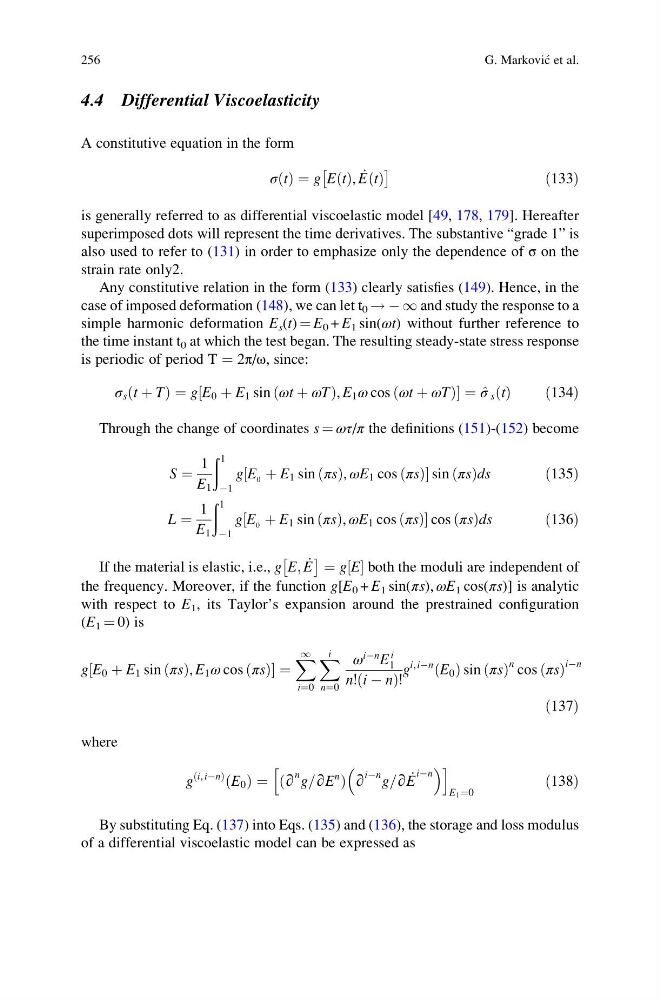
A constitutive equation in the form
σ t
ð Þ ¼ g E t
ð Þ, _
E t
ð Þ
Â
Ã
ð133Þ
is generally referred to as differential viscoelastic model [49, 178, 179]. Hereafter
superimposed dots will represent the time derivatives. The substantive “grade 1” is
also used to refer to (131) in order to emphasize only the dependence of σ on the
strain rate only2.
Any constitutive relation in the form (133) clearly satisfies (149). Hence, in the
case of imposed deformation (148), we can let t 0 ! À 1 and study the response to a
simple harmonic deformation E s (t) ¼ E 0 + E 1 sin(ωt) without further reference to
the time instant t 0 at which the test began. The resulting steady-state stress response
is periodic of period T ¼ 2π/ω, since:
σ s t þ T
ð
Þ¼g E 0 þ E 1 sin ωt þ ωT
ð
Þ , E 1 ω cos ωt þ ωT
ð
Þ
½
¼ ^
σ s t
ð Þ
ð134Þ
Through the change of coordinates s ¼ ωτ/π the definitions (151)-(152) become
S ¼
1
E 1
ð 1
À1
g E 0 þ E 1 sin πs
ð Þ, ωE 1 cos πs
ð Þ
½
sin πs
ð Þds
ð135Þ
L ¼
1
E 1
ð 1
À1
g E 0 þ E 1 sin πs
ð Þ, ωE 1 cos πs
ð Þ
½
cos πs
ð Þds
ð136Þ
If the material is elastic, i.e., g E; _
E
Â
à ¼ g E
½ both the moduli are independent of
the frequency. Moreover, if the function g[E 0 + E 1 sin(πs), ωE 1 cos(πs)] is analytic
with respect to E 1 , its Taylor’s expansion around the prestrained configuration
(E 1 ¼ 0) is
g E 0 þ E 1 sin πs
ð Þ, E 1 ω cos πs
ð Þ
½
¼
X 1
i¼0
X i
n¼0
ω
iÀn E
i
1
n! i À n
ð
Þ!
g
i, iÀn E 0
ð Þsin πs
ð Þ
n cos πs
ð Þ
iÀn
ð137Þ
where
g
i, iÀn
ð
Þ E 0
ð Þ ¼ ∂
n g=∂E
n
ð
Þ ∂
iÀn g=∂ _
E
iÀn
h
i
E 1 ¼0
ð138Þ
By substituting Eq. (137) into Eqs. (135) and (136), the storage and loss modulus
of a differential viscoelastic model can be expressed as
256
G. Markovic ´ et al.
A constitutive equation in the form
σ t
ð Þ ¼ g E t
ð Þ, _
E t
ð Þ
Â
Ã
ð133Þ
is generally referred to as differential viscoelastic model [49, 178, 179]. Hereafter
superimposed dots will represent the time derivatives. The substantive “grade 1” is
also used to refer to (131) in order to emphasize only the dependence of σ on the
strain rate only2.
Any constitutive relation in the form (133) clearly satisfies (149). Hence, in the
case of imposed deformation (148), we can let t 0 ! À 1 and study the response to a
simple harmonic deformation E s (t) ¼ E 0 + E 1 sin(ωt) without further reference to
the time instant t 0 at which the test began. The resulting steady-state stress response
is periodic of period T ¼ 2π/ω, since:
σ s t þ T
ð
Þ¼g E 0 þ E 1 sin ωt þ ωT
ð
Þ , E 1 ω cos ωt þ ωT
ð
Þ
½
¼ ^
σ s t
ð Þ
ð134Þ
Through the change of coordinates s ¼ ωτ/π the definitions (151)-(152) become
S ¼
1
E 1
ð 1
À1
g E 0 þ E 1 sin πs
ð Þ, ωE 1 cos πs
ð Þ
½
sin πs
ð Þds
ð135Þ
L ¼
1
E 1
ð 1
À1
g E 0 þ E 1 sin πs
ð Þ, ωE 1 cos πs
ð Þ
½
cos πs
ð Þds
ð136Þ
If the material is elastic, i.e., g E; _
E
Â
à ¼ g E
½ both the moduli are independent of
the frequency. Moreover, if the function g[E 0 + E 1 sin(πs), ωE 1 cos(πs)] is analytic
with respect to E 1 , its Taylor’s expansion around the prestrained configuration
(E 1 ¼ 0) is
g E 0 þ E 1 sin πs
ð Þ, E 1 ω cos πs
ð Þ
½
¼
X 1
i¼0
X i
n¼0
ω
iÀn E
i
1
n! i À n
ð
Þ!
g
i, iÀn E 0
ð Þsin πs
ð Þ
n cos πs
ð Þ
iÀn
ð137Þ
where
g
i, iÀn
ð
Þ E 0
ð Þ ¼ ∂
n g=∂E
n
ð
Þ ∂
iÀn g=∂ _
E
iÀn
h
i
E 1 ¼0
ð138Þ
By substituting Eq. (137) into Eqs. (135) and (136), the storage and loss modulus
of a differential viscoelastic model can be expressed as
256
G. Markovic ´ et al.