

σ t
ð Þ ¼ Àp t
ð ÞI þ ψ 1 t
ð ÞB t
ð Þ þ ψ 2 t
ð ÞB t
ð Þ
2
þ
X 2
i¼1
SYM F t
ð Þ
ð t
0
k t À s
ð
Þψ i s
ð ÞC s
ð Þ
i ds
!
F
À1 t
ð Þ
&
'
ð131Þ
where p t
ð Þ ¼ _
p t
ð Þ þ
ð 7
0
_
k t À s
ð
Þ_ p s
ð Þds is arbitrary and remains to be determined
from initial/ boundary conditions.
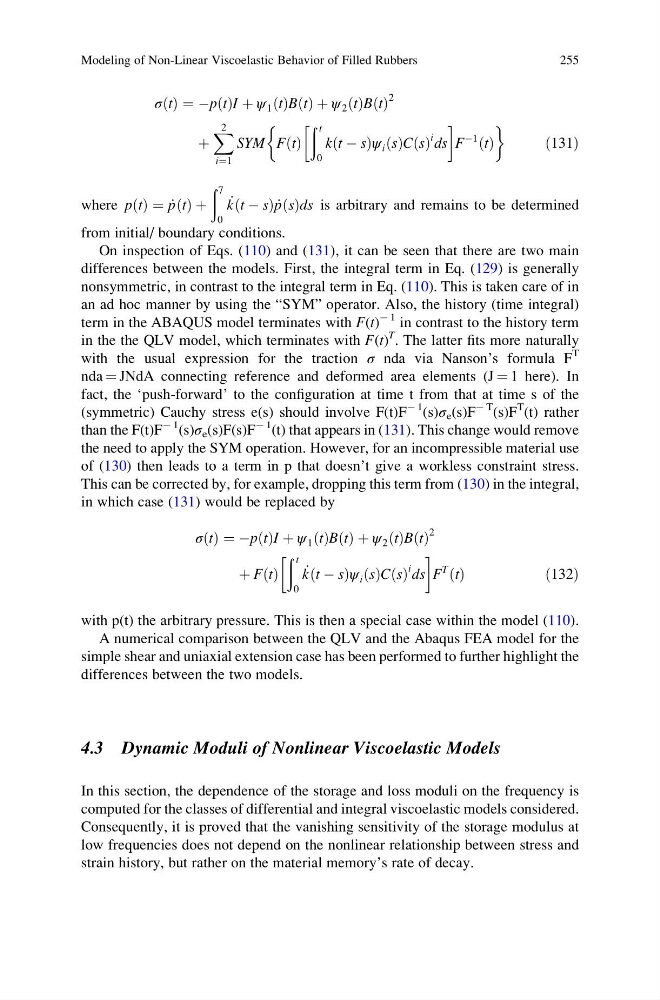
On inspection of Eqs. (110) and (131), it can be seen that there are two main
differences between the models. First, the integral term in Eq. (129) is generally
nonsymmetric, in contrast to the integral term in Eq. (110). This is taken care of in
an ad hoc manner by using the “SYM” operator. Also, the history (time integral)
term in the ABAQUS model terminates with F(t)
À 1 in contrast to the history term
in the the QLV model, which terminates with F(t)
T
. The latter fits more naturally
with the usual expression for the traction σ nda via Nanson’s formula F
T
nda ¼ JNdA connecting reference and deformed area elements (J ¼ 1 here). In
fact, the ‘push-forward’ to the configuration at time t from that at time s of the
(symmetric) Cauchy stress e(s) should involve F(t)F
À 1 (s)σ e (s)F
À T (s)F
T (t) rather
than the F(t)F
À 1 (s)σ e (s)F(s)F
À 1 (t) that appears in (131). This change would remove
the need to apply the SYM operation. However, for an incompressible material use
of (130) then leads to a term in p that doesn’t give a workless constraint stress.
This can be corrected by, for example, dropping this term from (130) in the integral,
in which case (131) would be replaced by
σ t
ð Þ ¼ Àp t
ð ÞI þ ψ 1 t
ð ÞB t
ð Þ þ ψ 2 t
ð ÞB t
ð Þ
2
þ F t
ð Þ
ð t
0
_
k t À s
ð
Þψ i s
ð ÞC s
ð Þ
i ds
!
F
T t
ð Þ
ð132Þ
with p(t) the arbitrary pressure. This is then a special case within the model (110).
A numerical comparison between the QLV and the Abaqus FEA model for the
simple shear and uniaxial extension case has been performed to further highlight the
differences between the two models.
4.3 Dynamic Moduli of Nonlinear Viscoelastic Models
In this section, the dependence of the storage and loss moduli on the frequency is
computed for the classes of differential and integral viscoelastic models considered.
Consequently, it is proved that the vanishing sensitivity of the storage modulus at
low frequencies does not depend on the nonlinear relationship between stress and
strain history, but rather on the material memory’s rate of decay.
Modeling of Non-Linear Viscoelastic Behavior of Filled Rubbers
255
ð Þ ¼ Àp t
ð ÞI þ ψ 1 t
ð ÞB t
ð Þ þ ψ 2 t
ð ÞB t
ð Þ
2
þ
X 2
i¼1
SYM F t
ð Þ
ð t
0
k t À s
ð
Þψ i s
ð ÞC s
ð Þ
i ds
!
F
À1 t
ð Þ
&
'
ð131Þ
where p t
ð Þ ¼ _
p t
ð Þ þ
ð 7
0
_
k t À s
ð
Þ_ p s
ð Þds is arbitrary and remains to be determined
from initial/ boundary conditions.
On inspection of Eqs. (110) and (131), it can be seen that there are two main
differences between the models. First, the integral term in Eq. (129) is generally
nonsymmetric, in contrast to the integral term in Eq. (110). This is taken care of in
an ad hoc manner by using the “SYM” operator. Also, the history (time integral)
term in the ABAQUS model terminates with F(t)
À 1 in contrast to the history term
in the the QLV model, which terminates with F(t)
T
. The latter fits more naturally
with the usual expression for the traction σ nda via Nanson’s formula F
T
nda ¼ JNdA connecting reference and deformed area elements (J ¼ 1 here). In
fact, the ‘push-forward’ to the configuration at time t from that at time s of the
(symmetric) Cauchy stress e(s) should involve F(t)F
À 1 (s)σ e (s)F
À T (s)F
T (t) rather
than the F(t)F
À 1 (s)σ e (s)F(s)F
À 1 (t) that appears in (131). This change would remove
the need to apply the SYM operation. However, for an incompressible material use
of (130) then leads to a term in p that doesn’t give a workless constraint stress.
This can be corrected by, for example, dropping this term from (130) in the integral,
in which case (131) would be replaced by
σ t
ð Þ ¼ Àp t
ð ÞI þ ψ 1 t
ð ÞB t
ð Þ þ ψ 2 t
ð ÞB t
ð Þ
2
þ F t
ð Þ
ð t
0
_
k t À s
ð
Þψ i s
ð ÞC s
ð Þ
i ds
!
F
T t
ð Þ
ð132Þ
with p(t) the arbitrary pressure. This is then a special case within the model (110).
A numerical comparison between the QLV and the Abaqus FEA model for the
simple shear and uniaxial extension case has been performed to further highlight the
differences between the two models.
4.3 Dynamic Moduli of Nonlinear Viscoelastic Models
In this section, the dependence of the storage and loss moduli on the frequency is
computed for the classes of differential and integral viscoelastic models considered.
Consequently, it is proved that the vanishing sensitivity of the storage modulus at
low frequencies does not depend on the nonlinear relationship between stress and
strain history, but rather on the material memory’s rate of decay.
Modeling of Non-Linear Viscoelastic Behavior of Filled Rubbers
255