

σ 12 t
ð Þ ¼ θ
_
1 t
ð Þγ
2 t
ð Þ þ
ð 1
0
_
k t À s
ð
Þγ s
ð Þ À γ t
ð Þ
½
2 ds
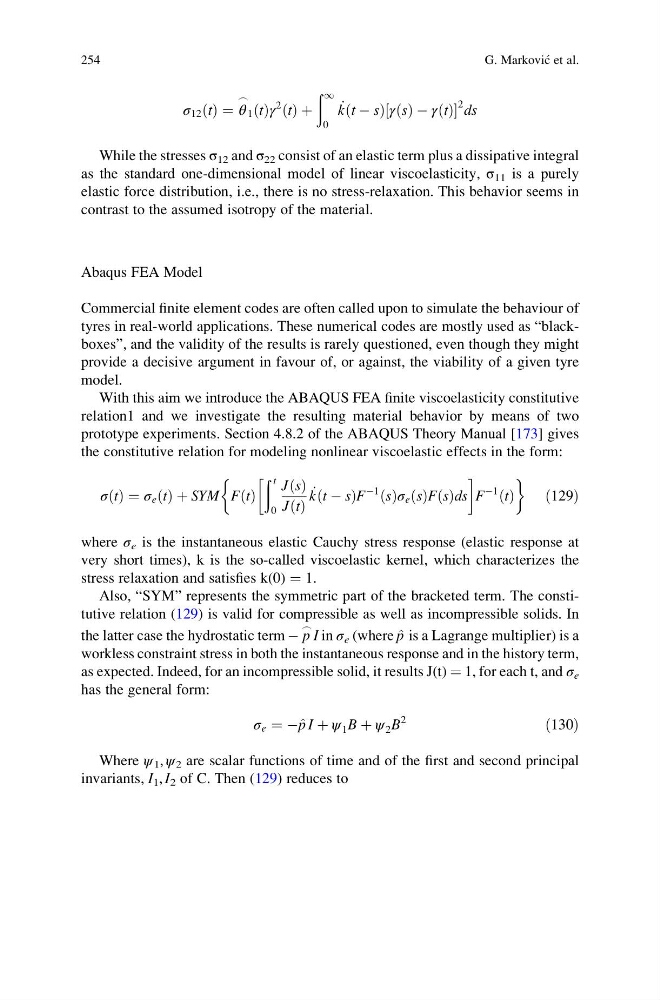
While the stresses σ 12 and σ 22 consist of an elastic term plus a dissipative integral
as the standard one-dimensional model of linear viscoelasticity, σ 11 is a purely
elastic force distribution, i.e., there is no stress-relaxation. This behavior seems in
contrast to the assumed isotropy of the material.
Abaqus FEA Model
Commercial finite element codes are often called upon to simulate the behaviour of
tyres in real-world applications. These numerical codes are mostly used as “blackboxes”, and the validity of the results is rarely questioned, even though they might
provide a decisive argument in favour of, or against, the viability of a given tyre
model.
With this aim we introduce the ABAQUS FEA finite viscoelasticity constitutive
relation1 and we investigate the resulting material behavior by means of two
prototype experiments. Section 4.8.2 of the ABAQUS Theory Manual [173] gives
the constitutive relation for modeling nonlinear viscoelastic effects in the form:
σ t
ð Þ ¼ σ e t
ð Þ þ SYM F t
ð Þ
ð t
0
J s
ð Þ
J t
ð Þ
_
k t À s
ð
ÞF
À1 s
ð Þσ e s
ð ÞF s
ð Þds
!
F
À1 t
ð Þ
&
'
ð129Þ
where σ e is the instantaneous elastic Cauchy stress response (elastic response at
very short times), k is the so-called viscoelastic kernel, which characterizes the
stress relaxation and satisfies k(0) ¼ 1.
Also, “SYM” represents the symmetric part of the bracketed term. The constitutive relation (129) is valid for compressible as well as incompressible solids. In
the latter case the hydrostatic term À p
_ I in σ e (where ^
p is a Lagrange multiplier) is a
workless constraint stress in both the instantaneous response and in the history term,
as expected. Indeed, for an incompressible solid, it results J(t) ¼ 1, for each t, and σ e
has the general form:
σ e ¼ À^ p I þ ψ 1 B þ ψ 2 B
2
ð130Þ
Where ψ 1 , ψ 2 are scalar functions of time and of the first and second principal
invariants, I 1 , I 2 of C. Then (129) reduces to
254
G. Markovic ´ et al.
ð Þ ¼ θ
_
1 t
ð Þγ
2 t
ð Þ þ
ð 1
0
_
k t À s
ð
Þγ s
ð Þ À γ t
ð Þ
½
2 ds
While the stresses σ 12 and σ 22 consist of an elastic term plus a dissipative integral
as the standard one-dimensional model of linear viscoelasticity, σ 11 is a purely
elastic force distribution, i.e., there is no stress-relaxation. This behavior seems in
contrast to the assumed isotropy of the material.
Abaqus FEA Model
Commercial finite element codes are often called upon to simulate the behaviour of
tyres in real-world applications. These numerical codes are mostly used as “blackboxes”, and the validity of the results is rarely questioned, even though they might
provide a decisive argument in favour of, or against, the viability of a given tyre
model.
With this aim we introduce the ABAQUS FEA finite viscoelasticity constitutive
relation1 and we investigate the resulting material behavior by means of two
prototype experiments. Section 4.8.2 of the ABAQUS Theory Manual [173] gives
the constitutive relation for modeling nonlinear viscoelastic effects in the form:
σ t
ð Þ ¼ σ e t
ð Þ þ SYM F t
ð Þ
ð t
0
J s
ð Þ
J t
ð Þ
_
k t À s
ð
ÞF
À1 s
ð Þσ e s
ð ÞF s
ð Þds
!
F
À1 t
ð Þ
&
'
ð129Þ
where σ e is the instantaneous elastic Cauchy stress response (elastic response at
very short times), k is the so-called viscoelastic kernel, which characterizes the
stress relaxation and satisfies k(0) ¼ 1.
Also, “SYM” represents the symmetric part of the bracketed term. The constitutive relation (129) is valid for compressible as well as incompressible solids. In
the latter case the hydrostatic term À p
_ I in σ e (where ^
p is a Lagrange multiplier) is a
workless constraint stress in both the instantaneous response and in the history term,
as expected. Indeed, for an incompressible solid, it results J(t) ¼ 1, for each t, and σ e
has the general form:
σ e ¼ À^ p I þ ψ 1 B þ ψ 2 B
2
ð130Þ
Where ψ 1 , ψ 2 are scalar functions of time and of the first and second principal
invariants, I 1 , I 2 of C. Then (129) reduces to
254
G. Markovic ´ et al.