

T t
ð Þ ¼ q t
ð ÞC
À1 t
ð Þ þ θ 0 t
ð ÞI þ θ 1 t
ð ÞC t
ð Þ
þ F
À1 t
ð ÞF
ÀT t
ð Þ
ð t
0
_
k t À s
ð
ÞC s
ð Þ
½
ds
&
'
F
À1 t
ð Þ
ð125Þ
or in terms of Cauchy stress,
σ t
ð Þ ¼ q
_ t
ð ÞI þ θ
_
0 t
ð ÞB t
ð Þ þ θ
_
1 t
ð ÞB
2 t
ð Þ
þ F
ÀT t
ð Þ
ð t
0
_
k t À s
ð
ÞC s
ð Þ
½
ds
&
'
F
À1 t
ð Þ
ð126Þ
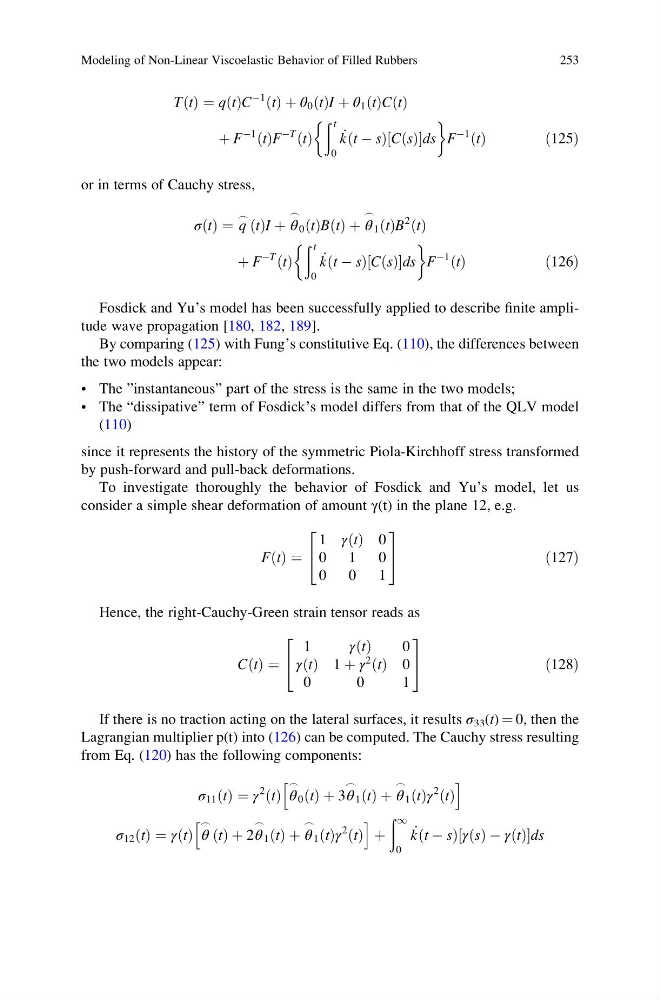
Fosdick and Yu’s model has been successfully applied to describe finite amplitude wave propagation [180, 182, 189].
By comparing (125) with Fung’s constitutive Eq. (110), the differences between
the two models appear:
• The ”instantaneous” part of the stress is the same in the two models;
• The “dissipative” term of Fosdick’s model differs from that of the QLV model
(110)
since it represents the history of the symmetric Piola-Kirchhoff stress transformed
by push-forward and pull-back deformations.
To investigate thoroughly the behavior of Fosdick and Yu’s model, let us
consider a simple shear deformation of amount γ(t) in the plane 12, e.g.
F t
ð Þ ¼
1 γ t
ð Þ 0
0 1
0
0 0
1
2
4
3
5
ð127Þ
Hence, the right-Cauchy-Green strain tensor reads as
C t
ð Þ ¼
1
γ t
ð Þ
0
γ t
ð Þ 1 þ γ
2 t
ð Þ 0
0
0
1
2
4
3
5
ð128Þ
If there is no traction acting on the lateral surfaces, it results σ 33 (t) ¼ 0, then the
Lagrangian multiplier p(t) into (126) can be computed. The Cauchy stress resulting
from Eq. (120) has the following components:
σ 11 t
ð Þ ¼ γ
2 t
ð Þ θ
_
0 t
ð Þ þ 3θ
_
1 t
ð Þ þ θ
_
1 t
ð Þγ
2 t
ð Þ
h
i
σ 12 t
ð Þ ¼ γ t
ð Þ θ
_
t
ð Þ þ 2θ
_
1 t
ð Þ þ θ
_
1 t
ð Þγ
2 t
ð Þ
h
i
þ
ð 1
0
_
k t À s
ð
Þγ s
ð Þ À γ t
ð Þ
½
ds
Modeling of Non-Linear Viscoelastic Behavior of Filled Rubbers
253
ð Þ ¼ q t
ð ÞC
À1 t
ð Þ þ θ 0 t
ð ÞI þ θ 1 t
ð ÞC t
ð Þ
þ F
À1 t
ð ÞF
ÀT t
ð Þ
ð t
0
_
k t À s
ð
ÞC s
ð Þ
½
ds
&
'
F
À1 t
ð Þ
ð125Þ
or in terms of Cauchy stress,
σ t
ð Þ ¼ q
_ t
ð ÞI þ θ
_
0 t
ð ÞB t
ð Þ þ θ
_
1 t
ð ÞB
2 t
ð Þ
þ F
ÀT t
ð Þ
ð t
0
_
k t À s
ð
ÞC s
ð Þ
½
ds
&
'
F
À1 t
ð Þ
ð126Þ
Fosdick and Yu’s model has been successfully applied to describe finite amplitude wave propagation [180, 182, 189].
By comparing (125) with Fung’s constitutive Eq. (110), the differences between
the two models appear:
• The ”instantaneous” part of the stress is the same in the two models;
• The “dissipative” term of Fosdick’s model differs from that of the QLV model
(110)
since it represents the history of the symmetric Piola-Kirchhoff stress transformed
by push-forward and pull-back deformations.
To investigate thoroughly the behavior of Fosdick and Yu’s model, let us
consider a simple shear deformation of amount γ(t) in the plane 12, e.g.
F t
ð Þ ¼
1 γ t
ð Þ 0
0 1
0
0 0
1
2
4
3
5
ð127Þ
Hence, the right-Cauchy-Green strain tensor reads as
C t
ð Þ ¼
1
γ t
ð Þ
0
γ t
ð Þ 1 þ γ
2 t
ð Þ 0
0
0
1
2
4
3
5
ð128Þ
If there is no traction acting on the lateral surfaces, it results σ 33 (t) ¼ 0, then the
Lagrangian multiplier p(t) into (126) can be computed. The Cauchy stress resulting
from Eq. (120) has the following components:
σ 11 t
ð Þ ¼ γ
2 t
ð Þ θ
_
0 t
ð Þ þ 3θ
_
1 t
ð Þ þ θ
_
1 t
ð Þγ
2 t
ð Þ
h
i
σ 12 t
ð Þ ¼ γ t
ð Þ θ
_
t
ð Þ þ 2θ
_
1 t
ð Þ þ θ
_
1 t
ð Þγ
2 t
ð Þ
h
i
þ
ð 1
0
_
k t À s
ð
Þγ s
ð Þ À γ t
ð Þ
½
ds
Modeling of Non-Linear Viscoelastic Behavior of Filled Rubbers
253