

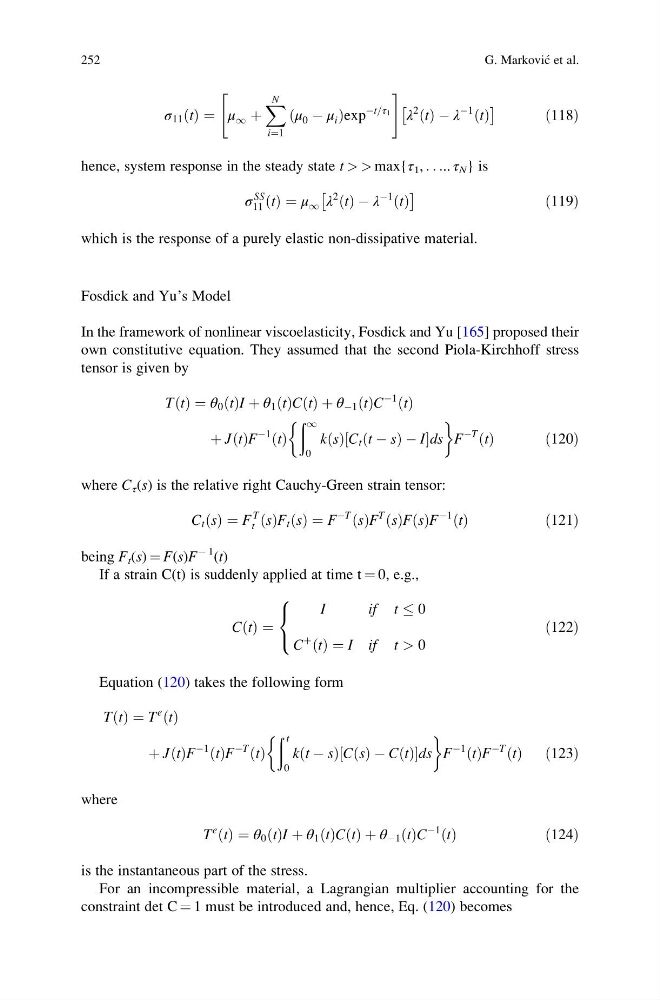
σ 11 t
ð Þ ¼ μ 1 þ
X N
i¼1
μ 0 À μ i
ð
Þexp
Àt=τ 1
"
#
λ
2 t
ð Þ À λ
À1 t
ð Þ
Â
Ã
ð118Þ
hence, system response in the steady state t > > max{τ 1 , . . ... τ N } is
σ
SS
11 t
ð Þ ¼ μ 1 λ
2 t
ð Þ À λ
À1 t
ð Þ
Â
Ã
ð119Þ
which is the response of a purely elastic non-dissipative material.
Fosdick and Yu’s Model
In the framework of nonlinear viscoelasticity, Fosdick and Yu [165] proposed their
own constitutive equation. They assumed that the second Piola-Kirchhoff stress
tensor is given by
T t
ð Þ ¼ θ 0 t
ð ÞI þ θ 1 t
ð ÞC t
ð Þ þ θ À1 t
ð ÞC
À1 t
ð Þ
þ J t
ð ÞF
À1 t
ð Þ
ð 1
0
k s
ð Þ C t t À s
ð
ÞÀI
½
ds
&
'
F
ÀT t
ð Þ
ð120Þ
where C τ (s) is the relative right Cauchy-Green strain tensor:
C t s
ð Þ ¼ F
T
t s
ð ÞF t s
ð Þ ¼ F
ÀT s
ð ÞF
T s
ð ÞF s
ð ÞF
À1 t
ð Þ
ð121Þ
being F t (s) ¼ F(s)F
À 1 (t)
If a strain C(t) is suddenly applied at time t ¼ 0, e.g.,
C t
ð Þ ¼
I
if t 0
C
þ t
ð Þ ¼ I if t > 0
8
<
:
ð122Þ
Equation (120) takes the following form
T t
ð Þ ¼ T
e t
ð Þ
þ J t
ð ÞF
À1 t
ð ÞF
ÀT t
ð Þ
ð t
0
k t À s
ð
ÞC s
ð Þ À C t
ð Þ
½
ds
&
'
F
À1 t
ð ÞF
ÀT t
ð Þ
ð123Þ
where
T
e t
ð Þ ¼ θ 0 t
ð ÞI þ θ 1 t
ð ÞC t
ð Þ þ θ À1 t
ð ÞC
À1 t
ð Þ
ð124Þ
is the instantaneous part of the stress.
For an incompressible material, a Lagrangian multiplier accounting for the
constraint det C ¼ 1 must be introduced and, hence, Eq. (120) becomes
252
G. Markovic ´ et al.
ð Þ ¼ μ 1 þ
X N
i¼1
μ 0 À μ i
ð
Þexp
Àt=τ 1
"
#
λ
2 t
ð Þ À λ
À1 t
ð Þ
Â
Ã
ð118Þ
hence, system response in the steady state t > > max{τ 1 , . . ... τ N } is
σ
SS
11 t
ð Þ ¼ μ 1 λ
2 t
ð Þ À λ
À1 t
ð Þ
Â
Ã
ð119Þ
which is the response of a purely elastic non-dissipative material.
Fosdick and Yu’s Model
In the framework of nonlinear viscoelasticity, Fosdick and Yu [165] proposed their
own constitutive equation. They assumed that the second Piola-Kirchhoff stress
tensor is given by
T t
ð Þ ¼ θ 0 t
ð ÞI þ θ 1 t
ð ÞC t
ð Þ þ θ À1 t
ð ÞC
À1 t
ð Þ
þ J t
ð ÞF
À1 t
ð Þ
ð 1
0
k s
ð Þ C t t À s
ð
ÞÀI
½
ds
&
'
F
ÀT t
ð Þ
ð120Þ
where C τ (s) is the relative right Cauchy-Green strain tensor:
C t s
ð Þ ¼ F
T
t s
ð ÞF t s
ð Þ ¼ F
ÀT s
ð ÞF
T s
ð ÞF s
ð ÞF
À1 t
ð Þ
ð121Þ
being F t (s) ¼ F(s)F
À 1 (t)
If a strain C(t) is suddenly applied at time t ¼ 0, e.g.,
C t
ð Þ ¼
I
if t 0
C
þ t
ð Þ ¼ I if t > 0
8
<
:
ð122Þ
Equation (120) takes the following form
T t
ð Þ ¼ T
e t
ð Þ
þ J t
ð ÞF
À1 t
ð ÞF
ÀT t
ð Þ
ð t
0
k t À s
ð
ÞC s
ð Þ À C t
ð Þ
½
ds
&
'
F
À1 t
ð ÞF
ÀT t
ð Þ
ð123Þ
where
T
e t
ð Þ ¼ θ 0 t
ð ÞI þ θ 1 t
ð ÞC t
ð Þ þ θ À1 t
ð ÞC
À1 t
ð Þ
ð124Þ
is the instantaneous part of the stress.
For an incompressible material, a Lagrangian multiplier accounting for the
constraint det C ¼ 1 must be introduced and, hence, Eq. (120) becomes
252
G. Markovic ´ et al.