

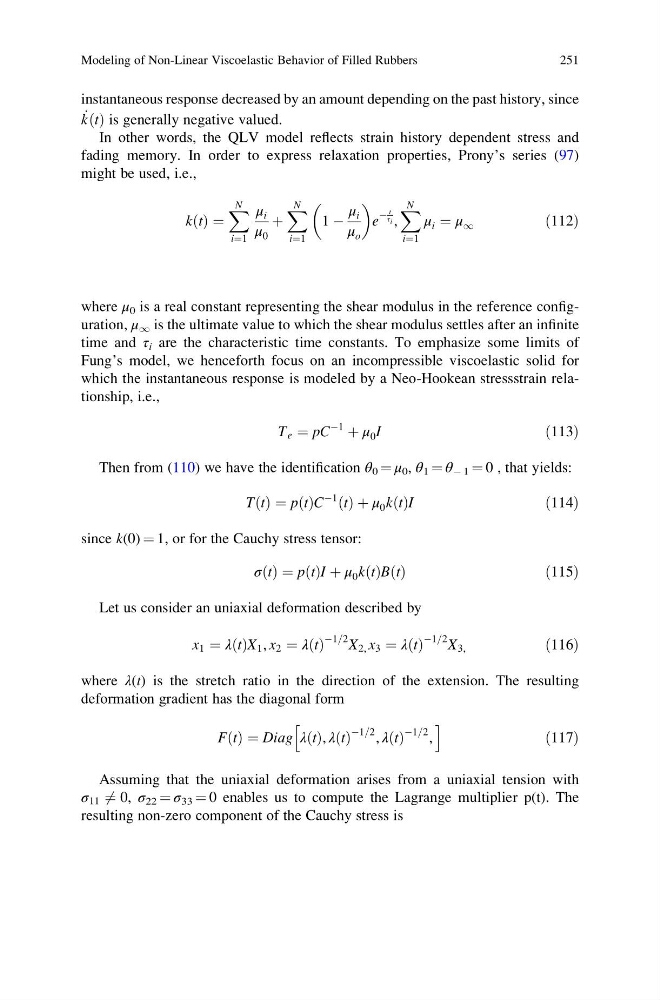
instantaneous response decreased by an amount depending on the past history, since
_
k t
ð Þ is generally negative valued.
In other words, the QLV model reflects strain history dependent stress and
fading memory. In order to express relaxation properties, Prony’s series (97)
might be used, i.e.,
k t
ð Þ ¼
X N
i¼1
μ i
μ 0
þ
X N
i¼1
1 À
μ i
μ o
e
À
t
τ i ,
X N
i¼1
μ i ¼ μ 1
ð112Þ
where μ 0 is a real constant representing the shear modulus in the reference configuration, μ 1 is the ultimate value to which the shear modulus settles after an infinite
time and τ i are the characteristic time constants. To emphasize some limits of
Fung’s model, we henceforth focus on an incompressible viscoelastic solid for
which the instantaneous response is modeled by a Neo-Hookean stressstrain relationship, i.e.,
T e ¼ pC
À1
þ μ 0 I
ð113Þ
Then from (110) we have the identification θ 0 ¼ μ 0 , θ 1 ¼ θ À 1 ¼ 0 , that yields:
T t
ð Þ ¼ p t
ð ÞC
À1 t
ð Þ þ μ 0 k t
ð ÞI
ð114Þ
since k(0) ¼ 1, or for the Cauchy stress tensor:
σ t
ð Þ ¼ p t
ð ÞI þ μ 0 k t
ð ÞB t
ð Þ
ð115Þ
Let us consider an uniaxial deformation described by
x 1 ¼ λ t
ð ÞX 1 , x 2 ¼ λ t
ð Þ
À1=2 X 2, x 3 ¼ λ t
ð Þ
À1=2 X 3,
ð116Þ
where λ(t) is the stretch ratio in the direction of the extension. The resulting
deformation gradient has the diagonal form
F t
ð Þ ¼ Diag λ t
ð Þ, λ t
ð Þ
À1=2 , λ t
ð Þ
À1=2 ,
h
i
ð117Þ
Assuming that the uniaxial deformation arises from a uniaxial tension with
σ 11 6 ¼ 0, σ 22 ¼ σ 33 ¼ 0 enables us to compute the Lagrange multiplier p(t). The
resulting non-zero component of the Cauchy stress is
Modeling of Non-Linear Viscoelastic Behavior of Filled Rubbers
251
_
k t
ð Þ is generally negative valued.
In other words, the QLV model reflects strain history dependent stress and
fading memory. In order to express relaxation properties, Prony’s series (97)
might be used, i.e.,
k t
ð Þ ¼
X N
i¼1
μ i
μ 0
þ
X N
i¼1
1 À
μ i
μ o
e
À
t
τ i ,
X N
i¼1
μ i ¼ μ 1
ð112Þ
where μ 0 is a real constant representing the shear modulus in the reference configuration, μ 1 is the ultimate value to which the shear modulus settles after an infinite
time and τ i are the characteristic time constants. To emphasize some limits of
Fung’s model, we henceforth focus on an incompressible viscoelastic solid for
which the instantaneous response is modeled by a Neo-Hookean stressstrain relationship, i.e.,
T e ¼ pC
À1
þ μ 0 I
ð113Þ
Then from (110) we have the identification θ 0 ¼ μ 0 , θ 1 ¼ θ À 1 ¼ 0 , that yields:
T t
ð Þ ¼ p t
ð ÞC
À1 t
ð Þ þ μ 0 k t
ð ÞI
ð114Þ
since k(0) ¼ 1, or for the Cauchy stress tensor:
σ t
ð Þ ¼ p t
ð ÞI þ μ 0 k t
ð ÞB t
ð Þ
ð115Þ
Let us consider an uniaxial deformation described by
x 1 ¼ λ t
ð ÞX 1 , x 2 ¼ λ t
ð Þ
À1=2 X 2, x 3 ¼ λ t
ð Þ
À1=2 X 3,
ð116Þ
where λ(t) is the stretch ratio in the direction of the extension. The resulting
deformation gradient has the diagonal form
F t
ð Þ ¼ Diag λ t
ð Þ, λ t
ð Þ
À1=2 , λ t
ð Þ
À1=2 ,
h
i
ð117Þ
Assuming that the uniaxial deformation arises from a uniaxial tension with
σ 11 6 ¼ 0, σ 22 ¼ σ 33 ¼ 0 enables us to compute the Lagrange multiplier p(t). The
resulting non-zero component of the Cauchy stress is
Modeling of Non-Linear Viscoelastic Behavior of Filled Rubbers
251