

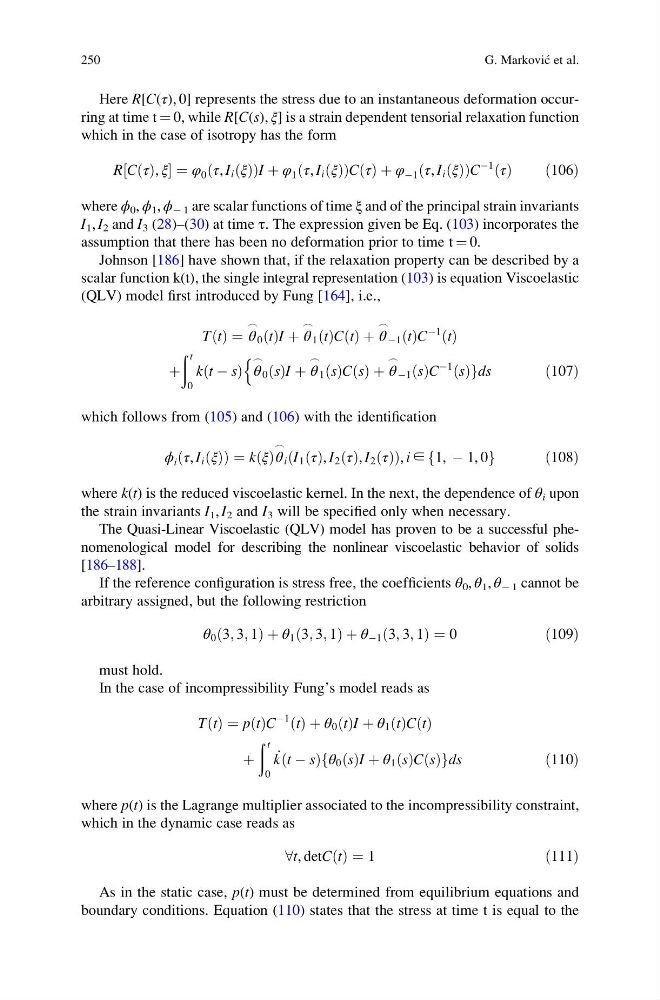
Here R[C(τ), 0] represents the stress due to an instantaneous deformation occurring at time t ¼ 0, while R[C(s), ξ] is a strain dependent tensorial relaxation function
which in the case of isotropy has the form
R C τ
ð Þ, ξ
½
¼φ 0 τ, I i ξ
ð Þ
ð
ÞI þ φ 1 τ, I i ξ
ð Þ
ð
ÞC τ
ð Þ þ φ À1 τ, I i ξ
ð Þ
ð
ÞC
À1
τ
ð Þ
ð106Þ
where ϕ 0 , ϕ 1 , ϕ À 1 are scalar functions of time ξ and of the principal strain invariants
I 1 , I 2 and I 3 (28)–(30) at time τ. The expression given be Eq. (103) incorporates the
assumption that there has been no deformation prior to time t ¼ 0.
Johnson [186] have shown that, if the relaxation property can be described by a
scalar function k(t), the single integral representation (103) is equation Viscoelastic
(QLV) model first introduced by Fung [164], i.e.,
T t
ð Þ ¼ θ
_
0 t
ð ÞI þ θ
_
1 t
ð ÞC t
ð Þ þ θ
_
À1 t
ð ÞC
À1 t
ð Þ
þ
ð t
0
k t À s
ð
Þ θ
_
0
n
s
ð ÞI þ θ
_
1 s
ð ÞC s
ð Þ þ θ
_
À1 s
ð ÞC
À1 s
ð Þgds
ð107Þ
which follows from (105) and (106) with the identification
ϕ i τ, I i ξ
ð Þ
ð
Þ¼k ξ
ð Þθ
_
i I 1 τ
ð Þ, I 2 τ
ð Þ, I 2 τ
ð Þ
ð
Þ , i ∈ 1, À 1, 0
f
g
ð108Þ
where k(t) is the reduced viscoelastic kernel. In the next, the dependence of θ i upon
the strain invariants I 1 , I 2 and I 3 will be specified only when necessary.
The Quasi-Linear Viscoelastic (QLV) model has proven to be a successful phenomenological model for describing the nonlinear viscoelastic behavior of solids
[186–188].
If the reference configuration is stress free, the coefficients θ 0 , θ 1 , θ À 1 cannot be
arbitrary assigned, but the following restriction
θ 0 3; 3; 1
ð
Þþθ 1 3; 3; 1
ð
Þþθ À1 3; 3; 1
ð
Þ¼0
ð109Þ
must hold.
In the case of incompressibility Fung’s model reads as
T t
ð Þ ¼ p t
ð ÞC
À1 t
ð Þ þ θ 0 t
ð ÞI þ θ 1 t
ð ÞC t
ð Þ
þ
ð t
0
_
k t À s
ð
Þ θ 0 s
ð ÞI þ θ 1 s
ð ÞC s
ð Þ
f
g ds
ð110Þ
where p(t) is the Lagrange multiplier associated to the incompressibility constraint,
which in the dynamic case reads as
8t, detC t
ð Þ ¼ 1
ð111Þ
As in the static case, p(t) must be determined from equilibrium equations and
boundary conditions. Equation (110) states that the stress at time t is equal to the
250
G. Markovic ´ et al.
which in the case of isotropy has the form
R C τ
ð Þ, ξ
½
¼φ 0 τ, I i ξ
ð Þ
ð
ÞI þ φ 1 τ, I i ξ
ð Þ
ð
ÞC τ
ð Þ þ φ À1 τ, I i ξ
ð Þ
ð
ÞC
À1
τ
ð Þ
ð106Þ
where ϕ 0 , ϕ 1 , ϕ À 1 are scalar functions of time ξ and of the principal strain invariants
I 1 , I 2 and I 3 (28)–(30) at time τ. The expression given be Eq. (103) incorporates the
assumption that there has been no deformation prior to time t ¼ 0.
Johnson [186] have shown that, if the relaxation property can be described by a
scalar function k(t), the single integral representation (103) is equation Viscoelastic
(QLV) model first introduced by Fung [164], i.e.,
T t
ð Þ ¼ θ
_
0 t
ð ÞI þ θ
_
1 t
ð ÞC t
ð Þ þ θ
_
À1 t
ð ÞC
À1 t
ð Þ
þ
ð t
0
k t À s
ð
Þ θ
_
0
n
s
ð ÞI þ θ
_
1 s
ð ÞC s
ð Þ þ θ
_
À1 s
ð ÞC
À1 s
ð Þgds
ð107Þ
which follows from (105) and (106) with the identification
ϕ i τ, I i ξ
ð Þ
ð
Þ¼k ξ
ð Þθ
_
i I 1 τ
ð Þ, I 2 τ
ð Þ, I 2 τ
ð Þ
ð
Þ , i ∈ 1, À 1, 0
f
g
ð108Þ
where k(t) is the reduced viscoelastic kernel. In the next, the dependence of θ i upon
the strain invariants I 1 , I 2 and I 3 will be specified only when necessary.
The Quasi-Linear Viscoelastic (QLV) model has proven to be a successful phenomenological model for describing the nonlinear viscoelastic behavior of solids
[186–188].
If the reference configuration is stress free, the coefficients θ 0 , θ 1 , θ À 1 cannot be
arbitrary assigned, but the following restriction
θ 0 3; 3; 1
ð
Þþθ 1 3; 3; 1
ð
Þþθ À1 3; 3; 1
ð
Þ¼0
ð109Þ
must hold.
In the case of incompressibility Fung’s model reads as
T t
ð Þ ¼ p t
ð ÞC
À1 t
ð Þ þ θ 0 t
ð ÞI þ θ 1 t
ð ÞC t
ð Þ
þ
ð t
0
_
k t À s
ð
Þ θ 0 s
ð ÞI þ θ 1 s
ð ÞC s
ð Þ
f
g ds
ð110Þ
where p(t) is the Lagrange multiplier associated to the incompressibility constraint,
which in the dynamic case reads as
8t, detC t
ð Þ ¼ 1
ð111Þ
As in the static case, p(t) must be determined from equilibrium equations and
boundary conditions. Equation (110) states that the stress at time t is equal to the
250
G. Markovic ´ et al.