

many, two of the most used FEA codes, which includes a finite viscoelasticity model,
are the Abauqs FEA and the LS-Dyna code. Both of these numerical tools are used in
different branches of engineering (e.g, aeronautical, automotive, structural).
In particular, the LS-Dyna finite viscoelastic relationship [175] takes into
account rate effects through linear viscoelasticity by a convolution integral. The
model corresponds to a Maxwell fluid consisting of dampers and springs in series.
The Abaqus FEA model is reminiscent of, and similar to, a well-established model
of finite viscoelasticity, namely the Pipkin–Rogers model [161]. This model, with
an appropriate choice of the constitutive parameters, reduces to the Fung (QLV)
model [173, 177].
4.2 Differential Viscoelasticity
Finally, it is worth mentioning another approach used to describe nonlinear viscoelastic solids: nonlinear differential viscoelasticity [49, 178, 179]. This theory has
been successfully applied to model finite amplitude waves propagation [180–
182]. It is the generalization to the three-dimensional nonlinear case of the rheological element composed by a dashpot in series with a spring. Thus in the simplest
case, the stress depends upon the current values of strain and strain rate only. In this
sense, it can account for the nonlinear short-term response and the creep behavior,
but it fails to reproduce the long-term material response (e.g., relaxation tests). The
so-called Mooney-Rivlin viscoelastic material [183] and the incompressible version of the model proposed by Landau and Lifshitz [184] belong to this class.
The substantive “grade 1” is generally used referring to such models for
remarking the dependence of stress on the strain rate only [108]. Constitutive
equations with higher order time derivatives are also used [165].
4.2.1 Quasi-Linear Viscoelasticity
Fung’s Model
A quite general integral series representation of the internal energy ψ was proposed
by Pipkin and Rogers [161]. Dai [185] used the first term of such an integral series
to describe the nonhomogeneous deformation of a nonlinearly viscoelastic slab.
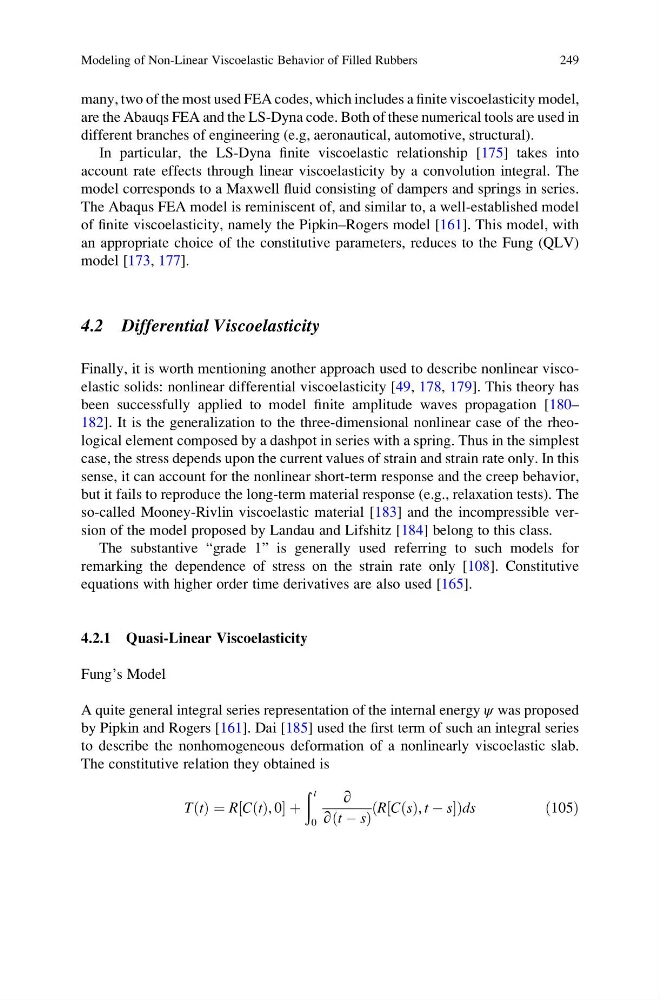
The constitutive relation they obtained is
T t
ð Þ ¼ R C t
ð Þ, 0
½
þ
ð t
0
∂
∂ t À s
ð
Þ
R C s
ð Þ, t À s
½
ð
Þ ds
ð105Þ
Modeling of Non-Linear Viscoelastic Behavior of Filled Rubbers
249
are the Abauqs FEA and the LS-Dyna code. Both of these numerical tools are used in
different branches of engineering (e.g, aeronautical, automotive, structural).
In particular, the LS-Dyna finite viscoelastic relationship [175] takes into
account rate effects through linear viscoelasticity by a convolution integral. The
model corresponds to a Maxwell fluid consisting of dampers and springs in series.
The Abaqus FEA model is reminiscent of, and similar to, a well-established model
of finite viscoelasticity, namely the Pipkin–Rogers model [161]. This model, with
an appropriate choice of the constitutive parameters, reduces to the Fung (QLV)
model [173, 177].
4.2 Differential Viscoelasticity
Finally, it is worth mentioning another approach used to describe nonlinear viscoelastic solids: nonlinear differential viscoelasticity [49, 178, 179]. This theory has
been successfully applied to model finite amplitude waves propagation [180–
182]. It is the generalization to the three-dimensional nonlinear case of the rheological element composed by a dashpot in series with a spring. Thus in the simplest
case, the stress depends upon the current values of strain and strain rate only. In this
sense, it can account for the nonlinear short-term response and the creep behavior,
but it fails to reproduce the long-term material response (e.g., relaxation tests). The
so-called Mooney-Rivlin viscoelastic material [183] and the incompressible version of the model proposed by Landau and Lifshitz [184] belong to this class.
The substantive “grade 1” is generally used referring to such models for
remarking the dependence of stress on the strain rate only [108]. Constitutive
equations with higher order time derivatives are also used [165].
4.2.1 Quasi-Linear Viscoelasticity
Fung’s Model
A quite general integral series representation of the internal energy ψ was proposed
by Pipkin and Rogers [161]. Dai [185] used the first term of such an integral series
to describe the nonhomogeneous deformation of a nonlinearly viscoelastic slab.
The constitutive relation they obtained is
T t
ð Þ ¼ R C t
ð Þ, 0
½
þ
ð t
0
∂
∂ t À s
ð
Þ
R C s
ð Þ, t À s
½
ð
Þ ds
ð105Þ
Modeling of Non-Linear Viscoelastic Behavior of Filled Rubbers
249