

suggested the following relationship for the second Piola-Kirchhoff stress T in
terms of the stretch λ :¼ l/l 0 .
T t
ð Þ ¼
ð t
À1
k t À s
ð
Þ
∂T
e
λ s
ð Þ
½
∂λ
∂λ
∂s
ds
ð101Þ
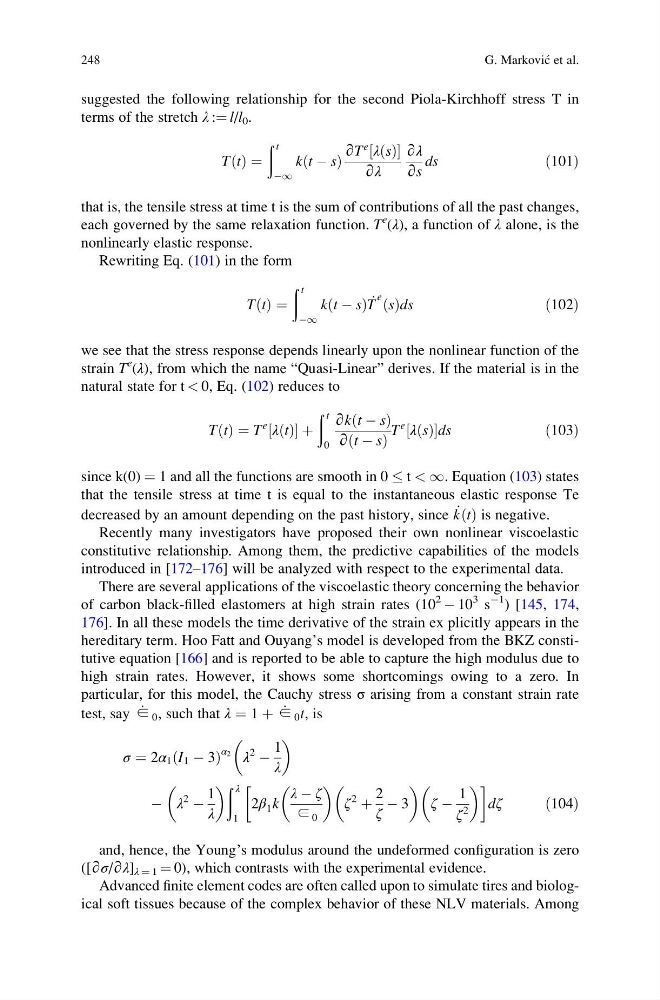
that is, the tensile stress at time t is the sum of contributions of all the past changes,
each governed by the same relaxation function. T
e (λ), a function of λ alone, is the
nonlinearly elastic response.
Rewriting Eq. (101) in the form
T t
ð Þ ¼
ð t
À1
k t À s
ð
Þ _
T
e s
ð Þds
ð102Þ
we see that the stress response depends linearly upon the nonlinear function of the
strain T
e (λ), from which the name “Quasi-Linear” derives. If the material is in the
natural state for t < 0, Eq. (102) reduces to
T t
ð Þ ¼ T
e
λ t
ð Þ
½ þ
ð t
0
∂k t À s
ð
Þ
∂ t À s
ð
Þ
T
e
λ s
ð Þ
½
ds
ð103Þ
since k(0) ¼ 1 and all the functions are smooth in 0 t < 1. Equation (103) states
that the tensile stress at time t is equal to the instantaneous elastic response Te
decreased by an amount depending on the past history, since _
k t
ð Þ is negative.
Recently many investigators have proposed their own nonlinear viscoelastic
constitutive relationship. Among them, the predictive capabilities of the models
introduced in [172–176] will be analyzed with respect to the experimental data.
There are several applications of the viscoelastic theory concerning the behavior
of carbon black-filled elastomers at high strain rates (10
2
À 10
3 s
À1 ) [145, 174,
176]. In all these models the time derivative of the strain ex plicitly appears in the
hereditary term. Hoo Fatt and Ouyang’s model is developed from the BKZ constitutive equation [166] and is reported to be able to capture the high modulus due to
high strain rates. However, it shows some shortcomings owing to a zero. In
particular, for this model, the Cauchy stress σ arising from a constant strain rate
test, say _
∈ 0 , such that λ ¼ 1 þ _
∈ 0 t, is
σ ¼ 2α 1 I 1 À 3
ð
Þ
α 2
λ
2
À
1
λ
À λ
2
À
1
λ
ð λ
1
2β 1 k
λ À ζ
∈ 0
ζ
2
þ
2
ζ
À 3
ζ À
1
ζ
2
!
dζ
ð104Þ
and, hence, the Young’s modulus around the undeformed configuration is zero
([∂σ/∂λ] λ ¼ 1 ¼ 0), which contrasts with the experimental evidence.
Advanced finite element codes are often called upon to simulate tires and biological soft tissues because of the complex behavior of these NLV materials. Among
248
G. Markovic ´ et al.
terms of the stretch λ :¼ l/l 0 .
T t
ð Þ ¼
ð t
À1
k t À s
ð
Þ
∂T
e
λ s
ð Þ
½
∂λ
∂λ
∂s
ds
ð101Þ
that is, the tensile stress at time t is the sum of contributions of all the past changes,
each governed by the same relaxation function. T
e (λ), a function of λ alone, is the
nonlinearly elastic response.
Rewriting Eq. (101) in the form
T t
ð Þ ¼
ð t
À1
k t À s
ð
Þ _
T
e s
ð Þds
ð102Þ
we see that the stress response depends linearly upon the nonlinear function of the
strain T
e (λ), from which the name “Quasi-Linear” derives. If the material is in the
natural state for t < 0, Eq. (102) reduces to
T t
ð Þ ¼ T
e
λ t
ð Þ
½ þ
ð t
0
∂k t À s
ð
Þ
∂ t À s
ð
Þ
T
e
λ s
ð Þ
½
ds
ð103Þ
since k(0) ¼ 1 and all the functions are smooth in 0 t < 1. Equation (103) states
that the tensile stress at time t is equal to the instantaneous elastic response Te
decreased by an amount depending on the past history, since _
k t
ð Þ is negative.
Recently many investigators have proposed their own nonlinear viscoelastic
constitutive relationship. Among them, the predictive capabilities of the models
introduced in [172–176] will be analyzed with respect to the experimental data.
There are several applications of the viscoelastic theory concerning the behavior
of carbon black-filled elastomers at high strain rates (10
2
À 10
3 s
À1 ) [145, 174,
176]. In all these models the time derivative of the strain ex plicitly appears in the
hereditary term. Hoo Fatt and Ouyang’s model is developed from the BKZ constitutive equation [166] and is reported to be able to capture the high modulus due to
high strain rates. However, it shows some shortcomings owing to a zero. In
particular, for this model, the Cauchy stress σ arising from a constant strain rate
test, say _
∈ 0 , such that λ ¼ 1 þ _
∈ 0 t, is
σ ¼ 2α 1 I 1 À 3
ð
Þ
α 2
λ
2
À
1
λ
À λ
2
À
1
λ
ð λ
1
2β 1 k
λ À ζ
∈ 0
ζ
2
þ
2
ζ
À 3
ζ À
1
ζ
2
!
dζ
ð104Þ
and, hence, the Young’s modulus around the undeformed configuration is zero
([∂σ/∂λ] λ ¼ 1 ¼ 0), which contrasts with the experimental evidence.
Advanced finite element codes are often called upon to simulate tires and biological soft tissues because of the complex behavior of these NLV materials. Among
248
G. Markovic ´ et al.