

The SPFM alone is not sufficient to define properly an internal energy, but rather
restrictive conditions must be satisfied to assure the existence of a stationary point
of ψ [151].
Over the years, many researchers have dealt with a proper definition of internal
energy accounting for deformation histories ([152–154] and references therein). It is
well known that the internal energy and entropy of a material with memory is
generally not uniquely defined [155]. A fundamental result in this area is due to Gurtin
and Hrusa [156] who obtained a necessary and sufficient condition for the existence of
the internal energy arising from a stress-strain constitutive relation of single integral
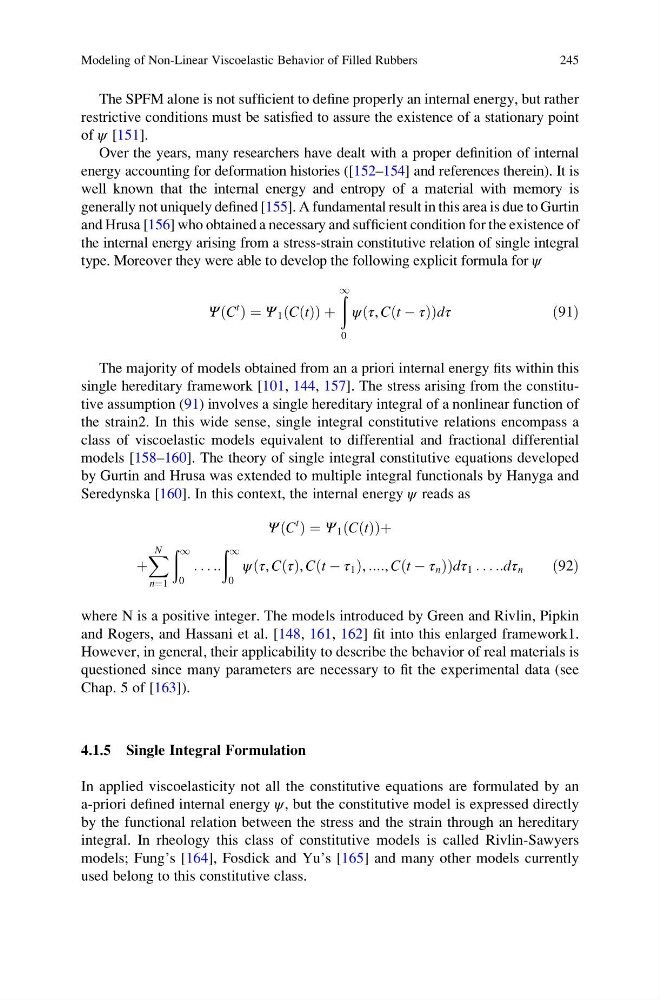
type. Moreover they were able to develop the following explicit formula for ψ
Ψ C
t
ð Þ ¼ Ψ 1 C t
ð Þ
ð
Þþ
ð
1
0
ψ τ, C t À τ
ð
Þ
ð
Þ dτ
ð91Þ
The majority of models obtained from an a priori internal energy fits within this
single hereditary framework [101, 144, 157]. The stress arising from the constitutive assumption (91) involves a single hereditary integral of a nonlinear function of
the strain2. In this wide sense, single integral constitutive relations encompass a
class of viscoelastic models equivalent to differential and fractional differential
models [158–160]. The theory of single integral constitutive equations developed
by Gurtin and Hrusa was extended to multiple integral functionals by Hanyga and
Seredynska [160]. In this context, the internal energy ψ reads as
Ψ C
t
ð Þ ¼ Ψ 1 C t
ð Þ
ð
Þþ
þ
X N
n¼1
ð 1
0
. . . ::
ð 1
0
ψ τ, C τ
ð Þ, C t À τ 1
ð
Þ, ::::, C t À τ n
ð
Þ
ð
Þ dτ 1 . . . ::dτ n
ð92Þ
where N is a positive integer. The models introduced by Green and Rivlin, Pipkin
and Rogers, and Hassani et al. [148, 161, 162] fit into this enlarged framework1.
However, in general, their applicability to describe the behavior of real materials is
questioned since many parameters are necessary to fit the experimental data (see
Chap. 5 of [163]).
4.1.5 Single Integral Formulation
In applied viscoelasticity not all the constitutive equations are formulated by an
a-priori defined internal energy ψ, but the constitutive model is expressed directly
by the functional relation between the stress and the strain through an hereditary
integral. In rheology this class of constitutive models is called Rivlin-Sawyers
models; Fung’s [164], Fosdick and Yu’s [165] and many other models currently
used belong to this constitutive class.
Modeling of Non-Linear Viscoelastic Behavior of Filled Rubbers
245
restrictive conditions must be satisfied to assure the existence of a stationary point
of ψ [151].
Over the years, many researchers have dealt with a proper definition of internal
energy accounting for deformation histories ([152–154] and references therein). It is
well known that the internal energy and entropy of a material with memory is
generally not uniquely defined [155]. A fundamental result in this area is due to Gurtin
and Hrusa [156] who obtained a necessary and sufficient condition for the existence of
the internal energy arising from a stress-strain constitutive relation of single integral
type. Moreover they were able to develop the following explicit formula for ψ
Ψ C
t
ð Þ ¼ Ψ 1 C t
ð Þ
ð
Þþ
ð
1
0
ψ τ, C t À τ
ð
Þ
ð
Þ dτ
ð91Þ
The majority of models obtained from an a priori internal energy fits within this
single hereditary framework [101, 144, 157]. The stress arising from the constitutive assumption (91) involves a single hereditary integral of a nonlinear function of
the strain2. In this wide sense, single integral constitutive relations encompass a
class of viscoelastic models equivalent to differential and fractional differential
models [158–160]. The theory of single integral constitutive equations developed
by Gurtin and Hrusa was extended to multiple integral functionals by Hanyga and
Seredynska [160]. In this context, the internal energy ψ reads as
Ψ C
t
ð Þ ¼ Ψ 1 C t
ð Þ
ð
Þþ
þ
X N
n¼1
ð 1
0
. . . ::
ð 1
0
ψ τ, C τ
ð Þ, C t À τ 1
ð
Þ, ::::, C t À τ n
ð
Þ
ð
Þ dτ 1 . . . ::dτ n
ð92Þ
where N is a positive integer. The models introduced by Green and Rivlin, Pipkin
and Rogers, and Hassani et al. [148, 161, 162] fit into this enlarged framework1.
However, in general, their applicability to describe the behavior of real materials is
questioned since many parameters are necessary to fit the experimental data (see
Chap. 5 of [163]).
4.1.5 Single Integral Formulation
In applied viscoelasticity not all the constitutive equations are formulated by an
a-priori defined internal energy ψ, but the constitutive model is expressed directly
by the functional relation between the stress and the strain through an hereditary
integral. In rheology this class of constitutive models is called Rivlin-Sawyers
models; Fung’s [164], Fosdick and Yu’s [165] and many other models currently
used belong to this constitutive class.
Modeling of Non-Linear Viscoelastic Behavior of Filled Rubbers
245