

Because Rivlin-Sawyers models are not obtained with the Coleman and Noll’s
procedure, their thermodynamic consistency must be verified a posteriori.
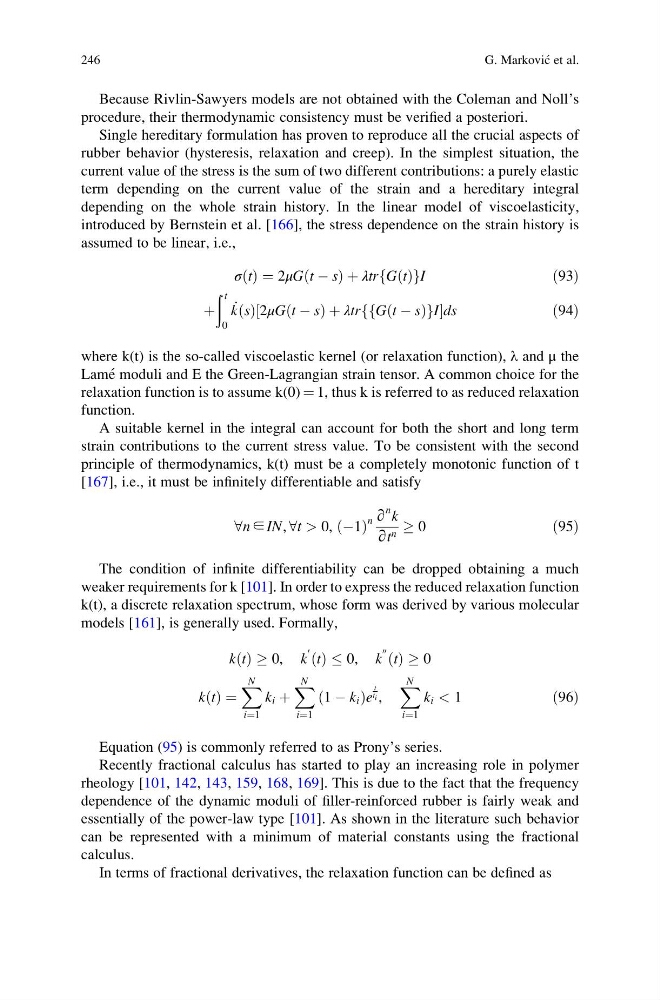
Single hereditary formulation has proven to reproduce all the crucial aspects of
rubber behavior (hysteresis, relaxation and creep). In the simplest situation, the
current value of the stress is the sum of two different contributions: a purely elastic
term depending on the current value of the strain and a hereditary integral
depending on the whole strain history. In the linear model of viscoelasticity,
introduced by Bernstein et al. [166], the stress dependence on the strain history is
assumed to be linear, i.e.,
σ t
ð Þ ¼ 2μG t À s
ð
Þþλtr G t
ð Þ
f
gI
ð93Þ
þ
ð t
0
_
k s
ð Þ 2μG t À s
ð
Þþλtr G t À s
ð
Þ
f
g I
f
½
ds
ð94Þ
where k(t) is the so-called viscoelastic kernel (or relaxation function), λ and μ the
Lame ´ moduli and E the Green-Lagrangian strain tensor. A common choice for the
relaxation function is to assume k(0) ¼ 1, thus k is referred to as reduced relaxation
function.
A suitable kernel in the integral can account for both the short and long term
strain contributions to the current stress value. To be consistent with the second
principle of thermodynamics, k(t) must be a completely monotonic function of t
[167], i.e., it must be infinitely differentiable and satisfy
8n ∈ IN, 8t > 0, À1
ð Þ
n ∂
n k
∂t n ! 0
ð95Þ
The condition of infinite differentiability can be dropped obtaining a much
weaker requirements for k [101]. In order to express the reduced relaxation function
k(t), a discrete relaxation spectrum, whose form was derived by various molecular
models [161], is generally used. Formally,
k t
ð Þ ! 0, k
0 t
ð Þ 0, k
00 t
ð Þ ! 0
k t
ð Þ ¼
X N
i¼1
k i þ
X N
i¼1
1 À k i
ð
Þe
t
t i ,
X N
i¼1
k i < 1
ð96Þ
Equation (95) is commonly referred to as Prony’s series.
Recently fractional calculus has started to play an increasing role in polymer
rheology [101, 142, 143, 159, 168, 169]. This is due to the fact that the frequency
dependence of the dynamic moduli of filler-reinforced rubber is fairly weak and
essentially of the power-law type [101]. As shown in the literature such behavior
can be represented with a minimum of material constants using the fractional
calculus.
In terms of fractional derivatives, the relaxation function can be defined as
246
G. Markovic ´ et al.
procedure, their thermodynamic consistency must be verified a posteriori.
Single hereditary formulation has proven to reproduce all the crucial aspects of
rubber behavior (hysteresis, relaxation and creep). In the simplest situation, the
current value of the stress is the sum of two different contributions: a purely elastic
term depending on the current value of the strain and a hereditary integral
depending on the whole strain history. In the linear model of viscoelasticity,
introduced by Bernstein et al. [166], the stress dependence on the strain history is
assumed to be linear, i.e.,
σ t
ð Þ ¼ 2μG t À s
ð
Þþλtr G t
ð Þ
f
gI
ð93Þ
þ
ð t
0
_
k s
ð Þ 2μG t À s
ð
Þþλtr G t À s
ð
Þ
f
g I
f
½
ds
ð94Þ
where k(t) is the so-called viscoelastic kernel (or relaxation function), λ and μ the
Lame ´ moduli and E the Green-Lagrangian strain tensor. A common choice for the
relaxation function is to assume k(0) ¼ 1, thus k is referred to as reduced relaxation
function.
A suitable kernel in the integral can account for both the short and long term
strain contributions to the current stress value. To be consistent with the second
principle of thermodynamics, k(t) must be a completely monotonic function of t
[167], i.e., it must be infinitely differentiable and satisfy
8n ∈ IN, 8t > 0, À1
ð Þ
n ∂
n k
∂t n ! 0
ð95Þ
The condition of infinite differentiability can be dropped obtaining a much
weaker requirements for k [101]. In order to express the reduced relaxation function
k(t), a discrete relaxation spectrum, whose form was derived by various molecular
models [161], is generally used. Formally,
k t
ð Þ ! 0, k
0 t
ð Þ 0, k
00 t
ð Þ ! 0
k t
ð Þ ¼
X N
i¼1
k i þ
X N
i¼1
1 À k i
ð
Þe
t
t i ,
X N
i¼1
k i < 1
ð96Þ
Equation (95) is commonly referred to as Prony’s series.
Recently fractional calculus has started to play an increasing role in polymer
rheology [101, 142, 143, 159, 168, 169]. This is due to the fact that the frequency
dependence of the dynamic moduli of filler-reinforced rubber is fairly weak and
essentially of the power-law type [101]. As shown in the literature such behavior
can be represented with a minimum of material constants using the fractional
calculus.
In terms of fractional derivatives, the relaxation function can be defined as
246
G. Markovic ´ et al.