

4.1.4 Integral Formulation
The internal-variables formulation is not the only way to define the internal energy.
Following the seminal work of [122, 148] Boltzmann and Green and Rivlin and
successively Coleman and Noll [124] proposed constitutive relations for which the
stress a time t depends upon the entire history of deformation up to the current time
instant. However, the definition of the internal energy was developed accordingly
and in agreement with the fading memory properties, i.e., strains which occurred in
the distant past have less influence on the present value of ψ than those which
occurred in the more recent past.
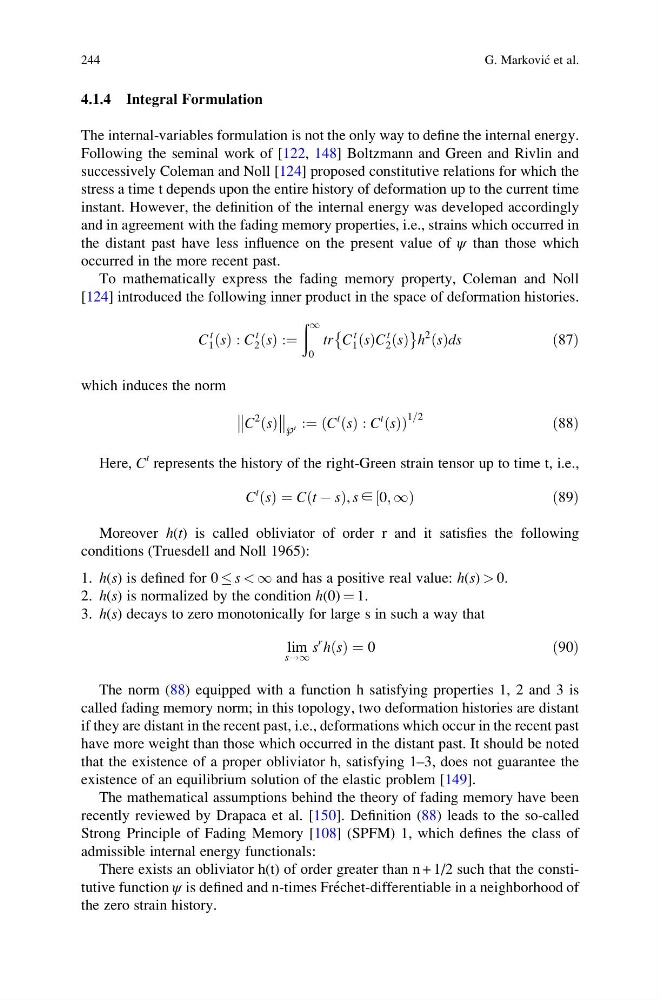
To mathematically express the fading memory property, Coleman and Noll
[124] introduced the following inner product in the space of deformation histories.
C
t
1 s
ð Þ : C
t
2 s
ð Þ :¼
ð 1
0
tr C
t
1 s
ð ÞC
t
2 s
ð Þ
È
É
h
2 s
ð Þds
ð87Þ
which induces the norm
C
2 s
ð Þ
℘ t :¼ C
t s
ð Þ : C
t s
ð Þ
ð
Þ
1=2
ð88Þ
Here, C
t represents the history of the right-Green strain tensor up to time t, i.e.,
C
t s
ð Þ ¼ C t À s
ð
Þ, s ∈ 0; 1
½
Þ
ð89Þ
Moreover h(t) is called obliviator of order r and it satisfies the following
conditions (Truesdell and Noll 1965):
1. h(s) is defined for 0 s < 1 and has a positive real value: h(s) > 0.
2. h(s) is normalized by the condition h(0) ¼ 1.
3. h(s) decays to zero monotonically for large s in such a way that
lim
s!1
s
r h s
ð Þ ¼ 0
ð90Þ
The norm (88) equipped with a function h satisfying properties 1, 2 and 3 is
called fading memory norm; in this topology, two deformation histories are distant
if they are distant in the recent past, i.e., deformations which occur in the recent past
have more weight than those which occurred in the distant past. It should be noted
that the existence of a proper obliviator h, satisfying 1–3, does not guarantee the
existence of an equilibrium solution of the elastic problem [149].
The mathematical assumptions behind the theory of fading memory have been
recently reviewed by Drapaca et al. [150]. Definition (88) leads to the so-called
Strong Principle of Fading Memory [108] (SPFM) 1, which defines the class of
admissible internal energy functionals:
There exists an obliviator h(t) of order greater than n + 1/2 such that the constitutive function ψ is defined and n-times Fre ´chet-differentiable in a neighborhood of
the zero strain history.
244
G. Markovic ´ et al.
The internal-variables formulation is not the only way to define the internal energy.
Following the seminal work of [122, 148] Boltzmann and Green and Rivlin and
successively Coleman and Noll [124] proposed constitutive relations for which the
stress a time t depends upon the entire history of deformation up to the current time
instant. However, the definition of the internal energy was developed accordingly
and in agreement with the fading memory properties, i.e., strains which occurred in
the distant past have less influence on the present value of ψ than those which
occurred in the more recent past.
To mathematically express the fading memory property, Coleman and Noll
[124] introduced the following inner product in the space of deformation histories.
C
t
1 s
ð Þ : C
t
2 s
ð Þ :¼
ð 1
0
tr C
t
1 s
ð ÞC
t
2 s
ð Þ
È
É
h
2 s
ð Þds
ð87Þ
which induces the norm
C
2 s
ð Þ
℘ t :¼ C
t s
ð Þ : C
t s
ð Þ
ð
Þ
1=2
ð88Þ
Here, C
t represents the history of the right-Green strain tensor up to time t, i.e.,
C
t s
ð Þ ¼ C t À s
ð
Þ, s ∈ 0; 1
½
Þ
ð89Þ
Moreover h(t) is called obliviator of order r and it satisfies the following
conditions (Truesdell and Noll 1965):
1. h(s) is defined for 0 s < 1 and has a positive real value: h(s) > 0.
2. h(s) is normalized by the condition h(0) ¼ 1.
3. h(s) decays to zero monotonically for large s in such a way that
lim
s!1
s
r h s
ð Þ ¼ 0
ð90Þ
The norm (88) equipped with a function h satisfying properties 1, 2 and 3 is
called fading memory norm; in this topology, two deformation histories are distant
if they are distant in the recent past, i.e., deformations which occur in the recent past
have more weight than those which occurred in the distant past. It should be noted
that the existence of a proper obliviator h, satisfying 1–3, does not guarantee the
existence of an equilibrium solution of the elastic problem [149].
The mathematical assumptions behind the theory of fading memory have been
recently reviewed by Drapaca et al. [150]. Definition (88) leads to the so-called
Strong Principle of Fading Memory [108] (SPFM) 1, which defines the class of
admissible internal energy functionals:
There exists an obliviator h(t) of order greater than n + 1/2 such that the constitutive function ψ is defined and n-times Fre ´chet-differentiable in a neighborhood of
the zero strain history.
244
G. Markovic ´ et al.