

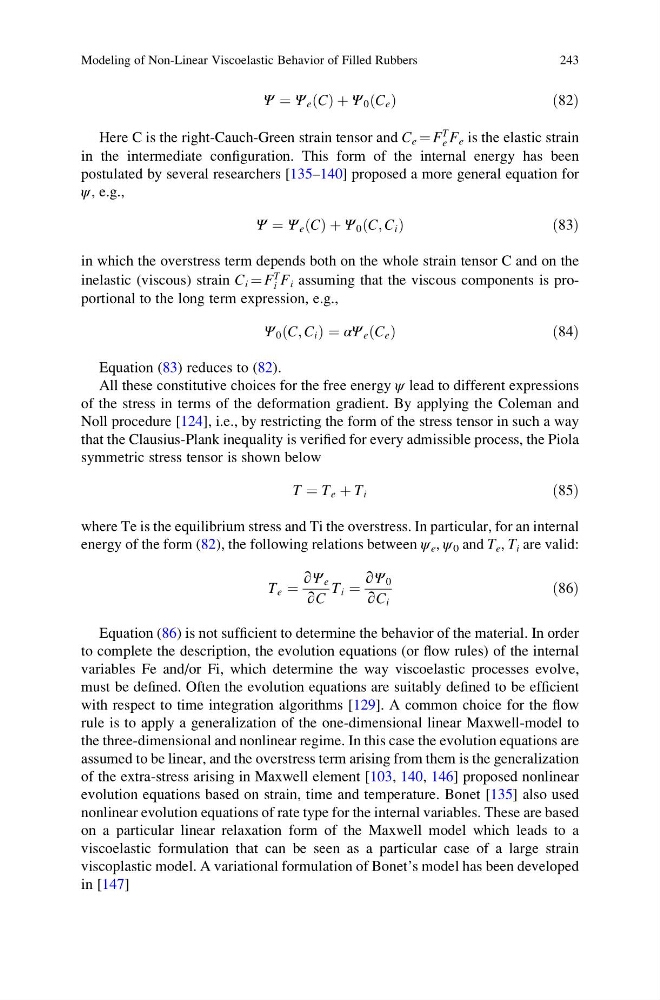
Ψ ¼ Ψ e C
ð Þ þ Ψ 0 C e
ð Þ
ð82Þ
Here C is the right-Cauch-Green strain tensor and C e ¼ F
T
e F e is the elastic strain
in the intermediate configuration. This form of the internal energy has been
postulated by several researchers [135–140] proposed a more general equation for
ψ, e.g.,
Ψ ¼ Ψ e C
ð Þ þ Ψ 0 C; C i
ð
Þ
ð83Þ
in which the overstress term depends both on the whole strain tensor C and on the
inelastic (viscous) strain C i ¼ F
T
i F i assuming that the viscous components is proportional to the long term expression, e.g.,
Ψ 0 C; C i
ð
Þ¼αΨ e C e
ð Þ
ð84Þ
Equation (83) reduces to (82).
All these constitutive choices for the free energy ψ lead to different expressions
of the stress in terms of the deformation gradient. By applying the Coleman and
Noll procedure [124], i.e., by restricting the form of the stress tensor in such a way
that the Clausius-Plank inequality is verified for every admissible process, the Piola
symmetric stress tensor is shown below
T ¼ T e þ T i
ð85Þ
where Te is the equilibrium stress and Ti the overstress. In particular, for an internal
energy of the form (82), the following relations between ψ e , ψ 0 and T e , T i are valid:
T e ¼
∂Ψ e
∂C
T i ¼
∂Ψ 0
∂C i
ð86Þ
Equation (86) is not sufficient to determine the behavior of the material. In order
to complete the description, the evolution equations (or flow rules) of the internal
variables Fe and/or Fi, which determine the way viscoelastic processes evolve,
must be defined. Often the evolution equations are suitably defined to be efficient
with respect to time integration algorithms [129]. A common choice for the flow
rule is to apply a generalization of the one-dimensional linear Maxwell-model to
the three-dimensional and nonlinear regime. In this case the evolution equations are
assumed to be linear, and the overstress term arising from them is the generalization
of the extra-stress arising in Maxwell element [103, 140, 146] proposed nonlinear
evolution equations based on strain, time and temperature. Bonet [135] also used
nonlinear evolution equations of rate type for the internal variables. These are based
on a particular linear relaxation form of the Maxwell model which leads to a
viscoelastic formulation that can be seen as a particular case of a large strain
viscoplastic model. A variational formulation of Bonet’s model has been developed
in [147]
Modeling of Non-Linear Viscoelastic Behavior of Filled Rubbers
243
ð Þ þ Ψ 0 C e
ð Þ
ð82Þ
Here C is the right-Cauch-Green strain tensor and C e ¼ F
T
e F e is the elastic strain
in the intermediate configuration. This form of the internal energy has been
postulated by several researchers [135–140] proposed a more general equation for
ψ, e.g.,
Ψ ¼ Ψ e C
ð Þ þ Ψ 0 C; C i
ð
Þ
ð83Þ
in which the overstress term depends both on the whole strain tensor C and on the
inelastic (viscous) strain C i ¼ F
T
i F i assuming that the viscous components is proportional to the long term expression, e.g.,
Ψ 0 C; C i
ð
Þ¼αΨ e C e
ð Þ
ð84Þ
Equation (83) reduces to (82).
All these constitutive choices for the free energy ψ lead to different expressions
of the stress in terms of the deformation gradient. By applying the Coleman and
Noll procedure [124], i.e., by restricting the form of the stress tensor in such a way
that the Clausius-Plank inequality is verified for every admissible process, the Piola
symmetric stress tensor is shown below
T ¼ T e þ T i
ð85Þ
where Te is the equilibrium stress and Ti the overstress. In particular, for an internal
energy of the form (82), the following relations between ψ e , ψ 0 and T e , T i are valid:
T e ¼
∂Ψ e
∂C
T i ¼
∂Ψ 0
∂C i
ð86Þ
Equation (86) is not sufficient to determine the behavior of the material. In order
to complete the description, the evolution equations (or flow rules) of the internal
variables Fe and/or Fi, which determine the way viscoelastic processes evolve,
must be defined. Often the evolution equations are suitably defined to be efficient
with respect to time integration algorithms [129]. A common choice for the flow
rule is to apply a generalization of the one-dimensional linear Maxwell-model to
the three-dimensional and nonlinear regime. In this case the evolution equations are
assumed to be linear, and the overstress term arising from them is the generalization
of the extra-stress arising in Maxwell element [103, 140, 146] proposed nonlinear
evolution equations based on strain, time and temperature. Bonet [135] also used
nonlinear evolution equations of rate type for the internal variables. These are based
on a particular linear relaxation form of the Maxwell model which leads to a
viscoelastic formulation that can be seen as a particular case of a large strain
viscoplastic model. A variational formulation of Bonet’s model has been developed
in [147]
Modeling of Non-Linear Viscoelastic Behavior of Filled Rubbers
243