

additively partitioned in the standard volumetric term plus an isochoric part. The
latter depends both on the isochoric strain and a set of internal variables Γ α that can
be regarded as an internal strain tensor. This approach generalizes the additive
decomposition introduced by Simo.
An advantage of the state-variable formulations is that, in contrast to the other
approaches, it is not restricted to isotropic responses. Anisotropic effects could be
easily taken into account, e.g., by introducing state variables depending upon fiber
orientations as in [129]. Moreover physical theories, such as dislocation models,
may be introduced directly in the formulation of the evolution equations. However,
it has been reported that the viscosity alone is not enough to reproduce the large
hysteretic energy behavior of high-damping rubber, used in vibration absorbers.
Thus, Yoshida et al. [130] proposed a constitutive model consisting of two parts: an
elastoplastic term with a strain-dependent isotropic hardening law, representing the
energy dissipation of the material, and a second part consisting of a hyperelastic
body with a damage model, which expresses the evolutional direction of the stress
tensor.
4.1.3 Additive Decomposition of ψ
A decomposition of the deformation gradient into elastic and inelastic terms leads
to alternative formulations of the strain energy function [131]. This decomposition
was first proposed by [132] Sidoroff and later by Lubliner [133] who extended the
pioneering work of Green and Tobolsky [134]. Although in the framework of
elastoplasticity the decomposition of the deformation gradient, into elastic and
plastic terms, relies on clear physical assumptions, there is a lack of evidence in
the context of viscoelasticity. However, it has been successfully applied in many
nonlinear constitutive equations [135–140] and many others.
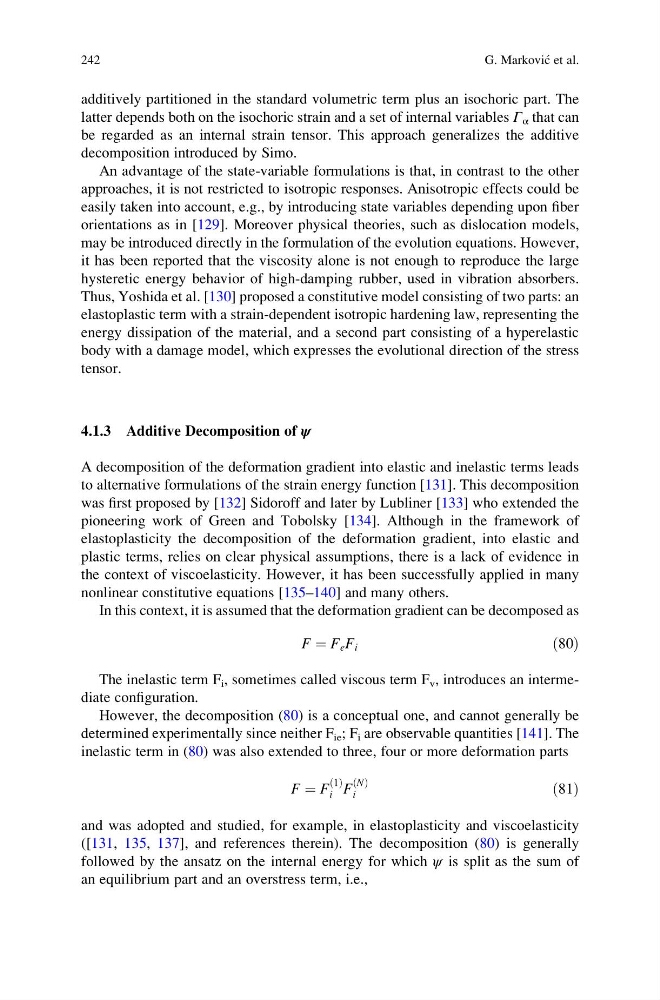
In this context, it is assumed that the deformation gradient can be decomposed as
F ¼ F e F i
ð80Þ
The inelastic term F i , sometimes called viscous term F v , introduces an intermediate configuration.
However, the decomposition (80) is a conceptual one, and cannot generally be
determined experimentally since neither F ie ; F i are observable quantities [141]. The
inelastic term in (80) was also extended to three, four or more deformation parts
F ¼ F
1
ð Þ
i F
N
ð Þ
i
ð81Þ
and was adopted and studied, for example, in elastoplasticity and viscoelasticity
([131, 135, 137], and references therein). The decomposition (80) is generally
followed by the ansatz on the internal energy for which ψ is split as the sum of
an equilibrium part and an overstress term, i.e.,
242
G. Markovic ´ et al.
latter depends both on the isochoric strain and a set of internal variables Γ α that can
be regarded as an internal strain tensor. This approach generalizes the additive
decomposition introduced by Simo.
An advantage of the state-variable formulations is that, in contrast to the other
approaches, it is not restricted to isotropic responses. Anisotropic effects could be
easily taken into account, e.g., by introducing state variables depending upon fiber
orientations as in [129]. Moreover physical theories, such as dislocation models,
may be introduced directly in the formulation of the evolution equations. However,
it has been reported that the viscosity alone is not enough to reproduce the large
hysteretic energy behavior of high-damping rubber, used in vibration absorbers.
Thus, Yoshida et al. [130] proposed a constitutive model consisting of two parts: an
elastoplastic term with a strain-dependent isotropic hardening law, representing the
energy dissipation of the material, and a second part consisting of a hyperelastic
body with a damage model, which expresses the evolutional direction of the stress
tensor.
4.1.3 Additive Decomposition of ψ
A decomposition of the deformation gradient into elastic and inelastic terms leads
to alternative formulations of the strain energy function [131]. This decomposition
was first proposed by [132] Sidoroff and later by Lubliner [133] who extended the
pioneering work of Green and Tobolsky [134]. Although in the framework of
elastoplasticity the decomposition of the deformation gradient, into elastic and
plastic terms, relies on clear physical assumptions, there is a lack of evidence in
the context of viscoelasticity. However, it has been successfully applied in many
nonlinear constitutive equations [135–140] and many others.
In this context, it is assumed that the deformation gradient can be decomposed as
F ¼ F e F i
ð80Þ
The inelastic term F i , sometimes called viscous term F v , introduces an intermediate configuration.
However, the decomposition (80) is a conceptual one, and cannot generally be
determined experimentally since neither F ie ; F i are observable quantities [141]. The
inelastic term in (80) was also extended to three, four or more deformation parts
F ¼ F
1
ð Þ
i F
N
ð Þ
i
ð81Þ
and was adopted and studied, for example, in elastoplasticity and viscoelasticity
([131, 135, 137], and references therein). The decomposition (80) is generally
followed by the ansatz on the internal energy for which ψ is split as the sum of
an equilibrium part and an overstress term, i.e.,
242
G. Markovic ´ et al.