

σ ¼ ÀpI þ 2
∂ψ
∂I 1
þ I 1
∂ψ
∂I 2
B À 2
∂ψ
∂I 2
B
2
ð56Þ
In order to verify the stress-free condition (σ (I) ¼ 0) in the reference configuration, the unknown pressure field p must satisfy:
p I 1 ; I 2
ð
Þj C¼I ¼ p 3; 3
ð Þ ¼ 2
∂ψ
∂I 1
C¼I
þ 4
∂ψ
∂I 2
C¼I
ð57Þ
3.6 Homogeneous Deformations
In the following we analyze some elementary problems in which the deformation is
homogeneous, i.e. the deformation gradient F is constant in whole body. Homogeneous deformations are equilibrium solution for all the class of hyperelastic materials; for this reason they are called universal solutions [116].
3.6.1 Simple Tension
In the case of simple tension or simple compression the deformation is given by
x 1 ¼ λ 1 X 1 , x 2 ¼ λ 2 X 2 , x 3 ¼ λ 3 X 3
ð58Þ
hence the deformation gradient is a diagonal matrix
F ¼ Diag λ 1 ; λ 2 ; λ 3
f
g
ð59Þ
where λ 1 , λ 2 are called principal stretches, which are constant because the deformation is homogeneous. Here the λ1-direction is the direction of the external load.
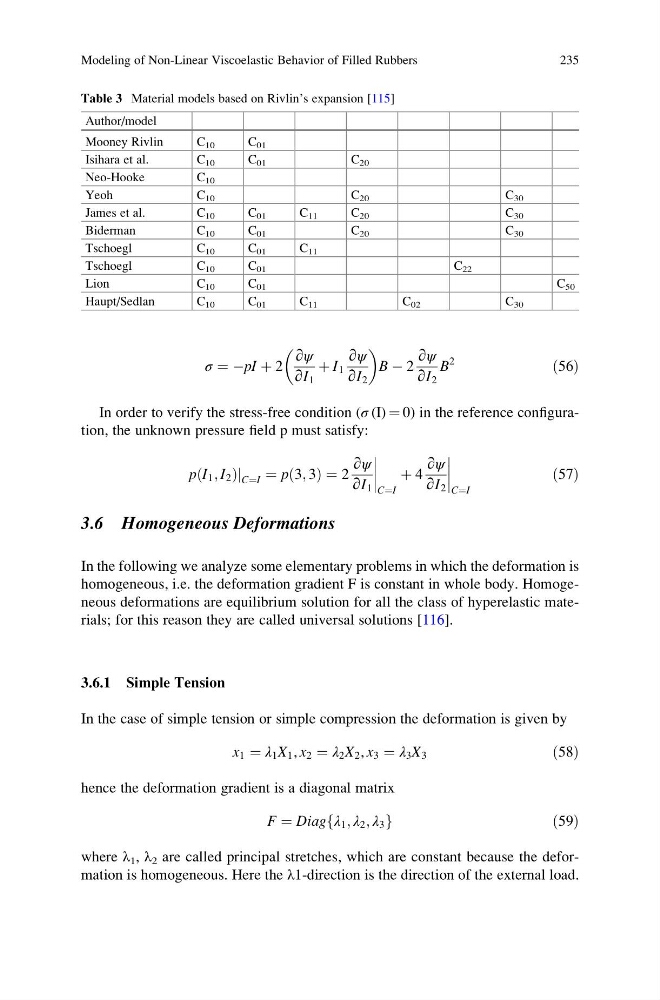
Table 3 Material models based on Rivlin’s expansion [115]
Author/model
Mooney Rivlin
C 10
C 01
Isihara et al.
C 10
C 01
C 20
Neo-Hooke
C 10
Yeoh
C 10
C 20
C 30
James et al.
C 10
C 01
C 11
C 20
C 30
Biderman
C 10
C 01
C 20
C 30
Tschoegl
C 10
C 01
C 11
Tschoegl
C 10
C 01
C 22
Lion
C 10
C 01
C 50
Haupt/Sedlan
C 10
C 01
C 11
C 02
C 30
Modeling of Non-Linear Viscoelastic Behavior of Filled Rubbers
235
∂ψ
∂I 1
þ I 1
∂ψ
∂I 2
B À 2
∂ψ
∂I 2
B
2
ð56Þ
In order to verify the stress-free condition (σ (I) ¼ 0) in the reference configuration, the unknown pressure field p must satisfy:
p I 1 ; I 2
ð
Þj C¼I ¼ p 3; 3
ð Þ ¼ 2
∂ψ
∂I 1
C¼I
þ 4
∂ψ
∂I 2
C¼I
ð57Þ
3.6 Homogeneous Deformations
In the following we analyze some elementary problems in which the deformation is
homogeneous, i.e. the deformation gradient F is constant in whole body. Homogeneous deformations are equilibrium solution for all the class of hyperelastic materials; for this reason they are called universal solutions [116].
3.6.1 Simple Tension
In the case of simple tension or simple compression the deformation is given by
x 1 ¼ λ 1 X 1 , x 2 ¼ λ 2 X 2 , x 3 ¼ λ 3 X 3
ð58Þ
hence the deformation gradient is a diagonal matrix
F ¼ Diag λ 1 ; λ 2 ; λ 3
f
g
ð59Þ
where λ 1 , λ 2 are called principal stretches, which are constant because the deformation is homogeneous. Here the λ1-direction is the direction of the external load.
Table 3 Material models based on Rivlin’s expansion [115]
Author/model
Mooney Rivlin
C 10
C 01
Isihara et al.
C 10
C 01
C 20
Neo-Hooke
C 10
Yeoh
C 10
C 20
C 30
James et al.
C 10
C 01
C 11
C 20
C 30
Biderman
C 10
C 01
C 20
C 30
Tschoegl
C 10
C 01
C 11
Tschoegl
C 10
C 01
C 22
Lion
C 10
C 01
C 50
Haupt/Sedlan
C 10
C 01
C 11
C 02
C 30
Modeling of Non-Linear Viscoelastic Behavior of Filled Rubbers
235