

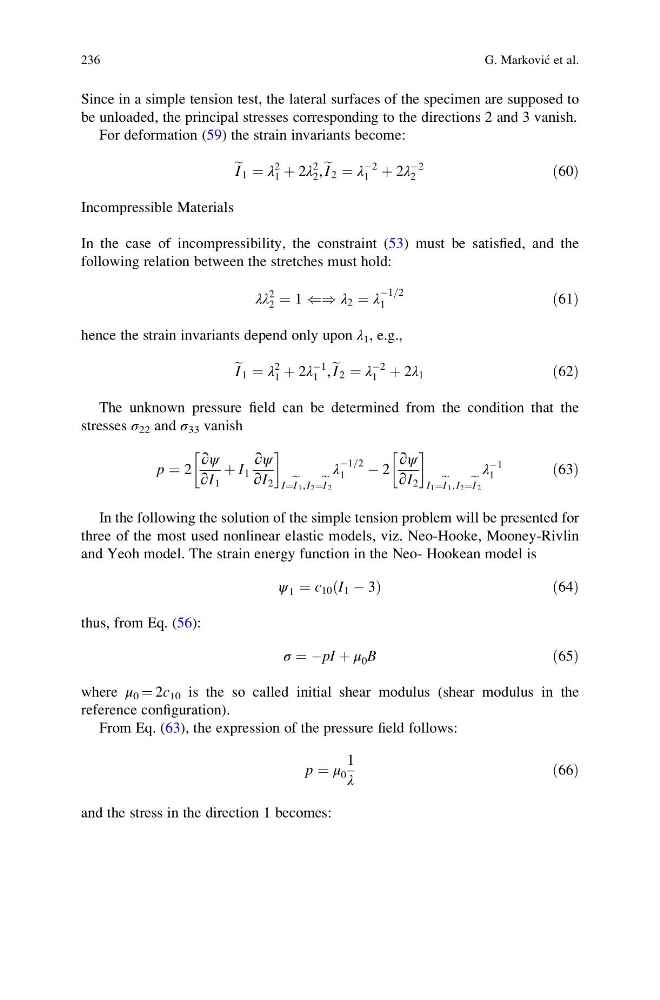
Since in a simple tension test, the lateral surfaces of the specimen are supposed to
be unloaded, the principal stresses corresponding to the directions 2 and 3 vanish.
For deformation (59) the strain invariants become:
e I 1 ¼ λ
2
1 þ 2λ
2
2 , e I 2 ¼ λ
À2
1 þ 2λ
À2
2
ð60Þ
Incompressible Materials
In the case of incompressibility, the constraint (53) must be satisfied, and the
following relation between the stretches must hold:
λλ
2
2 ¼ 1 () λ 2 ¼ λ
À1=2
1
ð61Þ
hence the strain invariants depend only upon λ 1 , e.g.,
e I 1 ¼ λ
2
1 þ 2λ
À1
1 , e I 2 ¼ λ
À2
1 þ 2λ 1
ð62Þ
The unknown pressure field can be determined from the condition that the
stresses σ 22 and σ 33 vanish
p ¼ 2
∂ψ
∂I 1
þ I 1
∂ψ
∂I 2
!
I¼ e I 1 , I 2 ¼ e I 2
λ
À1=2
1
À 2
∂ψ
∂I 2
!
I 1 ¼ e I 1 , I 2 ¼ e I 2
λ
À1
1
ð63Þ
In the following the solution of the simple tension problem will be presented for
three of the most used nonlinear elastic models, viz. Neo-Hooke, Mooney-Rivlin
and Yeoh model. The strain energy function in the Neo- Hookean model is
ψ 1 ¼ c 10 I 1 À 3
ð
Þ
ð64Þ
thus, from Eq. (56):
σ ¼ ÀpI þ μ 0 B
ð65Þ
where μ 0 ¼ 2c 10 is the so called initial shear modulus (shear modulus in the
reference configuration).
From Eq. (63), the expression of the pressure field follows:
p ¼ μ 0
1
λ
ð66Þ
and the stress in the direction 1 becomes:
236
G. Markovic ´ et al.
be unloaded, the principal stresses corresponding to the directions 2 and 3 vanish.
For deformation (59) the strain invariants become:
e I 1 ¼ λ
2
1 þ 2λ
2
2 , e I 2 ¼ λ
À2
1 þ 2λ
À2
2
ð60Þ
Incompressible Materials
In the case of incompressibility, the constraint (53) must be satisfied, and the
following relation between the stretches must hold:
λλ
2
2 ¼ 1 () λ 2 ¼ λ
À1=2
1
ð61Þ
hence the strain invariants depend only upon λ 1 , e.g.,
e I 1 ¼ λ
2
1 þ 2λ
À1
1 , e I 2 ¼ λ
À2
1 þ 2λ 1
ð62Þ
The unknown pressure field can be determined from the condition that the
stresses σ 22 and σ 33 vanish
p ¼ 2
∂ψ
∂I 1
þ I 1
∂ψ
∂I 2
!
I¼ e I 1 , I 2 ¼ e I 2
λ
À1=2
1
À 2
∂ψ
∂I 2
!
I 1 ¼ e I 1 , I 2 ¼ e I 2
λ
À1
1
ð63Þ
In the following the solution of the simple tension problem will be presented for
three of the most used nonlinear elastic models, viz. Neo-Hooke, Mooney-Rivlin
and Yeoh model. The strain energy function in the Neo- Hookean model is
ψ 1 ¼ c 10 I 1 À 3
ð
Þ
ð64Þ
thus, from Eq. (56):
σ ¼ ÀpI þ μ 0 B
ð65Þ
where μ 0 ¼ 2c 10 is the so called initial shear modulus (shear modulus in the
reference configuration).
From Eq. (63), the expression of the pressure field follows:
p ¼ μ 0
1
λ
ð66Þ
and the stress in the direction 1 becomes:
236
G. Markovic ´ et al.