

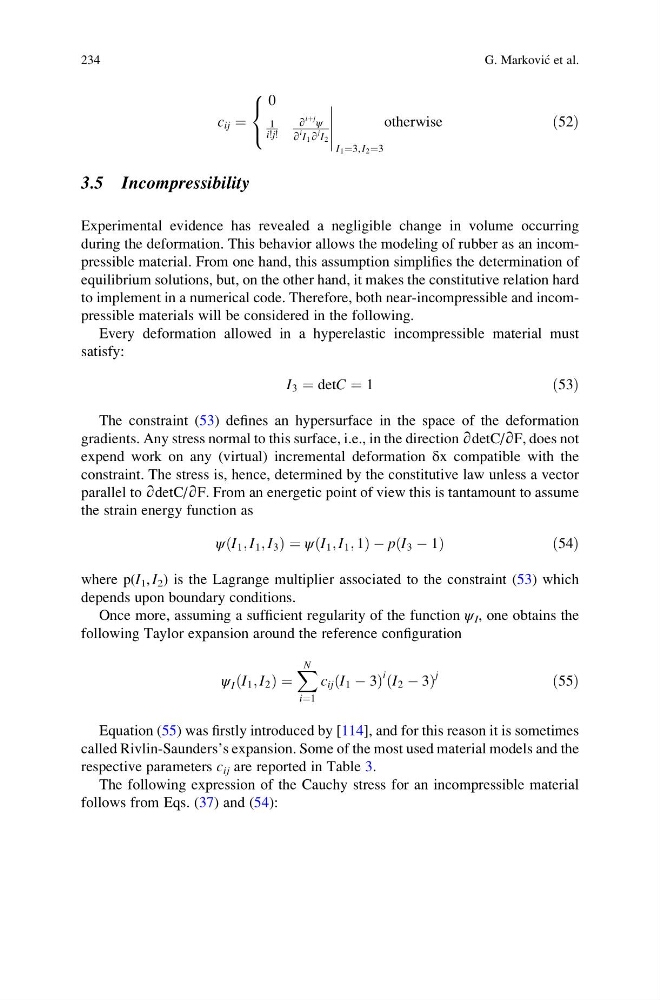
c ij ¼
0
1
i!j!
∂
iþj ψ
∂
i I 1 ∂
j I 2
8
<
:
I 1 ¼3, I 2 ¼3
otherwise
ð52Þ
3.5 Incompressibility
Experimental evidence has revealed a negligible change in volume occurring
during the deformation. This behavior allows the modeling of rubber as an incompressible material. From one hand, this assumption simplifies the determination of
equilibrium solutions, but, on the other hand, it makes the constitutive relation hard
to implement in a numerical code. Therefore, both near-incompressible and incompressible materials will be considered in the following.
Every deformation allowed in a hyperelastic incompressible material must
satisfy:
I 3 ¼ detC ¼ 1
ð53Þ
The constraint (53) defines an hypersurface in the space of the deformation
gradients. Any stress normal to this surface, i.e., in the direction ∂detC/∂F, does not
expend work on any (virtual) incremental deformation δx compatible with the
constraint. The stress is, hence, determined by the constitutive law unless a vector
parallel to ∂detC/∂F. From an energetic point of view this is tantamount to assume
the strain energy function as
ψ I 1 ; I 1 ; I 3
ð
Þ¼ψ I 1 ; I 1 ; 1
ð
ÞÀp I 3 À 1
ð
Þ
ð54Þ
where p(I 1 , I 2 ) is the Lagrange multiplier associated to the constraint (53) which
depends upon boundary conditions.
Once more, assuming a sufficient regularity of the function ψ I , one obtains the
following Taylor expansion around the reference configuration
ψ I I 1 ; I 2
ð
Þ¼
X N
i¼1
c ij I 1 À 3
ð
Þ
i I 2 À 3
ð
Þ
j
ð55Þ
Equation (55) was firstly introduced by [114], and for this reason it is sometimes
called Rivlin-Saunders’s expansion. Some of the most used material models and the
respective parameters c ij are reported in Table 3.
The following expression of the Cauchy stress for an incompressible material
follows from Eqs. (37) and (54):
234
G. Markovic ´ et al.
0
1
i!j!
∂
iþj ψ
∂
i I 1 ∂
j I 2
8
<
:
I 1 ¼3, I 2 ¼3
otherwise
ð52Þ
3.5 Incompressibility
Experimental evidence has revealed a negligible change in volume occurring
during the deformation. This behavior allows the modeling of rubber as an incompressible material. From one hand, this assumption simplifies the determination of
equilibrium solutions, but, on the other hand, it makes the constitutive relation hard
to implement in a numerical code. Therefore, both near-incompressible and incompressible materials will be considered in the following.
Every deformation allowed in a hyperelastic incompressible material must
satisfy:
I 3 ¼ detC ¼ 1
ð53Þ
The constraint (53) defines an hypersurface in the space of the deformation
gradients. Any stress normal to this surface, i.e., in the direction ∂detC/∂F, does not
expend work on any (virtual) incremental deformation δx compatible with the
constraint. The stress is, hence, determined by the constitutive law unless a vector
parallel to ∂detC/∂F. From an energetic point of view this is tantamount to assume
the strain energy function as
ψ I 1 ; I 1 ; I 3
ð
Þ¼ψ I 1 ; I 1 ; 1
ð
ÞÀp I 3 À 1
ð
Þ
ð54Þ
where p(I 1 , I 2 ) is the Lagrange multiplier associated to the constraint (53) which
depends upon boundary conditions.
Once more, assuming a sufficient regularity of the function ψ I , one obtains the
following Taylor expansion around the reference configuration
ψ I I 1 ; I 2
ð
Þ¼
X N
i¼1
c ij I 1 À 3
ð
Þ
i I 2 À 3
ð
Þ
j
ð55Þ
Equation (55) was firstly introduced by [114], and for this reason it is sometimes
called Rivlin-Saunders’s expansion. Some of the most used material models and the
respective parameters c ij are reported in Table 3.
The following expression of the Cauchy stress for an incompressible material
follows from Eqs. (37) and (54):
234
G. Markovic ´ et al.