

Ψ C
ð Þ ¼ Ψ I 1 ; I 2 ; I 3
ð
Þ
ð 33Þ
where
I 1 ¼ I
_
1 C
ð Þ, I 2 ¼ I
_
2 C
ð Þ, I 3 ¼ I
_
3 C
ð Þ
ð34Þ
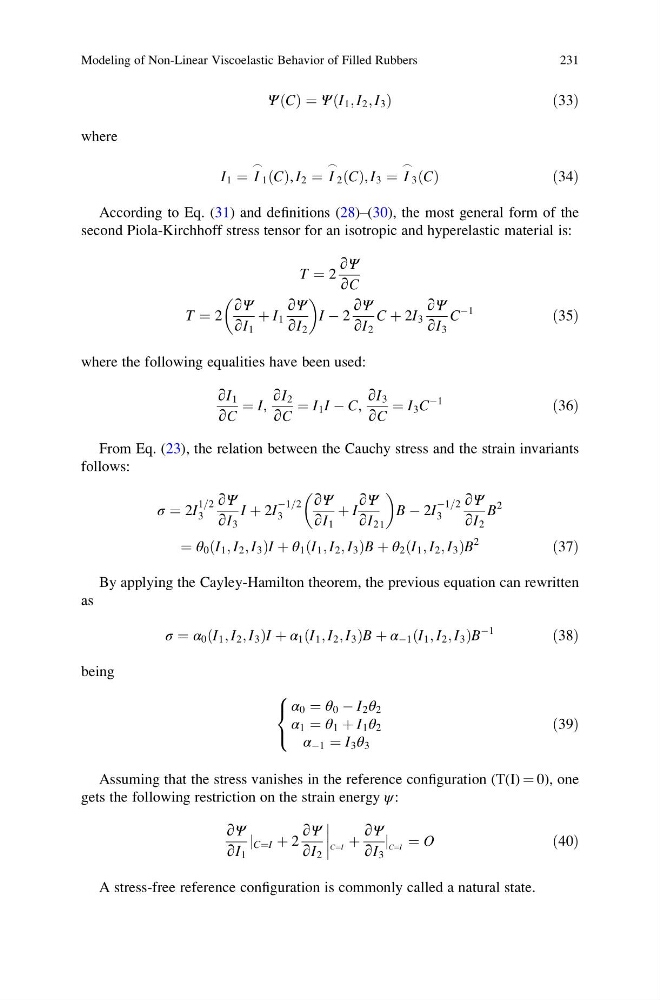
According to Eq. (31) and definitions (28)–(30), the most general form of the
second Piola-Kirchhoff stress tensor for an isotropic and hyperelastic material is:
T ¼ 2
∂Ψ
∂C
T ¼ 2
∂Ψ
∂I 1
þ I 1
∂Ψ
∂I 2
I À 2
∂Ψ
∂I 2
C þ 2I 3
∂Ψ
∂I 3
C
À1
ð35Þ
where the following equalities have been used:
∂I 1
∂C
¼ I,
∂I 2
∂C
¼ I 1 I À C,
∂I 3
∂C
¼ I 3 C
À1
ð36Þ
From Eq. (23), the relation between the Cauchy stress and the strain invariants
follows:
σ ¼ 2I
1=2
3
∂Ψ
∂I 3
I þ 2I
À1=2
3
∂Ψ
∂I 1
þ I
∂Ψ
∂I 21
B À 2I
À1=2
3
∂Ψ
∂I 2
B
2
¼ θ 0 I 1 ; I 2 ; I 3
ð
Þ I þ θ 1 I 1 ; I 2 ; I 3
ð
Þ B þ θ 2 I 1 ; I 2 ; I 3
ð
Þ B
2
ð37Þ
By applying the Cayley-Hamilton theorem, the previous equation can rewritten
as
σ ¼ α 0 I 1 ; I 2 ; I 3
ð
Þ I þ α 1 I 1 ; I 2 ; I 3
ð
Þ B þ α À1 I 1 ; I 2 ; I 3
ð
Þ B
À1
ð38Þ
being
α 0 ¼ θ 0 À I 2 θ 2
α 1 ¼ θ 1 þ I 1 θ 2
α À1 ¼ I 3 θ 3
8
<
:
ð39Þ
Assuming that the stress vanishes in the reference configuration (T(I) ¼ 0), one
gets the following restriction on the strain energy ψ:
∂Ψ
∂I 1
C¼I
j
þ 2
∂Ψ
∂I 2
C¼I
þ
∂Ψ
∂I 3
C¼I
j ¼ O
ð40Þ
A stress-free reference configuration is commonly called a natural state.
Modeling of Non-Linear Viscoelastic Behavior of Filled Rubbers
231
ð Þ ¼ Ψ I 1 ; I 2 ; I 3
ð
Þ
ð 33Þ
where
I 1 ¼ I
_
1 C
ð Þ, I 2 ¼ I
_
2 C
ð Þ, I 3 ¼ I
_
3 C
ð Þ
ð34Þ
According to Eq. (31) and definitions (28)–(30), the most general form of the
second Piola-Kirchhoff stress tensor for an isotropic and hyperelastic material is:
T ¼ 2
∂Ψ
∂C
T ¼ 2
∂Ψ
∂I 1
þ I 1
∂Ψ
∂I 2
I À 2
∂Ψ
∂I 2
C þ 2I 3
∂Ψ
∂I 3
C
À1
ð35Þ
where the following equalities have been used:
∂I 1
∂C
¼ I,
∂I 2
∂C
¼ I 1 I À C,
∂I 3
∂C
¼ I 3 C
À1
ð36Þ
From Eq. (23), the relation between the Cauchy stress and the strain invariants
follows:
σ ¼ 2I
1=2
3
∂Ψ
∂I 3
I þ 2I
À1=2
3
∂Ψ
∂I 1
þ I
∂Ψ
∂I 21
B À 2I
À1=2
3
∂Ψ
∂I 2
B
2
¼ θ 0 I 1 ; I 2 ; I 3
ð
Þ I þ θ 1 I 1 ; I 2 ; I 3
ð
Þ B þ θ 2 I 1 ; I 2 ; I 3
ð
Þ B
2
ð37Þ
By applying the Cayley-Hamilton theorem, the previous equation can rewritten
as
σ ¼ α 0 I 1 ; I 2 ; I 3
ð
Þ I þ α 1 I 1 ; I 2 ; I 3
ð
Þ B þ α À1 I 1 ; I 2 ; I 3
ð
Þ B
À1
ð38Þ
being
α 0 ¼ θ 0 À I 2 θ 2
α 1 ¼ θ 1 þ I 1 θ 2
α À1 ¼ I 3 θ 3
8
<
:
ð39Þ
Assuming that the stress vanishes in the reference configuration (T(I) ¼ 0), one
gets the following restriction on the strain energy ψ:
∂Ψ
∂I 1
C¼I
j
þ 2
∂Ψ
∂I 2
C¼I
þ
∂Ψ
∂I 3
C¼I
j ¼ O
ð40Þ
A stress-free reference configuration is commonly called a natural state.
Modeling of Non-Linear Viscoelastic Behavior of Filled Rubbers
231