

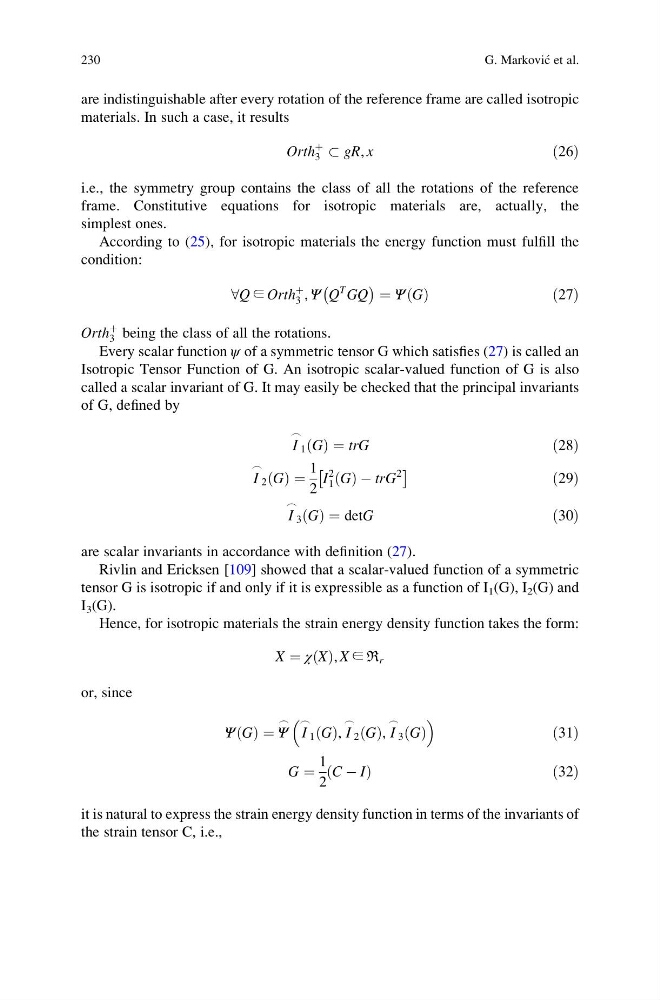
are indistinguishable after every rotation of the reference frame are called isotropic
materials. In such a case, it results
Orth
þ
3 & gR, x
ð26Þ
i.e., the symmetry group contains the class of all the rotations of the reference
frame. Constitutive equations for isotropic materials are, actually, the
simplest ones.
According to (25), for isotropic materials the energy function must fulfill the
condition:
8Q ∈ Orth
þ
3 , Ψ Q
T GQ
À
Á ¼ Ψ G
ð Þ
ð27Þ
Orth
þ
3 being the class of all the rotations.
Every scalar function ψ of a symmetric tensor G which satisfies (27) is called an
Isotropic Tensor Function of G. An isotropic scalar-valued function of G is also
called a scalar invariant of G. It may easily be checked that the principal invariants
of G, defined by
I
_
1 G
ð Þ ¼ trG
ð28Þ
I
_
2 G
ð Þ ¼
1
2
I
2
1 G
ð Þ À trG
2
Â
Ã
ð29Þ
I
_
3 G
ð Þ ¼ detG
ð30Þ
are scalar invariants in accordance with definition (27).
Rivlin and Ericksen [109] showed that a scalar-valued function of a symmetric
tensor G is isotropic if and only if it is expressible as a function of I 1 (G), I 2 (G) and
I 3 (G).
Hence, for isotropic materials the strain energy density function takes the form:
X ¼ χ X
ð Þ, X ∈ ℜ r
or, since
Ψ G
ð Þ ¼ Ψ
_
I
_
1 G
ð Þ, I
_
2 G
ð Þ, I
_
3 G
ð Þ
ð31Þ
G ¼
1
2
C À I
ð
Þ
ð32Þ
it is natural to express the strain energy density function in terms of the invariants of
the strain tensor C, i.e.,
230
G. Markovic ´ et al.
materials. In such a case, it results
Orth
þ
3 & gR, x
ð26Þ
i.e., the symmetry group contains the class of all the rotations of the reference
frame. Constitutive equations for isotropic materials are, actually, the
simplest ones.
According to (25), for isotropic materials the energy function must fulfill the
condition:
8Q ∈ Orth
þ
3 , Ψ Q
T GQ
À
Á ¼ Ψ G
ð Þ
ð27Þ
Orth
þ
3 being the class of all the rotations.
Every scalar function ψ of a symmetric tensor G which satisfies (27) is called an
Isotropic Tensor Function of G. An isotropic scalar-valued function of G is also
called a scalar invariant of G. It may easily be checked that the principal invariants
of G, defined by
I
_
1 G
ð Þ ¼ trG
ð28Þ
I
_
2 G
ð Þ ¼
1
2
I
2
1 G
ð Þ À trG
2
Â
Ã
ð29Þ
I
_
3 G
ð Þ ¼ detG
ð30Þ
are scalar invariants in accordance with definition (27).
Rivlin and Ericksen [109] showed that a scalar-valued function of a symmetric
tensor G is isotropic if and only if it is expressible as a function of I 1 (G), I 2 (G) and
I 3 (G).
Hence, for isotropic materials the strain energy density function takes the form:
X ¼ χ X
ð Þ, X ∈ ℜ r
or, since
Ψ G
ð Þ ¼ Ψ
_
I
_
1 G
ð Þ, I
_
2 G
ð Þ, I
_
3 G
ð Þ
ð31Þ
G ¼
1
2
C À I
ð
Þ
ð32Þ
it is natural to express the strain energy density function in terms of the invariants of
the strain tensor C, i.e.,
230
G. Markovic ´ et al.